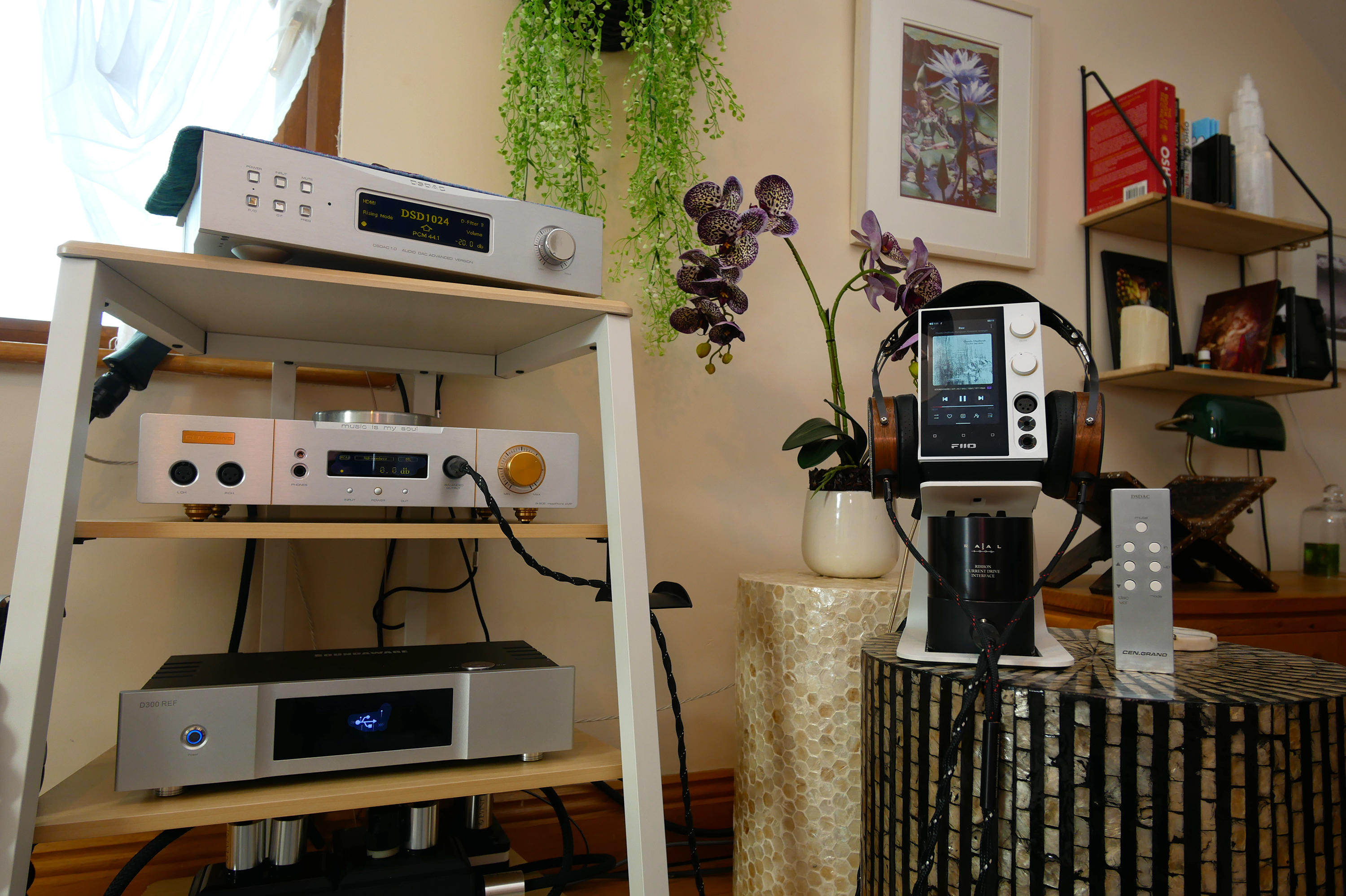
Upstairs first grabbed the IEC of a Cen.Grand DSDAC 1.0 Deluxe which tops the sidewall stack. This starts with a FiiO R7 SD-card transport within easy reach. USB-C connects to a Soundaware D300Ref USB bridge. Its ultra-cap powered I²S output feeds the DAC whose analog attenuator controls remote volume for both the ModalAkustik MusikBoxx speakers and headphone system. The latter runs off the companion Cen.Grand Silver Fox into Raal 1995 Immanis triple-ribbon earspeakers. Here I could track Flow with very hi-res transducers of the on- and off-ear persuasion. Flow-28 NCF has a peculiar feature by the way. Incoming and outgoing plugs are rotated by half a twist. If we have a stiff power cord seated just so and the Furutech addition forces us to twist that recalcitrant cable 180° to fit the new IEC, we might need a new swear word. My super-flexi Crystal leash threw no conniptions. But as a consumer by proxy on behalf of users of unwieldly power cables reluctant to twist along their long axis: please align Flow's two plugs the right way so they both orient identically.

In this setup, fronting a converter which resamples all incoming PCM to DSD1'024 on the fly made the most sense. It's complex computing for an FPGA to perform nonstop. Less AC-borne noise interference should make its life a bit easier? I say this based on downstairs experience. That had exploited Audirvana Studio's embedded r8brain resampler with a 7th-order modulator to send this DAC DSD256 instead of PCM. I then defeated its own upsampler. Shifting the math burden onto an iMac's far beefier CPU sounds still better than having the DAC's own FPGA work to DSD1'024. Even its designer agrees. Details. At this level of the game, they can really add up.








I look at this type noise reduction like archaeology. We're on a dig site removing layers of dirt with a fine brush. We might remove a few centimetres and find nothing. Then we remove an additional millimetre and suddenly hit upon something. Were the prior centimetres wasted? Obviously not. They got us to the necessary depth for the next discovery. So it was here. Fronting just the DAC meant empty centimetres. But once the Flow-28 fronted the 4-oulet power distributor which fed this stack, I penetrated extra depth for a clear find. But that actually was preceded by another dig chronicled here. To compact that link, swapping short off-brand jumpers for long on-brand versions between my monitor speakers and their external crossovers had given the fantastic dipole Mundorf air-motion transformer tweeters more data to work with. The Exact Express Earth links which now continue the preceding cable loom unbroken were clearly more transparent and lucid in the HF than what they replaced. That transformation set the stage for Furutech's extra depth mining.
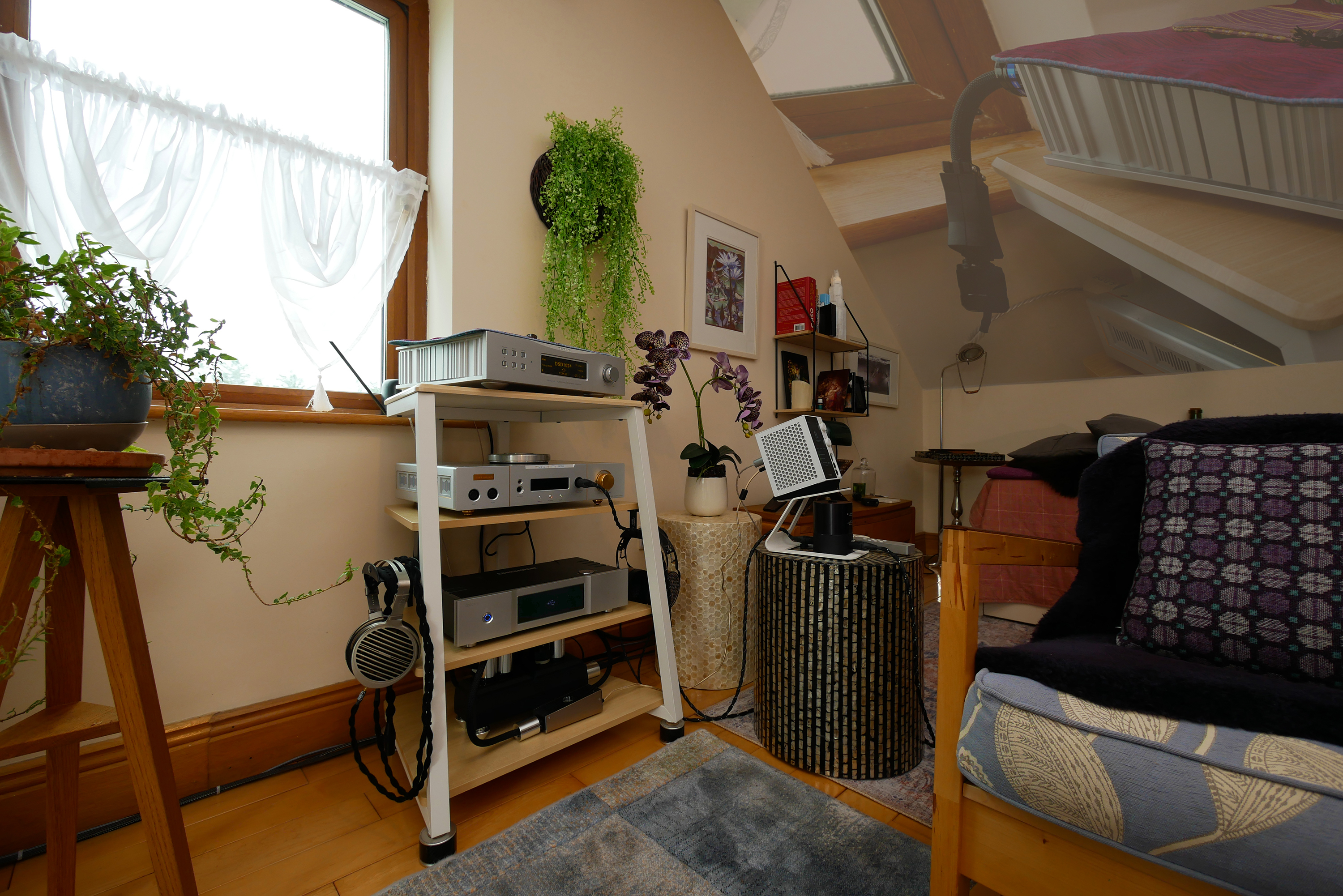 Vibex DC filter fronting Furutech GTO 2D NCF keeps the transformers of the Cen.Grand duo dead quiet on ~245VAC. Without it they hum a bit. The small wedge in the front is an iFi power supply for the FiiO.
Air. Flow-28's noise attenuation now affected what audiophilia calls air. It's a quality far finer than granitic bass. It happens in fact at the opposite end of the bandwidth. It's the signature domain of ribbon tweeters whose absence of mass won't store energy, whose absence of magnetic obstructions optimizes airflow. It's also the domain of AMT whose operational principle as velocity transformers outpaces dome tweeters on effective air motion for a given input signal. The presence of 'air' during playback describes our ability to hear more of the recorded venue. This comes by way of more obvious decay trails and the quasi halos they create around images which produce them.


 In the most basic of terms, we might think of more air as upgrading our tweeters. My prior jumper swap hadn't replaced tweeters but removed obstructions which allowed the same tweeters to do more work. Flow-28 didn't replace the tweeters either but removed microscopic HF obstructions. What that laid bare these tweeters could now glom onto with their high-resolution tracking. That occurs predominantly in the domain of overtones so above even the highest fundamental a piano's shortest string will make or a violin tickling its highest flageolet. For gorgeous violins in a neo-classic context, hit up Qobuz, Tidal or Spotify for Lebanese artist Claude Chalhoub. For solo violin and cello against orchestral strings, reach for The Ayoub Sisters. On close-mic'd bowed strings, our attention can zoom in on flickering air coming off oscillating strings. We might notice different layers like a singing bowl that makes multiple sounds at once.
In that microcosm of extremely brief events live different textures. Entering them is a form of inner game like professional athletes discuss amongst themselves. It's about observations related to their sport known only by those doing it. They are off limits to pure spectators. Audiophilia too has inner games. Entering them is contingent only on developing our listening attention which itself is preceded by curiosity, desire and passion. The term critical listening suggests finding fault. What I think critical listeners actually mean is fully attentive listening. It has them notice more than they do in 'non-critical' mode. That extra noticing is an act of volition. If we don't make it, it won't happen. It's certainly wholly voluntary. And like anything else in life, practice makes us better at it.
 I framed my Flow-28 NCF experiments on this page in such terms because the system here was already densely populated by other such noise attenuators. To get the newcomer to assert its presence required a virtual tweeter update by first eliminating the constricting jumper versions; then spreading Flow's action across multiple components at once by preceding the 4-outlet passive power bar rather than a single component. Then I could follow the Furutech's contribution. Still, it meant having to be 'with' and 'in' the music, not acting as lazy bystander and casual observer. Such a one puts all the experiential burden on the hardware: "I powered you up,
  now do me". It forgets that we can (must, should?) contribute to our experience by an act of deliberately focused attention. If we can't bother to curate our own experience, who else should or would? In those terms and in the context of my no longer basic system, Furutech's latest inline power filter played curator's assistant. I appreciated its help particularly on the Raal triple-ribbon ear speakers. Hovering within centimetres from my ear drums, they further magnified what the Mundorf AMT already did at four metres in a 4-3½ x 8m room. These transducers applied their own attention-focusing powers which we call extreme resolution without room interference. It meant that my own focus could be lazier; or at max capacity, notice even more than what came off the already very lucid speakers. Inherent in such language is a permanent subtext of caring. We must care about these things to matter. If we don't, they become inanimate objects whose fine influence won't register but whose sticker certainly will. That makes Furutech's Flow-28 NCF an advanced not beginner's product. You decide what type listener you are. Should you determine that your current power distributor is a beginner but you are not… that just might be the ideal place to add Flow and upgrade your AC bar to more advanced status.