I have though—lived long enough—to know how in reviewing, setup hence context can skew results. We'd expect for example that dropping Furutech's inline filter into a system already loaded up with equivalent filters should do less than a bare-boned rig plugged into a generic Electric Avenue power strip with throwaway power cords. We'd expect it to do less on a single component than complete system. So I had to give some thought on where to best start. I mentally scanned my various setups for which precise juncture promised the best context. I would have said my office because a recent AC filter test had there measured the by far highest EMI exposure of any of my systems. Here a USB bridge, DAC/pre and active monitors share the AC with a fibre-optic router, Windows 11/64 workstation, 34" computer monitor, LED and other light fixtures. The Belkin SurgeMaster outlet multiplier with surge protection which most of it plugs into dates back to my Cyprus residency with its rather spectacular quite regular dry lightning. Unfortunately the Belkin's UK power cord to the wall is captive. Meanwhile a Titan Audio power distributor with detachable cord and UK socketry I planned to replace it with hadn't shipped yet. I could precede just the iFi iDSD Pro Signature DAC with the Flow and would do so but wanted to start off with more of a bang. But could I? The front end of my big system plugs into a Furutech GTO 2D NCF 4-outlet distributor preceded by a very thick Furutech power cord with Mitsubishi copper. The 27" music iMac and dual LHY network switches hang off a Puritan Audio Labs AC/DC filter. The four mono amps for the speakers and dual-woofer sub draw power from a Kinki/Vinshine DC filter. Preceding either power block with the Flow would affect multiple components at once but certainly not start off with square one. My upstairs system mirrors the downstairs layout. The source stack of SD-card transport, USB bridge, DAC/pre and headphone amp plugs into another Furutech GTO 2D NCF preceded by a Vibex single-outlet DC filter. The active crossover, stereo amp and subwoofer draw power from a Vibex stacked AC/DC filter on a LessLoss power cord. Additionally an Akiko Corelli Corundum passive noise trap plugs into the Vibex. None of it was tabula rasa. Except for removing the Corelli, none of it could be dumbed down with more basic equivalents because I had no Computer Emporium-type power strips to mock up a beginner's power delivery. Can setup skew results? It most assuredly can. In this instance my best could only describe these less-than-ideal scenarios then proceed regardless. It's like saying "sorry" then slapping someone. How a basic system with no real thought given to power filtering might react when a Flow-28 NCF precedes it remains for another reviewer to report on. This reviewer will start in the office after all.
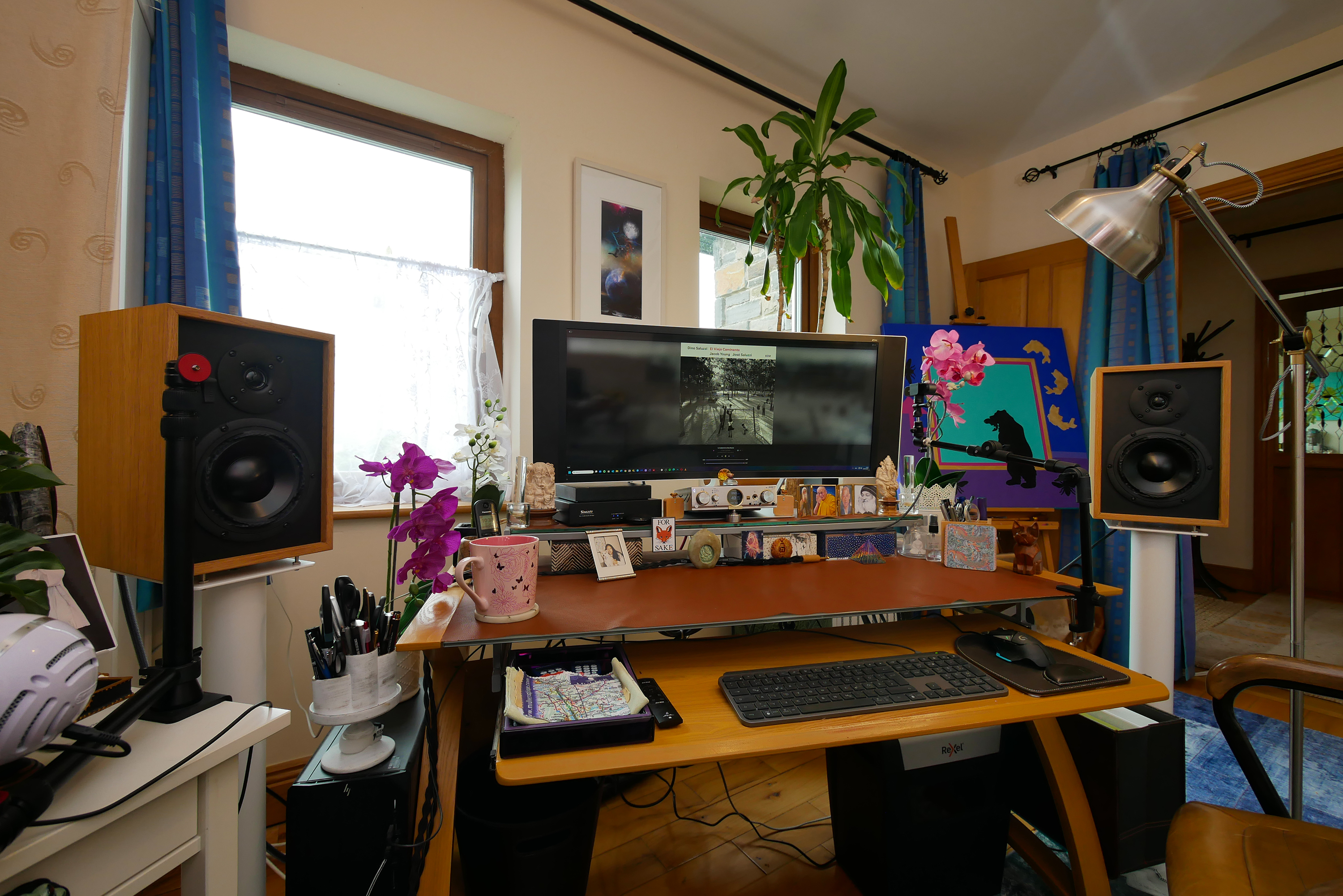
As I inserted Flow, I remembered because I saw it. The iFi DAC runs off an external highly regulated and filtered power supply albeit of the switch-mode persuasion. Would this disarm Flow's ability to perform? Not. The difference simply wasn't about depth layering which the active DMAX nearfield speakers with elaborate time-correction algorithm already excel at. The best way to describe the difference I heard instead is to say out loud words like pizzazz, razzmatazz, sizzle, slithering and others that contain splosives. With that sensation on your tongue, imagine it as a subliminal quality. Think very faint but constant sizzle of hot oil. But don't think of it as separate splatter. This one embeds in the sound. It's in the music. Baked in. With Flow, it disappeared. To be sure, this was subtle. A constant presence doesn't betray itself. It's how a stalking cat or snake frozen in position are invisible to their prey. They move in extreme slow motion then freeze again to create no apparent change. It's how we can be utterly oblivious to subliminal system noise until it suddenly lowers or disappears. It's in that moment of change that we see our cat or snake. Then they vanish again from our awareness until they pounce or strike and the comparison falls apart.











Aside from massed strings and the twangy tenor of Manouche¹ guitars, I find the tone of accordion to be very telling of stalking by subliminal grit or 'etch'. So some of the recordings I launched in my Qobuz Sublime subscription inside Audirvana Studio reached for Dino Saluzzi, Richard Galliano or Roberto de Brasov. You might have your own scopolamine truth serum that puts a magnifier on enhancements of inner smoothness. I like groups of violin, Django Reinhardt-style gipsy guitar or solo accordion. For the latter, Romanian wizards like de Brasov or Petar Ralchev are personal heroes for their incredible virtuosity and chromatic progressions. In any event, I next swapped Flow over to the Singxer SU-2 USB bridge which gets its 1s and 0s via an iFi USB 3.0 cable plus inline noise filter from my Win11/64 work station. As such it works solely in the digital domain. As a noise moat between computer and DAC plus reclocking and dejittering, it fulfils the same function which very costly 'audiophile' streamers build in. The bit-perfect brigade disavows the importance of USB decrappifiers because bits are bits. My PCfi experience knows different. Hence I spent coin on two Singxer and one Soundaware bridge to isolate the digital transports in three of my systems from their downstream converters.
______________________
¹ Aside from the classic Romane/Rosenberg collaborations, lend an ear to the Transatlantic Guitar Trio with Joscho Stephan, Richardt Smith and Rory Hoffmann. I prefer Volume I to II so start there. Incredible playing of three very different guitar timbres and techniques.
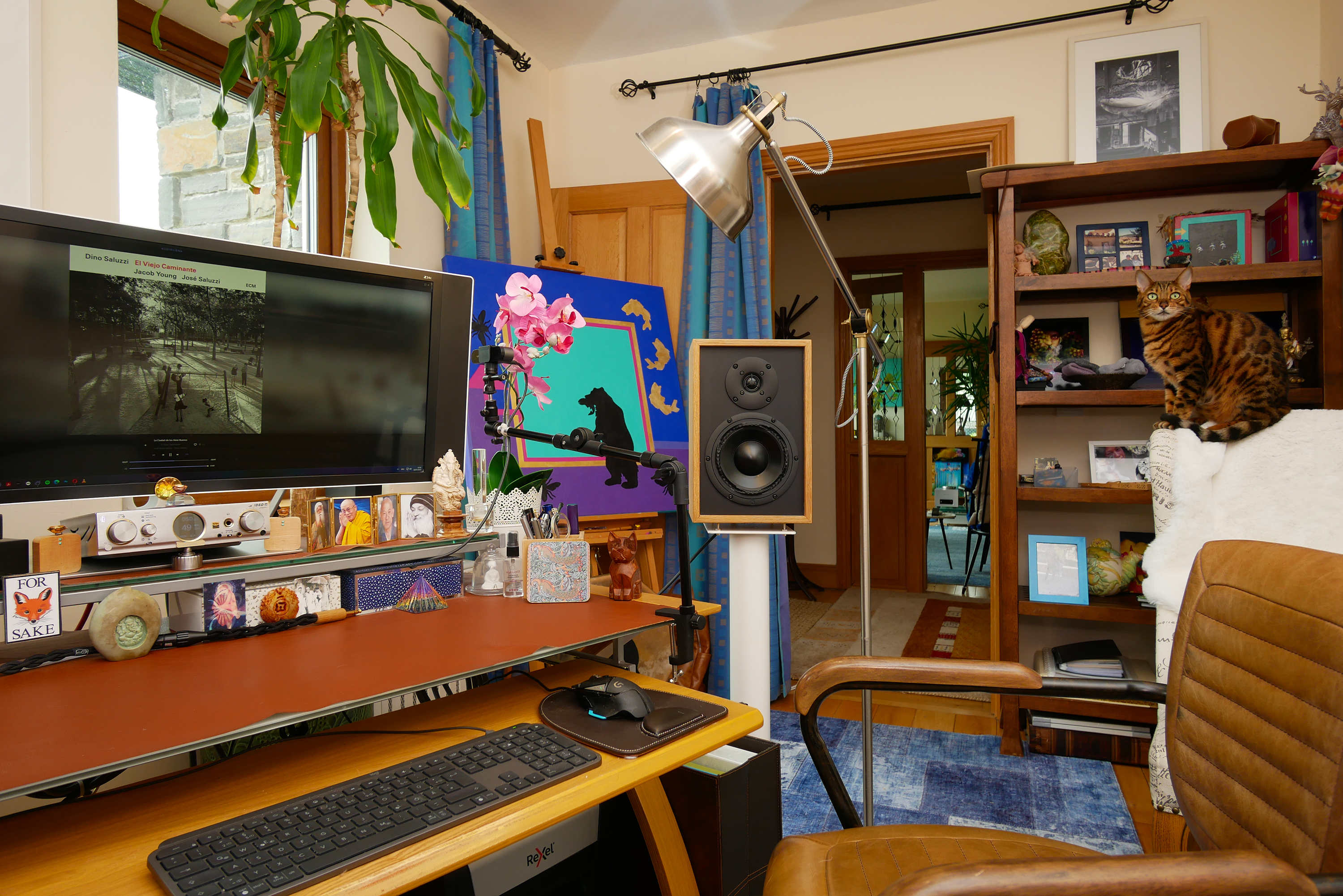 For viewers of my Darko podcasts who've expressed hope for a glimpse of the elusive Chai Baba, my Bengal lounge leopard who squawks while we record but doesn't show himself.
And wouldn't you know, the difference gap Flow made on the bridge was greater than on the DAC. The music felt bigger, freer and gushier. All this by the way involved zero boutique power cords. All my good cords terminate in US plugs because my audiophile career began in the States. Outside my office, all power distributors run US sockets. It's merely their power cords to the wall which terminate UK. Over the years I built up enough inventory of their kind to run three systems each with multiple UK wall taps. But I didn't push farther to also outfit my office kit into the UK-plugged Belkin with UK-terminated fancy power cables. Hence everything there runs off the type cord we get as freebies with hifi components. I couldn't tell you whether that played to or against Flow's max potential. I can tell you that between DAC and USB bridge, Flow hit harder in the domain of pure digital signal processing and clocking. I'd not replicate this in my two other systems whose USB bridges use ultra capacitors. The incoming AC merely charges them like virtual batteries which are filter agnostic.