
Country of Origin

 This review published in May 2026 on HifiKnights.com. By request of the manufacturer and permission of the author, it is hereby syndicated to reach a broader audience. – Ed.
Reviewer: Marek Dyba
Digital transport: custom passive Win10 server with Roon, Fidelizer Pro 7.10, JCAT NET XE and USB XE cards, ferrum Hypsos Signature PSU, Keces 8 mono supply for server, JCAT USB Isolator, Innuos Statement, fidata HFAS1-S10U
DAC: LampizatOr Poseidon with Ideon Audio 3R Master Time USB regenerator
Network: Silent Angel Bonn N8 + Silent Angel Forester F1 + optical LAN isolator
Vinyl: J.Sikora Standard Max turntable, J.Sikora KV12 & KV12 Max tonearms; AirTight PC-3, Audio Technica PTG33 Prestige & Le Son LS10 MKII cartridges; Grandinote Celio MkIV & ESE Lab Nibiru V 5 phono stages
Preamplifier: Circle Labs P300
Amplifier: GrandiNote Shinai, Circle Labs M200, Art Audio Symphony II (modified)
Speakers: GrandiNote Mach4, Ubiq Audio Model ONE Duelund Edition
Interconnects:Bastanis Imperial x2, Soyaton Benchmark, Hijiri Million Kiwami, Hijiri HCI-20, TelluriumQ Ultra Black, KBL Sound Himalaya 2 XLR, David Laboga Expression Emerald USB, David Laboga Digital Sound Wave Sapphire Ethernet
Speaker cables: Soyaton Benchmark Mk2, WK Audio The RAY Exclusive
Power cords: L Custom Audio 3D-S-AC Connect, LessLoss DFPC Signature, Gigawatt LC-3
Speaker signal conditioning: LessLoss Firewall for Loudspeakers, Boenicke ComDev
Anti-vibration conditioning: 12x Carbide Audio Carbide Base under DAC, preamp and speakers
Power delivery: Gigawatt PF-2 Mk2 and PC-3 SE Evo+; custom power line with Gigawatt LC-Y in-wall cable; Gigawatt G-044 Schuko and Furutech FT-SWS-D (R)
Equipment rack: Base VI, Rogoz Audio 3RP3/BBS
Resonance control: Rogoz MO40 and CPPB16 platforms with BW40MkII feet, OMEX Symphony 3S, Franc Accessories Ceramic Disc Slim Feet and Wood Block Platform, Graphite Audio CIS-35 and IC-35 Premium
Review component retail: €3K/pr ex VAT
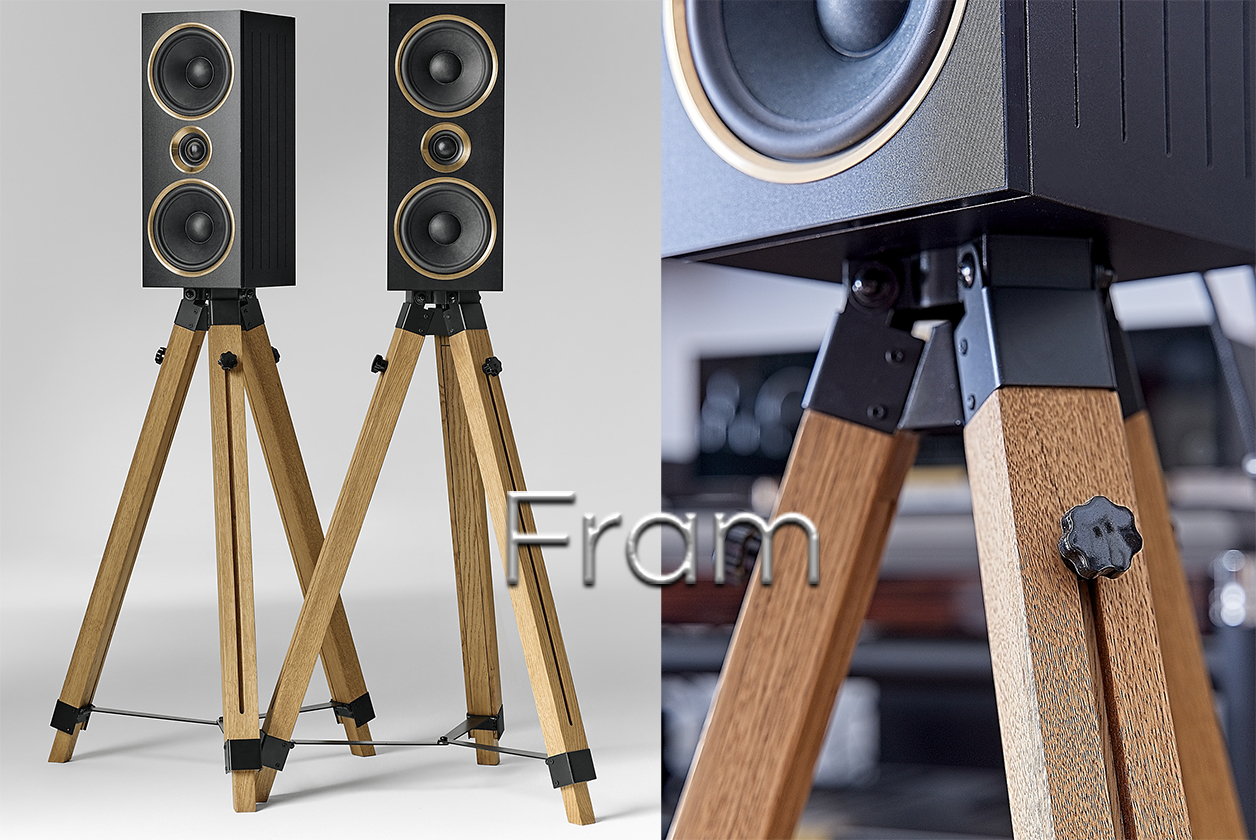
After my memorable tryst with Fram's range topper Arte Noire, I got a chance to spend time with their entry-level Fram Midi 150P. It's much smaller, not as extravagant of shape and significantly less expensive. Every time I begin to listen to good standmounts, I am reminded of their fantastic aspects. They create a unique presentation that many people love despite the obvious limitations. Yet cavernous soundstaging, brilliant imaging, coherence closer to a point source, ability to disappear—that's where such speakers shine. So let's start with an intro by chief designer Jarek Waszczyszyn. "One may say that the Midi 150P represents the latest evolution of our company. It all began a long time ago when between the spinning mill and weaving mill, three friends said: "I have nothing, you have nothing, he has nothing. That's perfect to start a factory." It's a reference to the classic Polish novel The Promised Land by Władysław Reymont. You just know what happened next. It's as ingrained in our culture as sayings like 'sugar gives you strength' or 'we all know that there are no dragons'. That's why when three friends got together to start a new company not far from Krakow's old spinning mill, those very words came to mind. Our first project was the development of all-purpose loudspeakers for multimedia and audio systems. They were meant to be fairly compact to conveniently place next to a TV but also had to handle large-scale sound at high quality. After many attempts we decided on an active design with my own DSP, a wideband driver and twin passive radiators. The latter work similar to a bass port. At its resonant frequency, the standard woofer gets damped and its energy dispersed through the radiators instead. With our small cubic volume, a port of sufficient length would have been impossible. Due to high acoustic power at resonance, the radiators use a larger surface area than the actual mid/woofer. The concept proved to be correct and was first presented at our annual Warsaw show. The drivers then were by Tonsil, the cabs wood and the front baffle aluminium. This debut convinced us to continue our R&D. We switched to 10cm SB Acoustic drivers, a company that was just building its reputation. The choice turned out to be spot-on. Thanks to their factory in Indonesia, these Danish drivers come at very reasonable prices with high performance and perfect build. We remain faithful to them to this day."
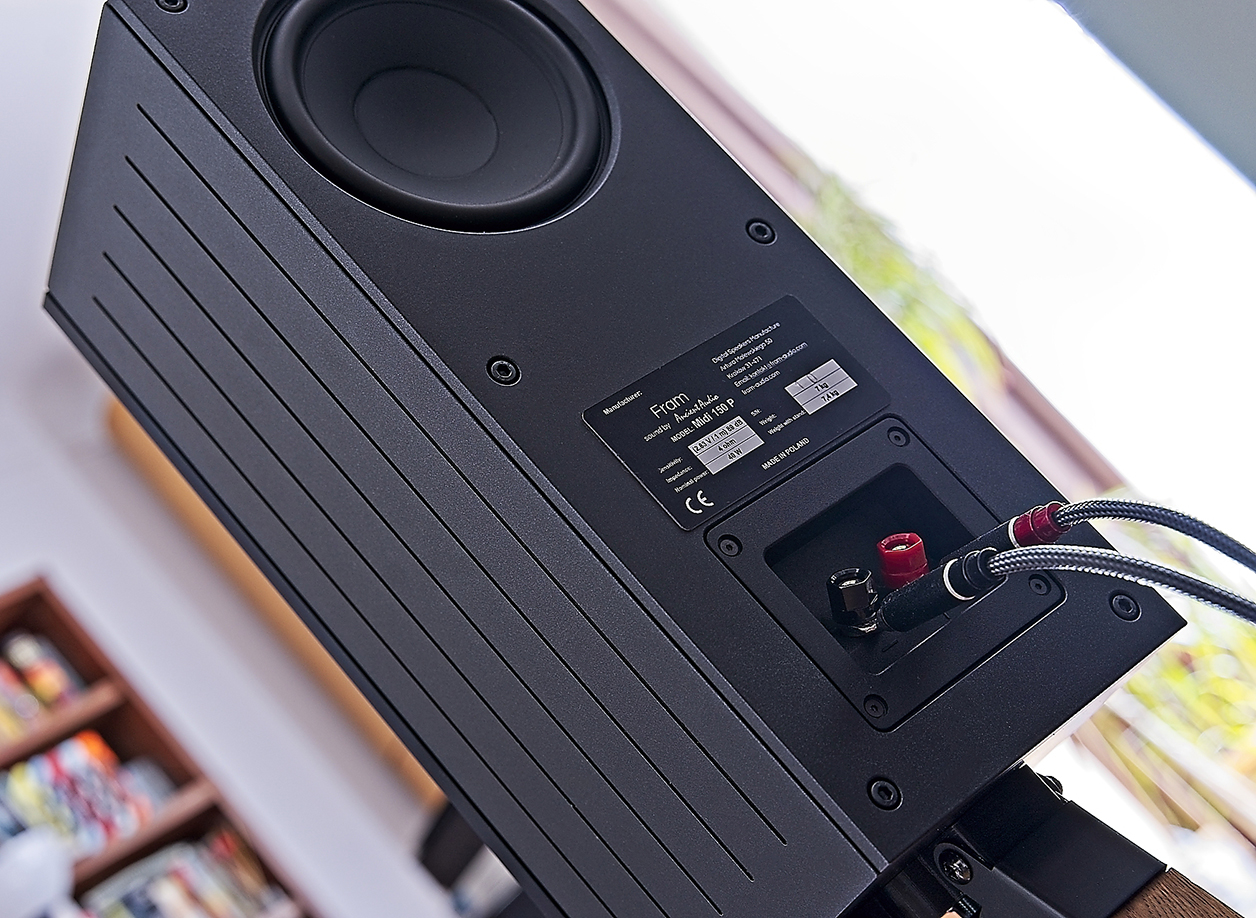
"Considerations of cabinets made from wood and aluminium were cut short by one of our team. In his professional life he had designed aircraft fuel systems and mastered many mechanical solutions we had no idea existed. He developed all-aluminium enclosures for us. They featured significantly thinner walls which mattered given our compact dimensions. Aluminium has low mechanical losses so the acoustics of the loudspeakers had to improve. Yet the sleek look of brushed anodized metal left no room for doubt. It fit perfectly with Fram's Scandinavian aesthetic: simple yet refined. As it turned out, these speakers also appealed to women which in our industry is quite an achievement. The initially limiting factor was our widebander. The desired bandwidth would have to split between two different drivers. Enter a problem. Adding a tweeter would have grown the speaker by almost 7cm. As has become Fram tradition, we solved the problem mechanically. Since the passive radiator activates only at the lowest omni frequencies, it could move to the rear. The final design offered not only excellent timbre and resolution but a wonderfully deep sense of space. Srajan reviewed it and this Midi 120 just 120mm wide received his prestigious Blue Moon award. In the follow-on wave of enthusiasm, we soon launched a version on a 15cm² footprint. Upsizing was purely a matter of going with SB Acoustic's 13cm papyrus-based cones. The tweeter was a textile dome with neodymium magnet. One passive radiator aimed forward, the other back. After tuning the speaker's digital processor, a superb loudspeaker offered sound quality comparable to audiophile-grade designs despite just using a simple 60wpc class D amplifier. The twin radiators not only offered serious slam but a beautiful sense of space. This Midi 150 became our bestseller. Considerations to advance it further called the bottleneck our built-in electronics. Convenient and compact though they were, they still had limitations. After experiments with better amplifiers, something that had originally begun as a TV appliance turned into a serious affair. Hello P version which returned to classic passive MO to be driven by the client's own electronics. Although the mechanical design simplified, no one complained about the sudden lack of sockets or controls. Now both speakers are identical as the previous master/slave division is no more. Obviously the filter network had to be completely revised. The tweeter sits on a 1st-order high pass for linear phase. The mid/woofer runs an elliptical filter to sum in balanced amplitude and phase."









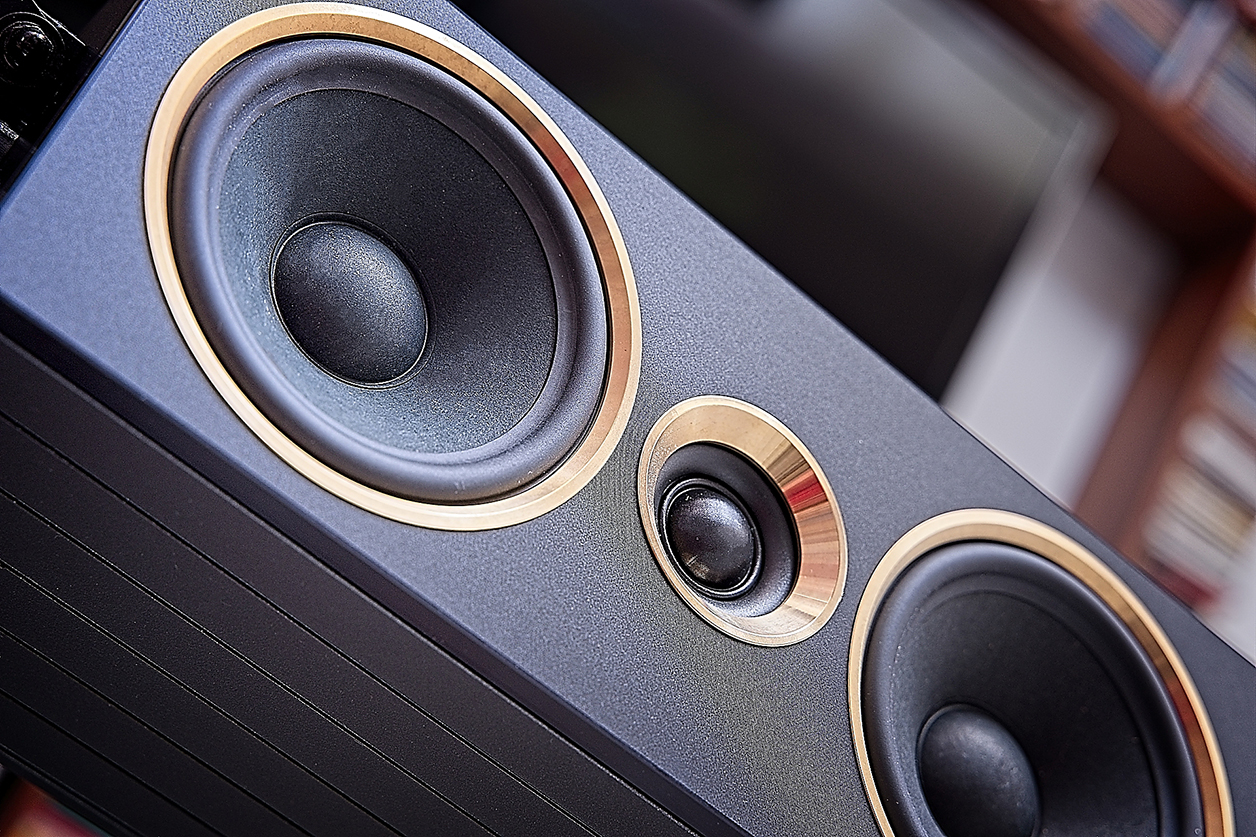
 To recap, this is a 15x17x37cm WxDxH four-driver passive 2-way of ~7kg in visually stunning, perfectly made all-black metallic dress code machined from solid recycled aluminium for optimal rigidity and damping. Two 13cm cellulose-based mid/woofers bracket a 26mm textile dome in an MTM array with a matching 13cm passive radiator on the back above recessed single-wire terminals. The crossover uses high-quality Jantzen Audio components. 89dB sensitivity and nominal 4Ω impedance claim good results with quality amplifiers from 8-150 watts. Optimal performance includes the bespoke wooden tripods with height adjustment and swivel for easy toe-in. Sonically the Midi 150P behaved surprisingly large already with the first very intimate album, Marek Dyjak's Moje Fado. With these tiny speakers, his voice grabbed my attention just ten seconds in and kept me involved and immersed until the very last note. His is a powerful voice, hoarse when needed, gentle and breaking when emotions peak. The Fram perfectly communicated the emotional subtext and steered me accordingly. The accompanying instruments occupied the space behind him yet their sound was very clear, offering good insight into layer after layer of recorded venue. I heard nicely resolved timbres and textures in open
 airy space in which images breathed freely. The next album was the Tsuyoshi Yamamoto Trio's Live at the Misty. First and foremost, the Fram took care of properly smooth flow. They recreated a relaxed joyful vibe and drew the club's ambience very convincingly. They nicely conveyed audience noises and cheers, lively conversations and the clatter of cutlery and porcelain for that live club vibe. The flow, above-average coherence and precise image localization were important building blocks of this replay as were natural timbres. Still, it was all those non-musical elements that enhanced the realism beyond what many other usually larger speakers managed before. I naturally segued into another live classic, Arne Domnerus' Jazz at the Pawnshop. While venue acoustics and audience participation remain important elements of this album, the closer capture of the performers and resultant larger size caught my attention first. Of late I mentioned numerous times another Polish monitor of outstanding performance, the latest incarnation of the AudioForm M200. Listening to this particular album over both interchangeably, I could clearly hear differences yet not decide which I liked better.
 The Fram was more precise, with a slightly faster leading edge, a more energetic clearer treble and upper midrange. The AudioForm was slightly richer and a little warmer, with the focus shifted more toward sustain and decay rather than transient. Therefore cymbals and other metallic percussion elements sounded clearer and a touch more vibrant over the Fram while the vibes offered slightly deeper tone with the M200. The latter extended the decays a bit so also delivered general reverb more convincingly. The drum solo seemed tighter, faster and even more energetic with the Fram even though the AudioForm extended slightly lower. The clarinet and saxophone had more bite and contour with the Midi 150P, descended a touch deeper and sounded richer if softer over the counterpart. These differences were quite small. I loved both for how resolving, dynamic and coherent they were, how tonally accurate. I would be happy with either. Granted, neither album contained particularly deep bass to suit smaller monitors. Now my question became, how would they fare on piano or double bass? I turned to one of my favourites, Ray Brown and
  his trio's Bassface. As it turned out, the bass with the Fram was tight, fast and tonally full just not extended enough to do complete justice to such a powerful instrument. However, I was surprised by how low and tight they did go and how everything but ultimate reach were spot on. There was a natural softness to each sound with good differentiation. The leading edge was accurately fast and tight followed by a nice sustain and decay. The dynamics were excellent also at the micro level and the timbres seemed right. On some recordings, the double bass is very subdued and of limited range to not overshadow other instruments. On the Ray Brown Trio, it's in the lead. My primary sense of the Fram presentation wasn't real lack of reach, just a somewhat gentler take on the upright. Isao Suzuki's bass in "Aqua Marine" from Blow Up was a different case, though. In this track, the bass extends so low and with such energy and weight that many big floorstanders can't truly convey it. With the Fram the same limitation was obvious yet if I hadn't known this track by heart, it would have been easy to accept what I heard as musical truth. It told me that the Fram didn't play the usual small-speaker tricks of emphasizing the mid bass.

12
