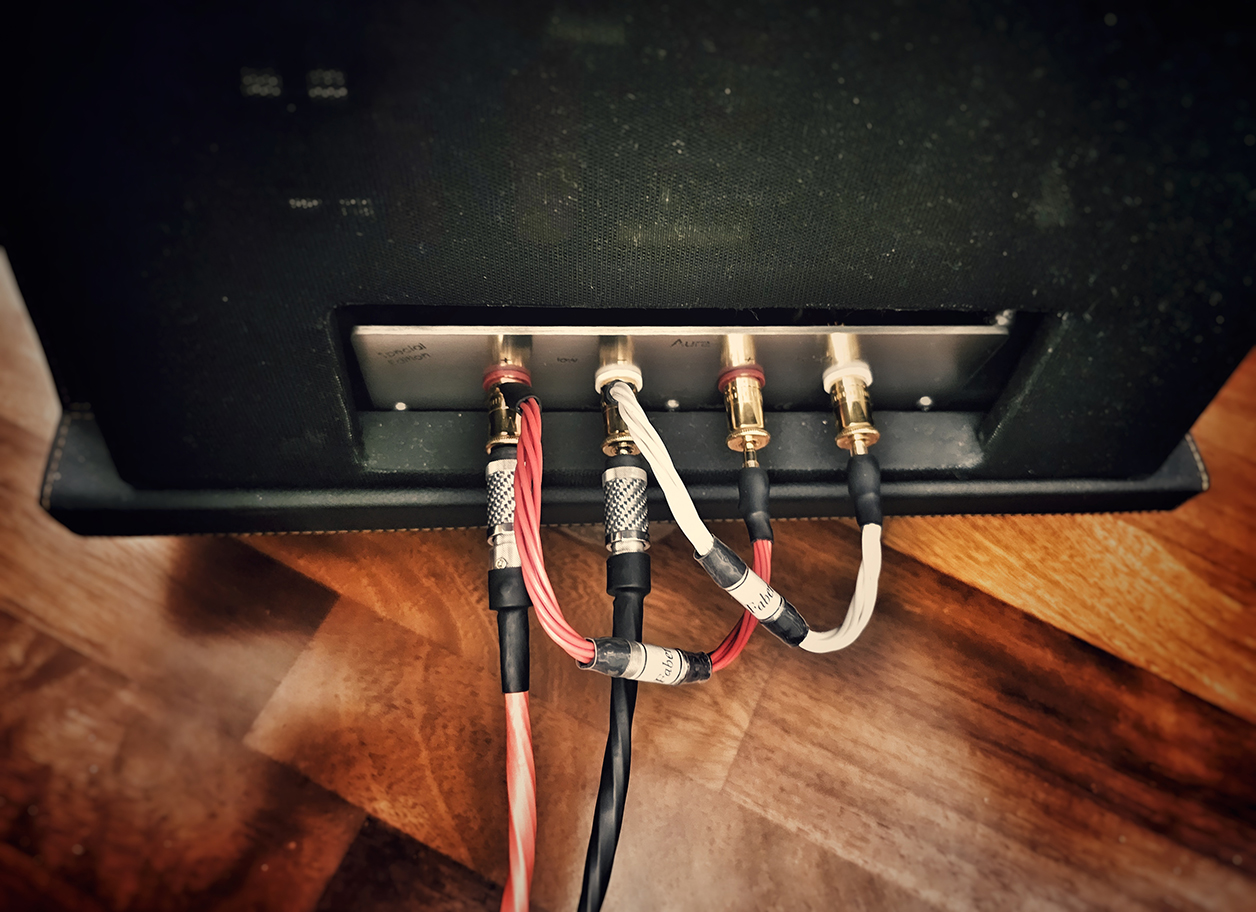
Initially I thought that perhaps I heard a tad of extra clarity and HF energy but when I reverted to the Sablon for confirmation, I could not detect a tangible change. Actually, this fell in line with one rationale for high-end network switches like the Taiko which immunize downstream digital signal to issues. Taiko Audio even recommend basic CAT6 cable to feed their switch. As for USB, the evaluation was still-borne given that the Olympus XDMI LampizatOr interface requiring a specific cable currently not included in Faber's catalogue is so dramatically superior to the USB input that there was no sense of insisting on the SixthSenseSpecial. I read glowing reports on Faber's digital cables so am confident they are worth considering but my system was not the best candidate to make them shine. Just when I thought I had hit a plateau, the La Potenza RCA interconnects in lieu of my Acrolink 7N-2090 Speciale Anniversary proved me wrong. The improvements were of liquidity with a further reduction of grain from the midrange up, easier flow and from it a general sense of naturalness and expansion. The texture of acoustic instruments and the increase of information in the decay structures of the Paniagua recording made the illusion of exposure to a real event stronger. The contrast between Liberty's carpet of sub-bass vibrations and crackling sound effects was even more stark and intriguing. It was with a grin of satisfaction for what I had achieved mixed with anticipation for what would still be coming that I moved to replacing my speaker cables, a humble set based on Furutech's FS-α36, with the python-sized La Potenza. Yet the initial result was underwhelming. I could not detect any improvement, perhaps even felt a slight lack of oxygen compared to the previous state. Now, my Diesis Audio Aura support biwiring, hence they have two sets of connectors coupled by a solid copper bridge. I realized that when replacing the speaker cables, I'd plugged the La Potenza to the other pair of connectors than the Furutech. The current now entered the 12" woofer terminal not the 10" mid/woofer and tweeter posts. As I had a nice set of Faber's jumpers available, I decided to revert the cable connection to the previous position and install the jumpers in place of the solid bridge.
 The result was immediately rewarding as the system responded not only with restored scale and openness but an increase of propulsion. This combination of speed, tightness and dynamics resulted in a stronger sense of rhythm and visceral impact. A reference track I used for this was "My Home is in the Delta” from Muddy Waters' Folk Singer album. The dynamics I heard at this point, the attacks of guitar and drums were shockingly violent, the volume shifts from Muddy's raucous voice almost frightening at times, building additional tension there at the edge of my seat. I had now reached the final stage of this project, with the La Potenza Grounding Box waiting to complete the loom. I was especially curious as I had never tried grounding devices so really did not know what to expect. Again, I tackled grounding from the source so the Taiko Audio Olympus. That has has two grounding posts. That by the XDMI connector grounds the floating chassis. The post by the IEC connects to the charger power supply which is grounded to the IEC outlet. The charging supply floats relative to Olympus and does not connect to the chassis. Taiko do not recommend grounding the Olympus unless hum requires it. I must say that my test confirmed the validity of their advice. When grounding the Olympus, especially its XDMI post, it flattened the soundstage and stole from transparency. Music now projected more as a wall of sound. Grounding the LampizatOr Horizon360 and Riviera Labs AIC-10 was definitely more effective. The most immediate change was the increase of air between images so their separation and how they emerged from the background in a more sculptural way. The holographic cliché popped to mind instinctively. The depth of the soundstage was the dimension affected the most and the improved vanishing of the loudspeakers from the soundscape a close second.










 A track like "Pie Jesu” from John Rutter's Requiem was the ideal showcase for this. The separation between soprano and orchestra, how both expanded within the cavernous setting of the Dallas Morton H. Meyerson Symphony Center, one of the largest concert halls in the world, made me smile in astonishment. The organ parts emerging from the blackest background I have experienced in my system made me feel I was part of this colossal venue, fully absorbed in the solemn yet tender musical message. At this point and for subsequent weeks when I let the system play with the complete Faber's set, I felt a satisfying sense of wellbeing at every session. Analysis and rationalization left room to abandon them, their end leaving me with a mix of fulfilment and craving for the next one. If I had to describe with a single word the cumulative effect of the full loom, I would choose 'liberating'. All the musical elements from the most vanishingly small to the more theatrical seemed to pour unhindered from the loudspeakers so purer and freer than before. Drowned in this pleasure, I was not prepared or willing to change anything but felt the reviewer's duty call to perform a reality check. I decided on the most brutal approach and reconnected all my previous cables at once to remove all traces of Faber's with a single drastic gesture.
The outcome was saddening. The system was still great but with a lingering feeling of musical impoverishment like a broken spell or the melancholy when summer's end approaches and everything around us, while being physically unchanged, seems wrapped in a delicate shroud of decadence lost. I was strong enough to resist the setback and let a few days pass. My perceptual sensitivity gradually adjusted and soon I was genuinely happy again with the sound of my system yet the sense of emotional deprivation remained with me to some extent. Going back to the full Faber's configuration was inevitable and what a joy that was. Once I re-attained my best-sounding configuration, I tried to remove one by one the Faber's components to understand at a more granular level what was contributing the most to the overall result. While I can testify that the overall result from the whole loom is greater than the sum of its parts, making the jump to the full loom I tested would require an investment not far off €50K so most of us would need to take the summit ascension in steps. This is where system dependency comes into play both in terms of what you replace and how sensitive your components are to cleaner electricity but in my case the DAC power cord and interconnect were the most impactful followed by the power distributor. Then I would progress to the amp's power cord, grounding, then the speaker cables to leave the server power and digital interconnects for the final touch.