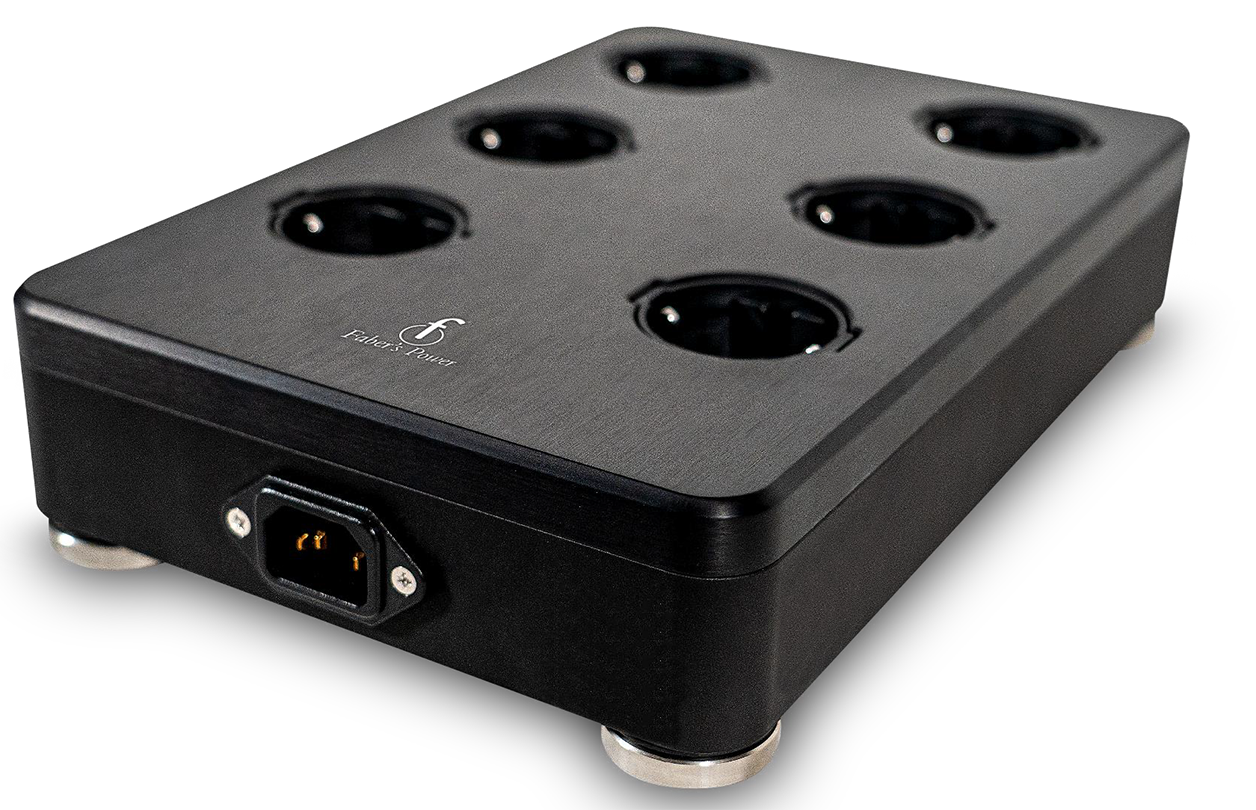
The La Potenza power distributor is a beautiful example of mechanical engineering, with its three parts CNC'd from aluminium alloy with Oyaide and IeGO components for best conductivity and custom stainless-steel footers with rubber O-rings for vibration isolation. The internals aim to minimize EMI and RFI interference, reject electromagnetic noise and reduce losses. The conductors are guided and kept separated by grooves machined into the case. The power distributor is entirely devoid of electrical components along the current path, as Fabrizio believes that this is the only way to preserve the dynamic and timing consistency of the signal unlike other approaches such as filters, regenerators, isolation transformers or batteries.
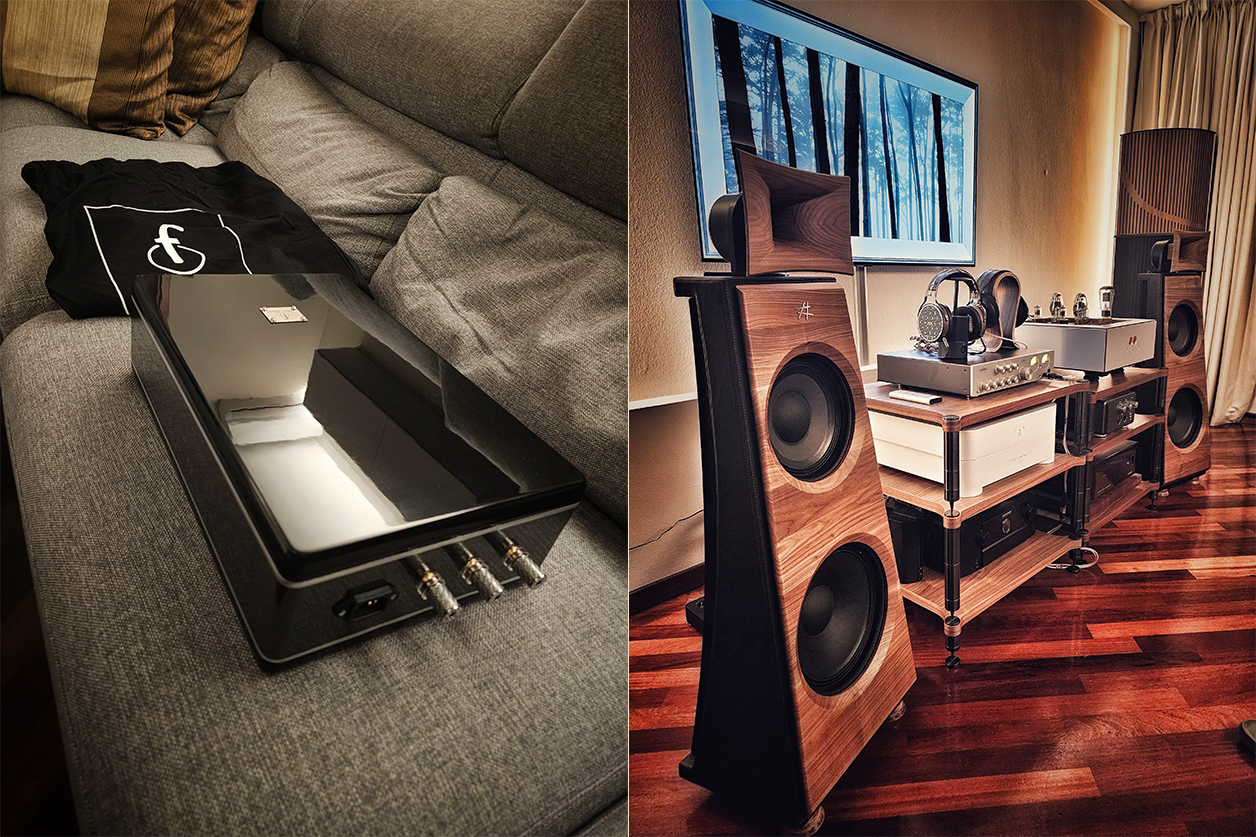
 The La Potenza Grounding Box below looks very elegant with its rounded edges and corners. Its shiny black finish combines a smooth top panel and carbon-fibre body for a visually stunning piece of equipment you would want on full display. It acts as a kind of black hole that attracts electromagnetic pollution which enters a component as a combination of electrostatic discharge (ESD), radio frequency and electromagnetic interference so high-frequency noise, all phenomena which increasingly affect our connected homes.
Instead of using the approach of a virtual ground by dissipating noise into heat with negatively charged piezoelectric crystals seen in purely passive grounding devices, Faber's Grounding Box has metallic innards and is designed to present a low-impedance potential beneath the system's electronics which various disturbances will naturally flow toward before being ultimately drained at the 'true' ground of our domestic electrical network. One advantage of this approach is that it doesn't risk saturating piezoelectric compounds over time.
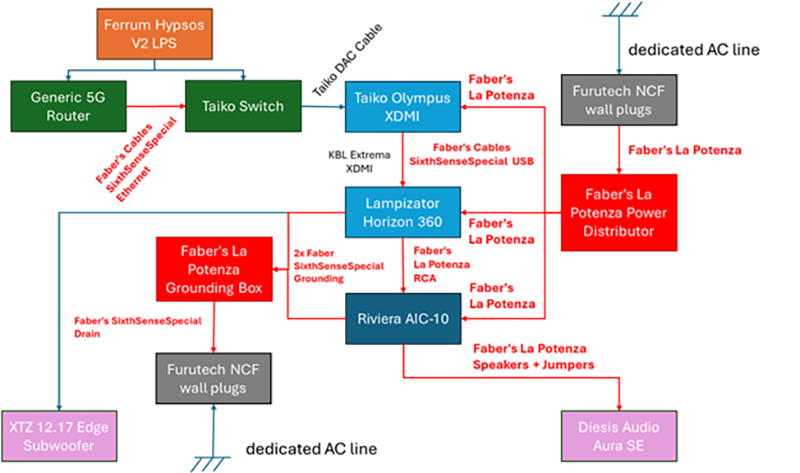
The methodology I used to conduct this complex test was to add a cable at a time, listen, then move to the next cable until the full loom was complete. I wanted to let the sonic changes and most importantly my reaction to music playback sink in. Therefore quick swaps were only an exception when something did not sound right which happened a few times. After some weeks of living with the Faber's-dominated setup, I reverted at once to the pre-Faber condition. Finally, based on the results I revisited some intermediate stages where only some of Faber's kit was present. The insertion of Faber's Cables and Faber's Power was strategized according to Fabrizio's advice by following the electrical signal's travel through the system:
At the end of the process my setup was as above where the red text and boxes indicate Faber's equipment. The grounding box comes with a drain cable that must insert in a wall plug although the device itself isn't powered. From it three or more grounding cables connect our gear.








 With how my brain works, I tend to pinpoint modifications from a system change in the very first seconds but it takes me longer to put those modifications into a context of being technically better or worse and even more days to conclude whether I consider the changes musically superior. Hence my approach was a mix of A/B tests with a selection of test tracks and longer more casual listening sessions. The first step introduced the La Potenza AC distributor plugged into the wall with a La Potenza power cord to replace my Audioquest Niagara 5000 conditioner and Hurricane HC cable. The first song I tried was "Fons Vitae / Dementia Praecox Angelorum / Supra Solfamireut" by La Folia de La Spagna from Grigorio Paniagua with the Atrium Musicae de Madrid. This is a highly pyrotechnical track based on motives from Iberian XVI-XVII century tradition where several ancient instruments play together with extraneous noises as crazy as a kazoo or spoons forming a spectacular palette of colorful dynamic contrasts spatially arranged in a supremely transparent way. The effect of the first instalment of Faber's goods was a clearer lighter sound with more resolution, transparency, dynamics, immediacy and extension. The Niagara was smoother, darker, and weightier but felt somehow slower and veiled by direct comparison. A characteristic I later discovered is part of the Faber's Cable and Power DNA was the feeling that the sound detached better from the speakers, with a general uplift of the soundstage's center of gravity, or, more specifically, a better layering of musical elements. Next came the Taiko Olympus server where a La Potenza power cable replaced an Audioquest Hurricane Source. The Olympus is battery powered but part of the batteries charge continuously, thus a power cord remains present during normal operation. For this reason power cables are reported to make a difference though after having already tried half a dozen power cords on it, the impact wasn't as evident as it was with its predecessor, the Taiko Extreme which I also owned. The Faber's flagship power cable did elevate clarity, bass tightness and presence but by an extent I'd judge just above subtle. That situation changed more incisively when it was the turn of LampizatOr's Horizon360 DAC. Here a La Potenza replaced an Audioquest Hurricane HC and the improvement of separation, harmonic nuance and sound projection filling the room was easily noticeable.
 The Paniagua track clearly showed instruments being more tactile and present while their colours from plucks to percussive noises took on additional hues, exposing an almost fractal level of resolution especially with high-frequency information. Annette Askvik's Liberty has become an audiophile classic and there is no hifi show where you won't hear her soft voice emerging from atmospheric bass textures and 3D instrumental effects. It is a track that makes most system shine but with very good ones the wow effect immediately turns to being sucked in emotionally and physically. With the La Potenza on the LampizatOr the sonic landscape seemed to transcend the physical limits of my room, with Annette's voice crystal clear yet full, floating well above the Diesis Aura Special Edition horn-loaded tweeters while the deep bass became more textured. Already satisfied by the amount of improvement I had achieved at this point, I replaced my trusty Shunyata Alpha HC on the Riviera Labs AIC-10 hybrid amp with another La Potenza power cord. I immediately noticed an increase in speed with more startling attacks and the feeling of more air on top. This last step was definitely smaller but given the level I'd already reached, I was expecting any improvements to become ever more marginal. This feeling was reinforced by the introduction of the digital cables although most likely for different reasons. The SixthSenseSpecial Ethernet replaced a Sablon Audio 2020 Ethernet cable between my router and Taiko Switch and I noticed little to no changes.