Looks don't matter? Clearly Enleum wouldn't know. Fan or not, they deserve kudos for going to these lengths. The majority of hifi brands is perfectly happy to regurgitate the tried 'n' true as though we were cows with four stomachs. And yes, being able and willing to spend extra on refined cosmetics and execution takes coin. Where only the sound matters, bent sheet metal even plastic may do. We all start somewhere. It's just not how this fortune cookie crumbles for the hidden Confucius note which declares "it is what it is; until it's not". This isn't about starting somewhere. It's about ending up elsewhere. Now Wikipedia explains, "Chinese culture considers 4 unlucky because its pronunciation 'si' sounds very similar to the word 'death'. This phonetic resemblance creates a superstitious association so pervasive that buildings often skip the fourth floor, hospitals may avoid room number 4 and businesses might not use 4 in pricing to avoid bad luck." The same applies to Japan and South Korea where the AMP-44R is built. It clearly doesn't kowtow to tetraphobia which in some Western cultures becomes 13. Or does it apply the old math of two negatives making a positive as in, death + death = life? In Enleum numerology, twin figures refer to product series plus circuit generation so the AMP-54R is series 5 with a 4th gen iteration of the brand's proprietary current-mode circuitry whilst R abbreviates 'reference'. The smaller amp establishes the new size of product series 4.
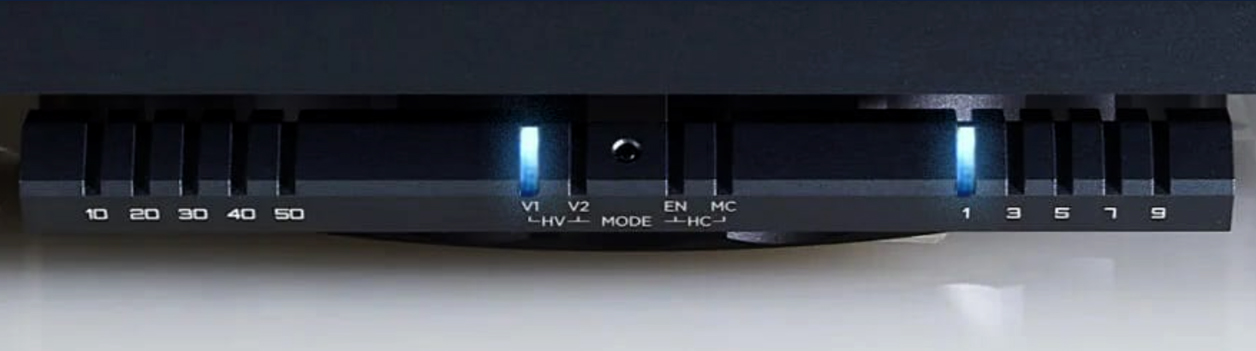 On this shot from Enleum's website, the digital inputs shown on my first page are gone. Did the modular DAC project cancel?
By November 27th, "I hope this email finds you well and I am happy to be writing you in an official capacity with Enleum by now working with their sales & marketing across Europe and the Middle East. To think that my first email to you more than a decade ago was about 'my' old Ballerina Sweetspot listening chair then the CanCans headphone stand and even back then I was moving on to support Soo In and Martin at the Munich shows and meeting you there as well. Kind of full circle now. I know there has been a very long wait for the AMP-54R but I finally received a review unit for Europe and am wondering whether you would like to be the first to take it." That was Michael Hollesen from Sweden. Full circle indeed. How could I not say yes? For the unboxing we go to John DeVore's channel:
"Correct, for now the DAC module unfortunately went the way of the dodo but other things are on the horizon in that regard. However, the previously optional transimpedance phono stage now includes standard." How about the lo/hi-power feature mentioned earlier? "That's very much current. The dual-output options deliver 115/200 watts into 8/4Ω in high voltage for a more open dynamic presentation, 50/100wpc into 8/4Ω in high-current mode for a more intimate reading." How do we select? "Pushing the power button for 5 seconds by remote or on the amp switches between the two. Upon start-up the floating display lights up to show the selected mode." The V1+V2 lights coming on together signify high-voltage mode, EN+MC high current. In the court of public opinion, a power increase from 100 to now 115 watts won't overwrite relative bonsai perception in this price class of a brand-new 2025 Citroën C3 but owners of high-eff speakers will applaud the half-power option. EN-Link is a current-mode input on BNC reserved for a future Enleum source with matching outputs. The MC input is on standard RCA of course. Having never owned a single record, to me MC abbreviates must cease. The next recipient of this EU review loaner will have to rename it again. The only thing left before delivery day is stating that the small Enleum remains my favourite transistor amp when up to the task. With its 45wpc/4Ω that sadly hasn't been the case since I divested myself of Cube Audio's Nenuphar v2 and crossed over to the dark side of ~82dB jobs like ModalAkustik's MusikBoxx and Virtual's Viper. My AMP-23R thus has slummed it on headfi exclusively. If the AMP-54R could rekindle my Enleum enthusiasm over speakers into a blaze, it'd make my day, never mind that I couldn't pay for it. A short-lived experience would have to suffice. Coitus interruptus. It's what most of us reviewers sign up for. "There was a delay in customs as our review unit was on a round trip to Korea for the final software upgrade. Hopefully it's now on its way back and we'll ship it to you as soon as it arrives." It's a reminder. Like FPGA-powered digital converters, Enleum's smart bias at the heart of their current-mode circuit runs proprietary control code. Changes in control code have a direct sonic impact. PS Audio made a whole career of successive firmware updates which altered the performance of their DSD DACs. So it was sensible that I conduct my review running the AMP-54R on its very latest code.










Or direct from our leaping frog's mouth, "the AMP-54R's JET Bias circuit operates with a highly sophisticated algorithm which controls the output transistors and never lets them completely turn off regardless of temperature, changes or load. As such, in traditional terms one could call it a variation on 'Class A'. But as the algorithm tracks and adjusts the output bias in real time, it never lets the circuit operate constantly at full capacity either which would be very inefficient. In terms of efficiency, it's closer to conventional 'Class AB'. So the AMP-54R runs like Class A but with the efficiency of Class AB, something we call 'Class SA' for 'Smart A' or 'Super A'." Our industry has seen 'sliding class A bias' before, also responses from designers of classic class A so constant bias equal at idle or full power. Here we needn't engage in class warfare. Our ears don't care about the 'how' just 'what'. In all my years of following Bakoon Int. then Enleum, I just never heard their circuit referred to in these terms. Though if Devialet calls theirs class AD, why not Enleum's class SA? Differentiation in overcrowded markets is key, good story telling an essential element thereof. With this model being Enleum's big-gun hardware, it makes sense to run it with big promotional swagger.
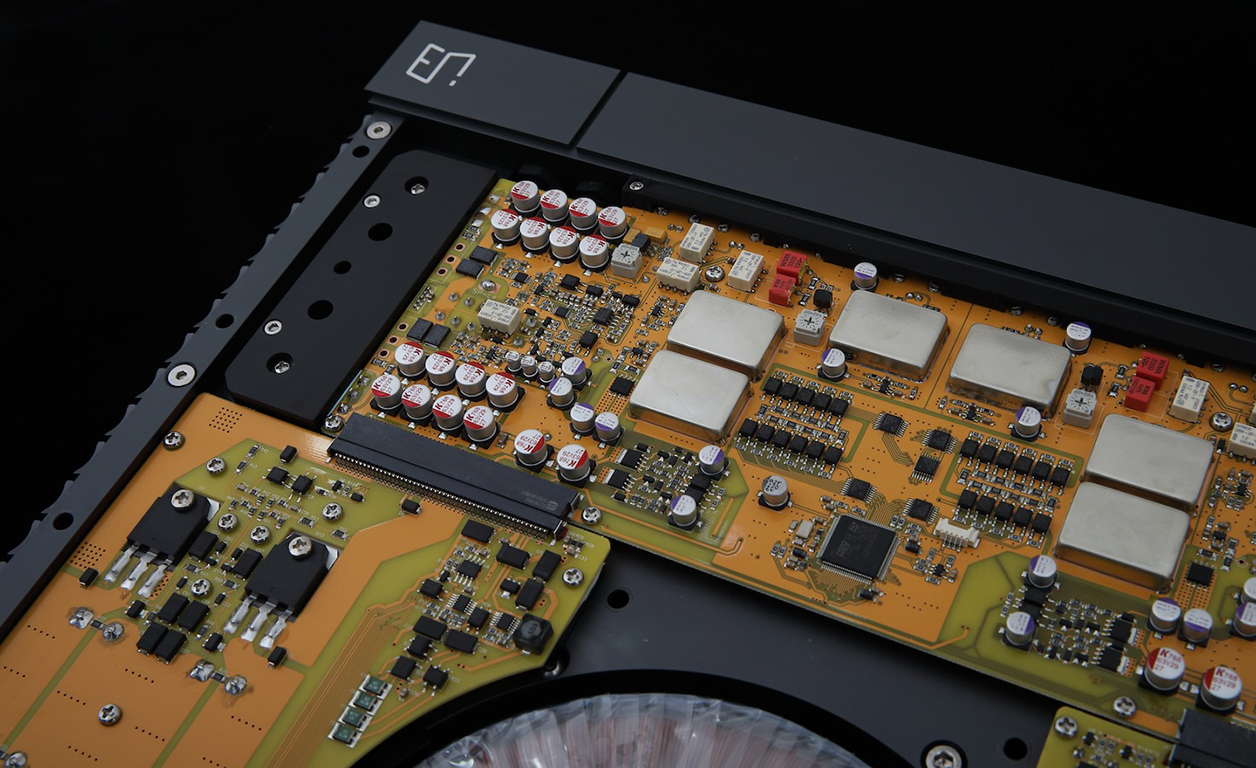
Thinking readers appreciate that 115wpc/8Ω from this compact chassis would turn the entire casework into a heatsink so cook very hot in pure class A. Adaptive bias meanwhile tracks the input signal in real time then dynamically reacts to actual power demands. This relies on very fast processing speeds to avoid any time lag whilst purists might still call it a mere approximation of class A. Krell of yore referred to their implementation of sliding bias as plateau biasing, Technics had their 'new class A'. Today's Chord Ultima 5 might still use a sliding bias scheme as could Schiit's Continuity output stage. We note that over time a number of designers endeavoured to harness the sonic advances of class A whilst reducing the concept's well-known inefficiency. Enleum now formally joined their ranks. For the AMP-23R, Enleum's marketing still focused predominantly on their Ensence circuit as their evolution of Bakoon's original Satri current-mode gain circuit. For the AMP-54R, their latest-gen bias controller has moved deeper into the spotlight and leverages advances in its 32-bit CPU to run the new tracking algorithm for greater precision, more stability and higher power output.
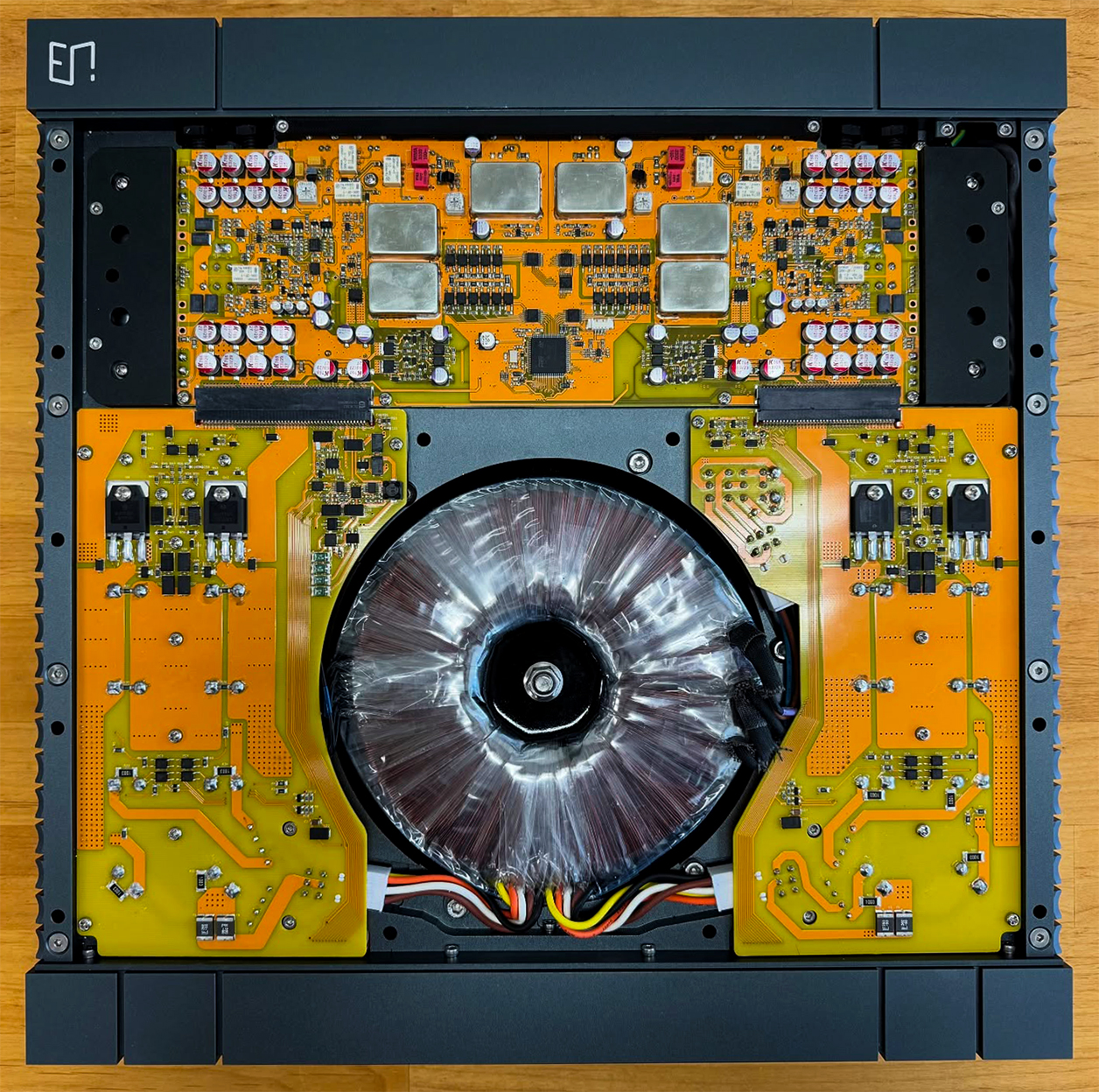
Even laypeople appreciate how each square inch of available real estate is used to maximum capacity. It's a packaging job par excellence whose only visible cabling are the short transformer leads. Just how hot would this lot run in high-voltage mode? Incidentally, a claimed side benefit of Enleum's self-correcting precision bias is instant gratification so no need for a traditional warm-up prior to each session before this circuit performs its best. Many classic class A amps want ~30 minutes before their output devices have reached thermal equilibrium. Still in the anecdotal vein, in a follow-up video to his unboxing, John DeVore mentions other amplifiers in his collection: class A Sugden monos; and a pair of fire-rescued Nagra Classic Amps. The latter track my own exposure whereby if you enjoy the Enleum experience, you'll also like those Nagra amps. For myself, I'd still add the earlier Ivo LinnenberG Liszt monos, the Kinki Studio EX-B7 monos and the general Goldmund aesthetic to this picture. Whilst certainly not the same, it seems fair to suggest that amplifiers from these brands share enough to compete for the same customers. By this stage of the narrative, 2025 was just about a wrap to condense a nearly 3-year genesis story into my three intro pages. Good things. Worth the wait?