On high so in the treble and relatedly, overtone land, both amps were surprisingly similar. As a real fan of harmonic luminosity, I truly appreciated the Canor's ability to hang with the Kinki twins which with their matching Exact Fire cables and Tai Hang DC blocker excel at suggesting virtual super tweeters in action. If the Virtus didn't get quite as brilliant with a spiked fiddle's flageolet fire of its high register or the odd-order bite of a strained muted trumpet, it certainly wasn't far off. As Herb Reichert of Stereophile recently coined the Voxativ Hagen2 speaker an Herb speaker, I could designate this Canor a Srajan amp. I simply doubt it'd mean anything to anyone. What I will say is that recorded higher harmonics beyond the 5th tend to get very homeopathic in dose so nearly subliminal in amplitude. Yet they're vital to complete a given instrument's or voice's overtone character and maximally differentiate Kenny G's soprano sax from that of Branford Marsalis or Jan Garbarek. To recover them requires, amongst other things, a very low noise floor. Certain close-mic'd piano recordings too have that scintillating milieu of harmonic fire flies and night-sky embers flickering in the air which adds the metallic string aspects atop the resonant tone-wood core. Components deliberately tuned for darkness don't fully resolve that dimension. They may sound rich and inoffensive but shrink the difference delta of timbres and tone modulations. Whenever musicians strain, tone changes and generates more odd-order harmonics. When strain relaxes again, sweetness might dominate. So we want to hear the full tone-colour journey of how sweetness morphs to huskiness to glassiness and back with as many gradations as possible. In my book this requires an open treble with minimal phase shift so wide bandwidth. On that score and particularly so for a high-power variant, the S1S amp scored brilliantly. Think of it perhaps as that sparkly fizzy effervescent quality of champagne before it goes stale. And stale is what sound turns into when it loses that aerated quality. Now its bubbly has burst. Not hear. Cheers.
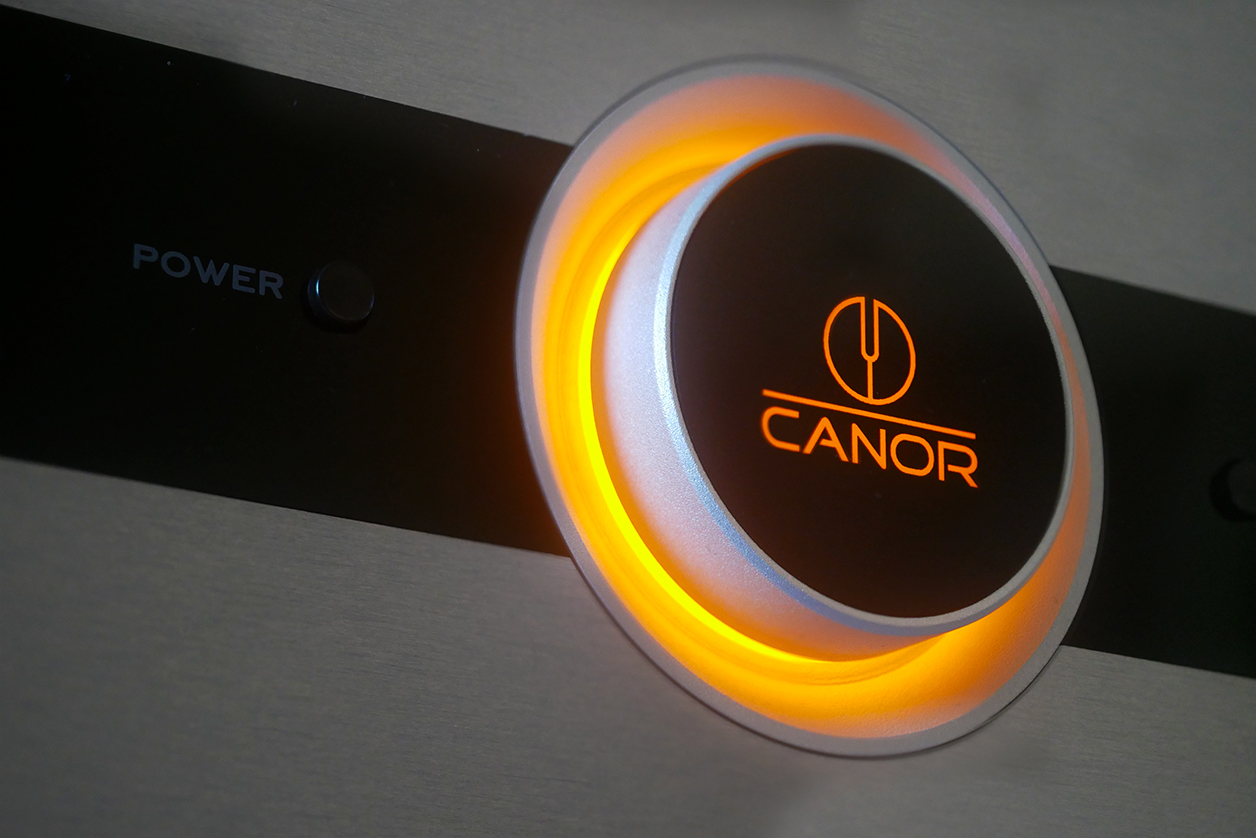 A power button right (left?) where it ought to be without becoming in the least bit visually distracting. In standby the yellow light ring and logo go off and a small red LED next to 'power' comes on.
I'm of the rather unpopular opinion that most soundstaging is proper setup. Speaker width sets stage width with the occasional extra of beyond-speaker phase effects. Front-wall distance informs how much stage depth we develop. An amplifier doesn't have much say over those coordinates. It does however with how images populate the 3D field set up by those parameters. That's about the precision or lack of localization lock; and how specific layering gets. The best amplifiers get as sorted and mapped in the front-to-back dimension as they do in the left-to-right panorama. In my experience any gains in noise-floor suppression immediately benefit depth legibility and contrast ratio as that tacit 'pop' of sounds against silence. So-called ambient recovery as the overlay of the recorded acoustic onto our own ties to S/NR as well. Faint recorded reflections behind/around images are the colours which paint that space to become audible. Then there are time-domain improvements by way of lower phase shift. Suffice to say that on those counts, the posh-nosed Canor syndicated my Kinki standards with a perfect rerun.
Modern parlance calls it HD or hi-res. Space per se is invisible. When we look at a night sky, we interpolate space because faraway stars have us see that huge emptiness separates them from us. Recorded space is like that. We don't hear silence per se, only in contrast as that against which sounds arise. When around robust images we detect trailing reflections like haloes, they light up the space in which those images were captured like a comet's tail illuminates the dark. The more the flotsam of such connective inter-image tissue becomes audible, the more emptiness/space becomes a presence. It's how recorded space turns audible. And that's one of the 'high-end' dimensions which a generic clock radio can't resolve and which lesser 'proper' amps may hint at but not fully tap. If your speakers are set up to maximize staging and of sufficient resolving power, Canor's Virtus S1S will open up that "4th" dimension which fills up the three dimensions of width, depth and height. If you're inclined, that can make listening a most visual experience. All the data our ear/brain needs to resurrect recorded space are there.










 For textures the Canor expressed dry warmth. I call fuzz, blur and ringing the enablers of humidity. Insufficient driver control doesn't stop sounds on time. Like in a church, they linger past their sell-by date. The counter polarity is the unamplified outdoor concert. Lack of reflective surfaces causes a quasi anechoic effect. The sound dries up like a shed snake skin lacks a living centre. That's how I experience hyper-damped class D. With its finger keenly on the pulse of recorded decays, the S1S is far from dry per se when it doesn't overdamp music's ring-outs. But because it exerts correct driver control, there's no faux warmth from artificially upping decay lengths. It's why my description of the textural effect is dry warmth. It's supposed to suggest a lovely summer day not in the tropics where excess moisture in the air makes us sweat and experience difficulties breathing. Instead it's a summer day farther north where the air is warm but dry. Transpose that to sound et voilà, the S1S's climate, milieu or atmosphere: very comfortably sunny.
This evidence of an excellent treble, superior soundstaging, a demonstrably low noise floor, ideal control and a basic sunny disposition arrives me at true high resolution. It's not faked up with heavily front-loaded transient emphasis or tonal-balance aberrations. It's not about spot-lighting musically irrelevant noises like the proverbial squeaky chair amongst the second violins. It's not about sensory overload. Instead it presents the available data in such an obvious manner that high-level playback becomes easeful. It  bleeds out stress of having to figure it out. The score is clear. There's no work understanding it. I won't call it organic high resolution because that tends to imply darkish slightly padded undertones. In my lingo, the Canor aesthetic is fast, evenly lit up across the bandwidth, extremely visual, tonally correct and capable of digging deep into the subtle harmonic layers of tone colours. Designer Zdenek Brezovjak also mentioned wide dynamics. By temperament I neither listen very loud nor to large-scale classical with its extreme dynamics. I played in orchestras and don't find hifi's shrinkage that persuasive. My room could host a live string quartet but not a 70-strong symphony. My dynamic focus is primarily on the micro realm of melodic emphasis, the gentler cresting of a phrase or the irregular amplitudes of beat patterns. See what this young Azeri at left can do with just one voice. This is not about the max distance between a subliminal tremolo in the double-bass section and the full-throttle blare of a Brucknerian brasses salvo. Whilst I thus can't speak to Zdenek's ultimate macro ambitions, I can confirm that in the micro realm, his Virtus amp showed proper speed and S/NR for lively finely nuanced dynamic inflections. With its lower input sensitivity, I simply had to sit quite a number of clicks higher on the volume control than with my resident amps to achieve equivalent SPL.