
Country of Origin

Reviewer: Srajan Ebaen
Financial interests: click here
Main system: Sources: Retina 5K 27" iMac (i5, 256GB SSD, 40GB RAM, Sonoma 14), 4TB external SSD with Thunderbolt 3, Audirvana Studio, Qobuz Sublime, Singxer SU-6 USB bridge, LHY Audio SW-8 & SW-6 switch, Laiv Audio Harmony and Sonnet Pasithea; Active filter: Lifesaver Audio Gradient Box 2; Power amplifiers: Kinki Studio EX-B7 monos & Gold Note monos on subwoofer; Headamp: Kinki Studio THR-1, Enleum AMP-23R, aune S17Pro Evo; Phones: Raal 1995 Immanis; Loudspeakers: Qualio IQ [on loan] Cables: Kinki Studio Fire, Furutech; Power delivery: Kinki/Vinshine Tai Hang on amps, Furutech GTO 2D NCF on low-level gear; Equipment rack: Artesanía Audio Exoteryc double-wide 3-tier with optional glass shelves, Exoteryc amp stands; Sundry accessories: Acoustic System resonators, LessLoss Firewall for loudspeakers, Furutech NCF Signal Boosters; Room: 6 x 8m with open door behind listening seat; Room treatment: 2 x PSI Audio AVAA C214 active bass traps
2nd system: Source: FiiO R7 into Soundaware D300Ref SD transport to COS Engineering D1 DAC/pre; Filter: Lifesaver Audio Gradient Box 2; Amplifier: Kinki Studio EX-M7; Headamp: Cen.Grand Silver Fox; Loudspeakers: MonAcoustic SuperMon Mini + Dynaudio S18 sub, sound|kaos Vox 3awf, Albedo Aptica; Power delivery: Vibex Granada/Alhambra, Akiko Audio Corelli; Equipment rack: Hifistay Mythology Transform X-Frame [on extended loan]; Sundry accessories: Audioquest Fog Lifters; Furutech NFC Clear Lines; Room: ~3.5 x 8m
Desktop system: Source: HP Z2 work station Win10/64; USB bridge: Singxer SU-2; DAC: iFi Pro iDSD Signature; Speakers: DMAX P61; Headphones: Final D-8000 & aune SR7000 Audeze LCD-XC
Upstairs headfi system: FiiO R7; Headphones: Meze 109 Pro, Fiio FT3, Raal 1995 Magna, HiFiMan Susvara
2-channel video system: Source: Oppo BDP-105; All-in-One: Gold Note IS-1000 Deluxe; Loudspeakers: Zu Soul VI; Subwoofer: Zu Submission; Power delivery: Furutech eTP-8, Room: ~6x4m
Review component retail: €16'500 ex VAT

Canor. Doesn't the name ring a bell? A number of high-profile brands rely on the vertical OEM/ODM integration and production resources of our already 30-year old Slovakian enterprise in Prešov which controls its own chassis, circuit board, SMD population, laser engraving, PC-guided anodizing and transformer manufacture, even an anechoic chamber and fully shielded measurement room for electromagnetic compatibility compliance. Since 2015 they occupy an 8'000m² facility and by 2020 had grown their staff to 80 employees. Today that includes John Westlake known for his work at Audiolab, Leak and Quad who at Canor is the author of the new Virtus A3 all-in-one combining class A and A/B, tubes and transistors, digital and phono. In 2022 they launched their Reference line. Today's Virtus S1S is its solid-state stereo amplifier. That transistorized distinction must be made when Canor's very first product still branded Edgar was in fact a valve integrated. They still view themselves as tube specialists and designed their own in-house valve testing gear. It's a good reminder that JJ Tubes too operate out of Slovakia. Even car brand Škoda maintain factories there whose production volume is said to exceed what Italy makes in automobiles. For a prior LowBeats tour of Canor's premises from 2023, go here.
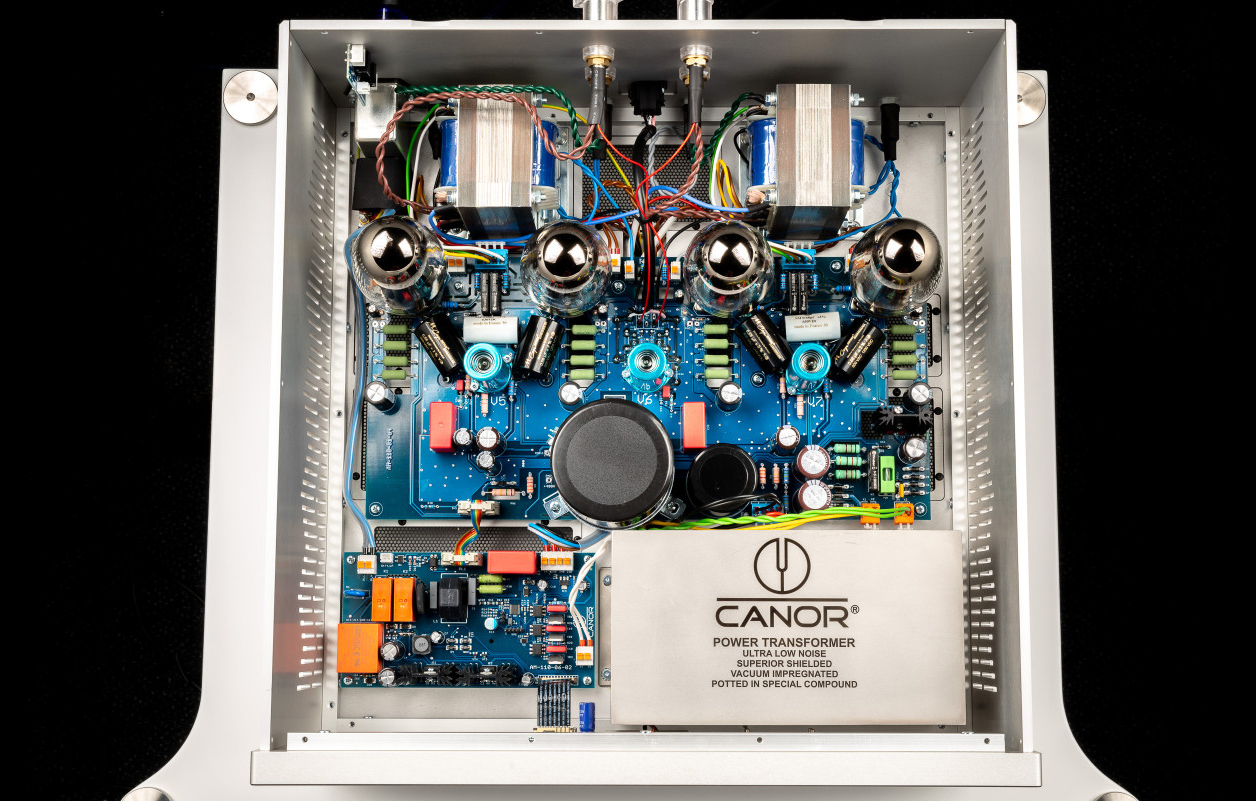 Canor's flagship tube mono amplifier.
Today's Canorlogue – er, catalogue includes pure tube, pure transistor and hybrid models. Being a devout sandman myself, I asked for their best solid-state effort, a 250/400wpc into 8/4Ω dual-mono proposition whose 5 pairs of class AB output transistors mount to 350mm² copper plates for thermal dissipation and lower output impedance. The power and signal circuits separate with 10mm aluminium braces. Voltage gain is a standard 26dB, input impedance 200kΩ on XLR, 33kΩ on RCA. 5W/1kHz THD is given as below 0.0002%, bandwidth as 5-250'000Hz -3dB, S/NR as better than 120dB. It all packs into a black or silver casing of 45 x 21 x 52cm WxHxD to weigh a solid 39kg. The power light ring's intensity can be adjusted in 5 levels and the turn-on protocol takes just 12 seconds. That's all the boiling stuff on a plate we learn straight off the product page. For more I had to get to the engineers. Enter my factory contact so marketing manager Ivan Bosnovic. He promised to interface with co-owner and chief engineer Zdenek Brezovjak on our behalf and alerted me to 55kg worth of inbound Dachser freight pallet. The Virtus S1S is no lightweight coming or going. Mr. Zdenek isn't just an accredited engineer, he grew up as the son of a multi-instrumentalist musician so himself learnt to play the violin and saxophone. He knows live sound and in his career worked on actual P.A. amplifiers.








Playing good copper. Aavik of Denmark and Dan d'Agostino in the US are two other brands which swear by copper-coupling transistors to lower their output Ω. Where the ex Krell boss plays bad copper with our wallet to craft entire heatsinks with vertical bores from it; whilst Aavilk line the insides of their best chassis with it as do Auralic; Canor place thick copper plates between their output devices and classic aluminium heatsinks. So copper has illustrious precedents in hifi chassis where we can't forget Kondo of Japan's signature early use. As we already saw, the S1S's dual-mono designation applies back all the way to its vertically-mounted twin power transformers to not share that part between channels. For convenience only the IEC power inlet is single to not require two power cords. Rather than many small filter capacitors, Canor play it old school with a few beefy high-voltage units the size of shot glasses. As to the name Virtus and its Latin origin vir for man, it won't surprise that in ancient Rome it was considered a specific manly virtue connoting valour, courage, character and worth. Millennia later, Athena still shakes her head in amusement. But no doubt it's mostly men who kneel at the altar of powerful machinery. So the name for Canor's best transistor amp feels well chosen. For the real macho men who prefer pointy feet and shoes to flat footers, there's even a quad of those included to swap out the stockers. But unlike he-man muscle amps with massive mains switches routinely 'round back or hidden on the belly, Canor's standby switch is a small nub right on the front panel where it's easily reached without disfiguring the optics.

Here are Canor's answers to some questions. "How many gain stages?" "The first stage is a super-symmetric differential stage. Then comes the oscillator stage, finally the power stage." "What about the output devices?" "The power transistors are bipolar." "Is this circuit direct or cap-coupled?" "It is a cap-coupled circuit. Since our Jfet input circuit is of high Ω, we could use a very high-quality coupling cap with relatively low capacitance." "What were some of the design considerations for this project relative to performance and sonics?" "We wanted to achieve a power amplifier with very high dynamics and top distortion and S/NR values combined with excellent sound at the end." "Anything else you'd want prospective buyers to know?" "The goal was to create a powerful dynamic amplifier that can drive even the most demanding speakers on the market. The combination of Virtus S1S with our tube-based Hyperion P1 is perhaps unique but perfectly balanced." From that we see that for ultimate sonics, Canor like to combine tubes and transistors, in this instance a quad of 6922 and pair of 6H30PI for the glowing preamp glass shown above. As to lorry life, five days after Canor ordered my freight pickup with Dachser, the road-going pallet had arrived in Köln/Germany. Three days after that it landed in Limerick/Ireland, requiring just another hour's drive by local dispatch to deliver to my door: not ho-hum but hurry with the heave-ho. Better yet, nice 'n' slow. This beast is no joke.