AA. Here it isn't short for Audioholics Anonymous but Aural Aesthetic. To be worth his salt or her beans, any hifi designer must have one. Sven Boenicke's preferred recording perspective is the resonant field of the venue acoustic. It's where reflections dominate and mix with direct sound. He shuns the isolation of a sealed recording booth. He wants to be enveloped in the musical atmosphere not just hear the nude direct data a 1st-row seat or close spot mic would. Once we understand this preference and its implications, we understand what all of Sven's tuning measures pursue. Knowing that Boenicke-branded cables scale up LessLoss C-MARC tech adds another useful data point. The LessLoss aural aesthetic is clearly enough kin to Boenicke's own to embed in the Swiss catalogue. If you're an adrenaline junkie who can't sit close enough to the musicians, you're wearing different stripes. This doesn't at all imply that you wouldn't enjoy a dose or three of Boenicke/LessLoss seasoning. You simply know beforehand that it should deliberately counter-steer your native tuning. Seasoned properly, it could be your ideal course correction by adding qualities you had perhaps short-changed a bit. Overdone it might enter you into a different school of sonic values altogether. Silver-bullet myths and one-size-pleases-all hopes disregard the wide variety of aural flavours which combining various components in different rooms can achieve; especially when some kit is very deliberately voiced.
Knowing what we prioritize versus what the 'house sound' of a brand is or its designer's AA helps us make more informed decisions. Sven Boenicke also subscribes to violin maker Dieter Ennemoser's research ideas where "the more a sound is coloured according to the C37 harmonic structure, the less coloured but warm, beautiful, natural, meaty and communicative our brain perceives it. The harmonic structures of aluminium or all manner of plastics at room temperature have little in common with the human hearing structure of flesh, bone, hair and inner-ear liquid at 37°C." Again, this type thinking considers the one having the listening experience not just the audio hardware. It asks how human hearing works and how to best convince our brain that playback is more real, natural and compelling so less artificial, mechanical and ultimately, unsatisfying. Answering that question can obviously not be done by microphone or oscilloscope. How would machines know what sounds more natural when human hearing itself is nonlinear and produces its own distortions which standard measurements don't account for? As you'll appreciate now, my intro for a very small wooden part of mysterious MO has covered a lot of ground just to scatter sufficient crumbs so that those curious to follow tracks well off the mainstream can do so. The rest simply wants to know how the TTN impacted the sound of three different speakers if at all. Let's find out.










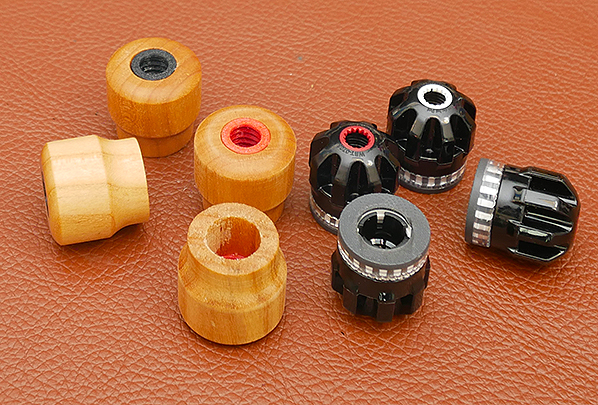 Even Dublin customs were curious. An 'opened by' tape and carefree rattling accompanied my small 2-day FedEx delivery. What must have been clam-shell packaging lacked one half after the inspector had satisfied himself that I wasn't importing Swiss designer drugs. Whether he knew what he looked at before dropping eight free nuts back into the box is doubtful of course.
Swapping half the set onto the Polish monitors on my desktop took no time at all. Neither did hearing definitive changes. The first was indeed imaging that felt suspiciously taller. How that's even possible I'll leave to clumsy Irish customs who clearly have more important things to do than wonder about audiophiles. Setting aside sorcery—if anything, this is white not black magic—I'll abandon any attempts at reasonable explanations. I'll report on what I heard then make a hasty exit to Beats Me.
Removing the TTN didn't reset any stage boundaries yet still managed to make their contents feel more compact, thick and positioned clearly lower. Treble textures hardened up a bit and my sense of air and upper-harmonic shimmer dimmed. In my lingo and perception, black relates to bass and sonic materialism. White is about treble, illumination and spirit. On that axis, without TTN sounded darker, denser, lower and 'clumpier'. With them sounded lighter, higher, more teased out and expansive. What surprised me was twofold. One, this difference was more overt than expected. Two, it didn't follow the LessLoss protocol of shifting subjective weight between attacks and decays onto the fades to act as softening, subtle overlay agent and black injector. The percussive pepper of brisk transients thus didn't mellow. It just gave up some glittering edge or embedded metallic rust. But how I hear, the TTN clearly worked in my white not black domain – without making the presentation lightweight.
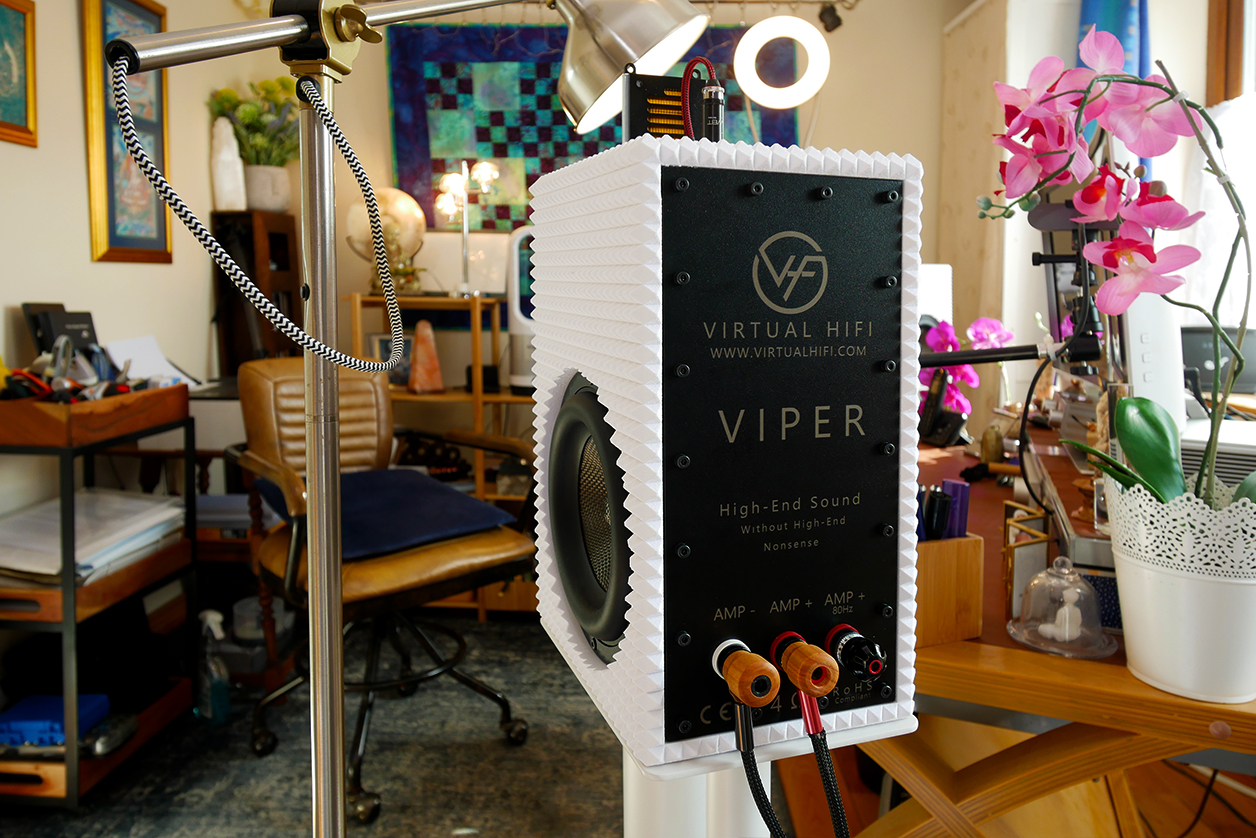
Where this makeover of gestalt mirrored the LessLoss effect was bleeding out treble grit. It just wasn't accompanied by subjectively slowing down the tunes or incurring energetic losses. Not having heard any recent Boenicke speakers, perhaps Sven's aural aesthetic has shifted since Ivette and I lived in Switzerland? Whatever the case, this Boenicke tweak behaved different than anticipated. It still was about greater refinement and soundstaging but without inserting an energetic damper or undue darkness. So it felt as though Sven had tuned this tweak sitting closer to stage.