In-room positioning was the first order of business and something I had sorted within minutes. All of Sven's designs thrive on generous breathing space and the V01 quickly made clear that it is no different. Positioned 1m from the side walls, 1.5m from the front wall and gently toed-in to cross behind the seat, it snapped into focus, locked all images in place and delivered bass in an orderly well-controlled manner. From that point onward, things escalated—and in a very enjoyable direction. Before moving on, it's worth outlining what has become the usual Boenicke house sound. Without exception, all of Sven's speakers are spatial freaks. The soundscape they cast in front of the listener is not only vast of scale but richly layered and complex in all directions, largely courtesy of wideband drivers augmented by ambient tweeters. This spatial ability has arguably become the brand's most defining trait, particularly when one considers the very slim profiles of its bestsellers. On paper nothing suggests this level of performance yet in practice they consistently over-deliver. With a significant portion of the audible bandwidth handled by one driver, resultant point-source behaviour ensures high spatial accuracy that keeps image blur at bay. Boenicke speakers are also surprisingly bass capable. Sven routinely demonstrates even his smallest W5 monitors in large rooms without any subwoofer support. Add everything up and you get a family of nicely dressed speakers that perform well beyond what their compact footprints would suggest. For many, including me, the appeal is obvious.
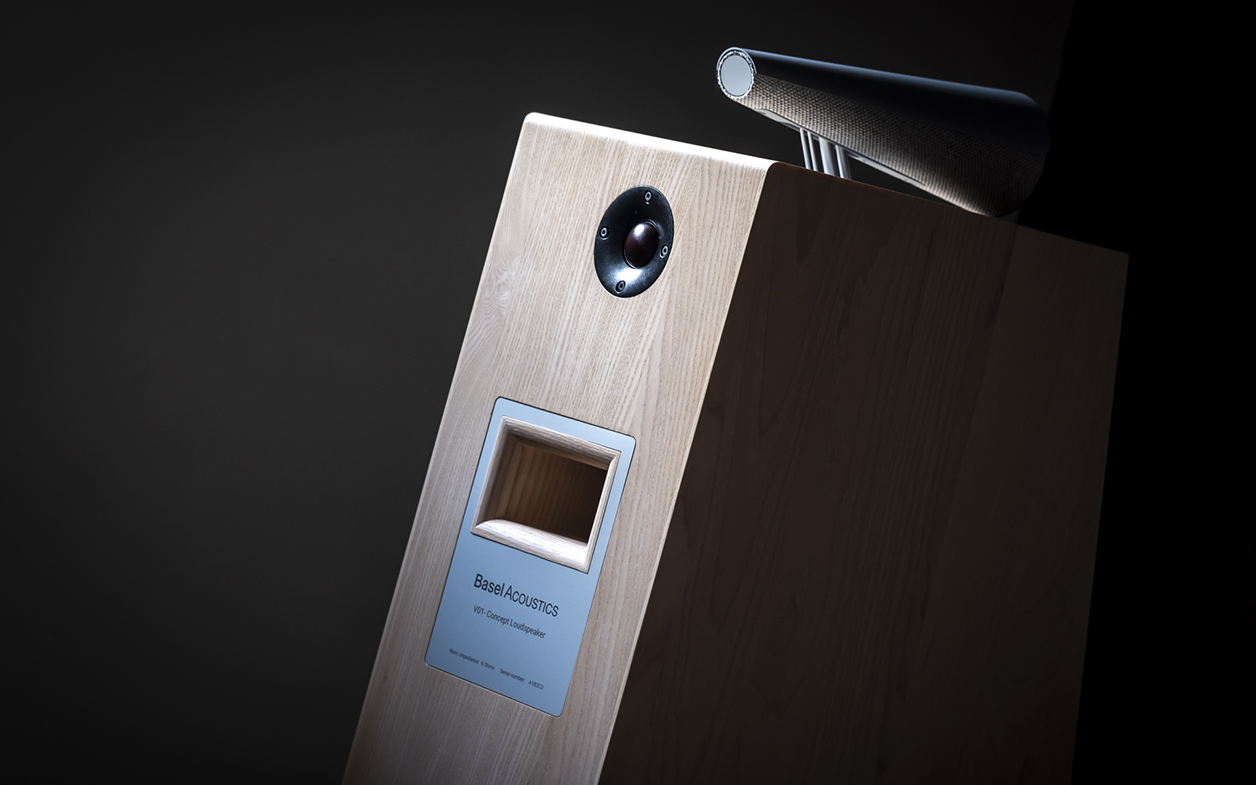
That the V01 carries a fair share of Boenicke DNA was expected. Its frontal drivers overlap generously and sit close to one another. It makes this design particularly adept at spatial accuracy, clarity and soundstage scale. While that already points clearly at the designer involved, the V01 has a few additional aces up its sleeve. Its topology gives some clues. While technically a floorstander, in many ways it behaves more like a two-way monitor on steroids, the latter manifested primarily in its bass performance. The way the Basel Acoustics debut product handles this aspect is puzzling at first. On paper, a single 8-incher in a reasonably sized enclosure doesn't suggest extension much below 35Hz. In practice however, the V01 confidently dips into the sub-30Hz zone where proper room-shaking rumble resides. If its boldly spacious presentation came as no surprise, the kind of bass that could be felt in my chest certainly did. That was the first "okay, interesting" moment I had with this speaker but not the last. If many conventional two-ways have a nicely flowing coherent character, the V01's widebander pushes that a fair bit further. The sound it produced in my room was exceptionally coherent and flowing to feel as though a single driver handled the entire bandwidth. In hindsight that shouldn't be surprising given the V01's minimalist filtering with its generous overlap. Still, just days prior I had the Daudio MOB3 open-baffle three-way in-house which—impressive as it was in terms of scale and sheer propulsion—sounded comparatively more diffuse and less emotionally engaged on more intimate acoustic material and vocal-centric recordings. In that regard, the V01 came remarkably close to my sound|kaos Vox3 monitors which excel at exactly this kind of repertoire. The space projected by the Swiss newcomer was very well organized and to a notable extent similarly enveloping. All in, this was a finely resolved highly nuanced speaker that clearly thrives on acoustic material rich in real instruments and delicate female vocals. That alone makes it a finessed performer. But there was more.










If it weren't for that surprisingly deep bass, I could now easily draw the line, label the V01 particularly suited to jazz and acoustic genres, highlight its strengths in those delicate areas and call it a day. In absolute terms however, its voicing was just as energetic, lucid, quicksilvery, radiant, responsive, fresh and elastic as it was sensual, intimate, vibrant and tonally packed. That broad skillset made the V01 equally adept at all kinds of music including electronica driven by rapid synth pulses which ultimately meant a very versatile design. If most listeners exposed to the V01 would first describe it as spatially outrageous, I wouldn't argue. In that sense it sits very close to the Boenicke house sound. It does however present one non-negotiable requirement: an amplifier capable of exerting firm control over the mid/woofer's ported rear stroke. To illustrate, driven by Trilogy 995R monos in pure class A bias produced bass that was noticeably softer, bloomier and loose and on bass-intense material, often overpowering. Switching those monos to class AB for lower output impedance and four times more power somewhat reduced these issues. With the Aavik I-588 meanwhile they evaporated altogether. This wasn't unusual. My W5 monitors and W11 SE+ floorstanders behave much the same. So did the long-gone W8 and many other ported speakers. While class D currently offers the most cost-effective path to unlocking the V01's full potential, well-executed class AB designs with sufficiently low output impedance should deliver comparable results. Ultimately, this is less about amplifier topology or price and more about electrical compliance aka low output Ω and current. After spending several days with the V0, it was high time to pitch it against the W11 SE+. That encounter doubled as timely reminder why I've never seriously entertained replacing the latter. Recent experiences with Voxativ's Alberich², Daudio's MOB3 and Børresen's M8 Gold Signature left me quite taken with dipole bass. In that context the W11 SE+ is rather special. While rear-vented, its side-firing 10-inch woofer with flat carbon-fiber cone on a long-throw suspension which barely moves delivers LF with a distinct dipole-like character. Bass doesn't sound bloomy or round but predominantly taut, energetic, thunderous, immediate and downright slamming. If most ported speakers offer bass that's round, thick and warm, my daily driver leans primarily toward contour, contrast, impact and violence which I enjoy. Against that backdrop, the V01's bass struck me as primarily voluptuous, full and less rigid, more centred between the speakers and in general closer to what one expects from a conventional bass-reflex design, albeit here capable of very generous reach given driver and enclosure size.
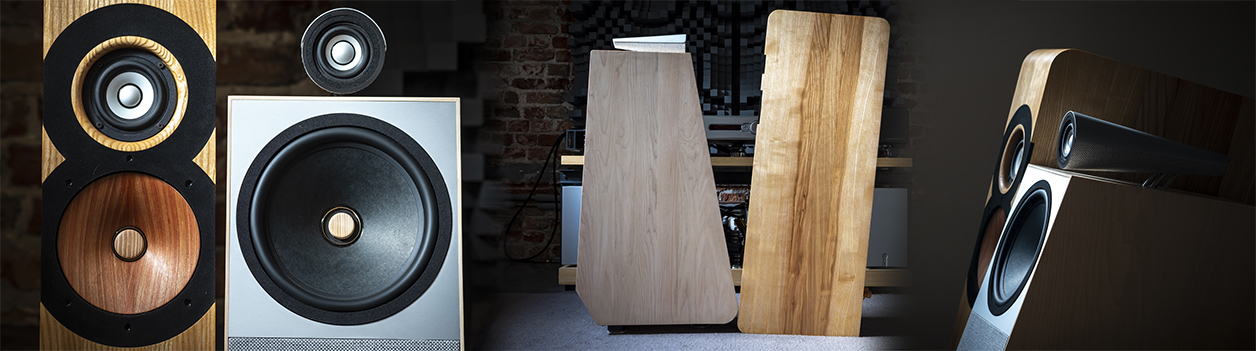
The above outlines where the W11 SE+ held the upper hand. While the V01's voicing is hardly relaxed, cosy, warm or delicate per se, my daily driver still came across as more lit-up, spatially majestic, energized, dynamically broad and propulsive. The way it moved air felt entirely different, resulting in a presentation that was spicier, more immediate and direct and with its tonal centre of gravity higher. Naturally, the V01's own tuning felt more grounded but also juicier, more picturesque, sensual, delicate and—again—finessed in how it rendered colours and subtle tonal shifts in a way the W11 SE+ currently cannot at my place, at least not without one specific amplifier that costs roughly three times as much. No matter. The key takeaway lies elsewhere. After spending time with both speakers, I'd wager a guess that most listeners in my room would prefer the V01. It's simply more approachable and sonorous. The W11 SE+ is a special case that demands additional effort to fully harness while preserving its vivaciousness, dynamics, high-tier resolution and electric demeanour. Room size sits at the very top of that list where mine is nowhere near as large as it should be. In absolute terms, the W11 SE+ can do more than the V-01 but also demands far more from the listening space, associated hardware and ultimately, listener. The V01 does not. Pair it with a sufficiently controlling amplifier, surround it with as much space as you can and it simply works. That's what I did and the payoff exceeded expectations. In fact, during the final days of its stay, I found myself using the V01 far more often than the W11 SE+. Let's wrap.
In an industry populated by intimidatingly large multi-driver loudspeakers, the Basel Acoustics V01 may come across as an extravagant oddity that's hard to justify. It isn't. Inhale, step back, take in the whole, exhale—and the picture sharpens instantly. The V01 isn't trying to win the usual arms race nor does it even bother to compete on those terms. Instead it leans heavily into mechanical ingenuity, resonance control and unorthodox driver implementation to show just how far a minimalist two-way floorstander can push. That it borrows from the Boenicke playbook works very much in its favour but make no mistake—what you get is no imitation but a recognisably related reinterpretation that stands tall as its own sharply dressed, brilliantly voiced and quietly subversive creation. It warrants attention and lingers in memory much like the Boenicke designs that inspired it. Props to Piotr for backing the right man, staying the course, walking the walk and ultimately getting there. The Basel Acoustics V01 serves as compelling confirmation.