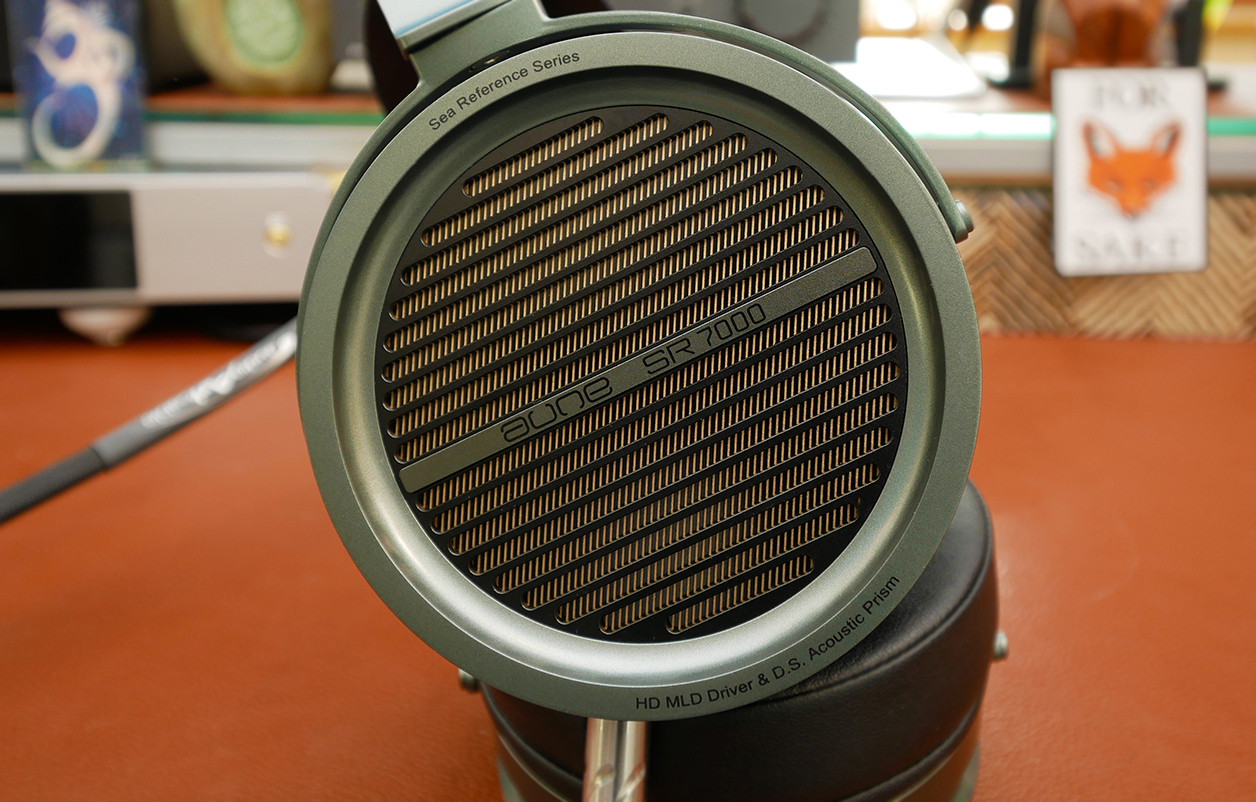
House of the Dragon's Scale. The SR7000's tuning is midrange out. Whilst bass is beautifully linear all the way into the 1st octave and the treble open, this is neither a bottom-up nor top-down voicing where a frequency extreme would salute at stiff lookie-here attention. As you were. So like all natural tunings should, the centre of gravity belongs to the midrange. But a small shift of attention is enough to ascertain that this aune extends fully in either direction. It's all there and unmistakably so. It's just not bassy or bright. Such terms signify a flashy attention grab, imbalance or interpretive weighting. They prioritize a particular band for effect. The SR7000 instead radiates from the midrange out. Where the scaly matter of acoustic absorbers factors are ideally controlled LF textures. They demonstrably avoid the boom, bloom and bloat of typical sealed headphones with their temporal blur, ringing and flawed stoppage. More scaly evidence manifests as an extra-wide headstage not bedevilled by cavity containment effects and resonances. If you're allergic to those because of super-vented alternatives like Raal ribbons, you could be as surprised as I that the SR7000's sealed nature won't materialize in the expected ways. That's the dragons at work. They're no gimmick or cheap marketeer's hook. For once there's truth in advertising. The scales do some of what my Swiss active bass traps do in the big room. Where KEF's meta material only works in the HF behind their tweeters, aune's is effective across the bandwidth. I already imagine the competition taking a pair of SR7000 apart to reverse-engineer those innards.
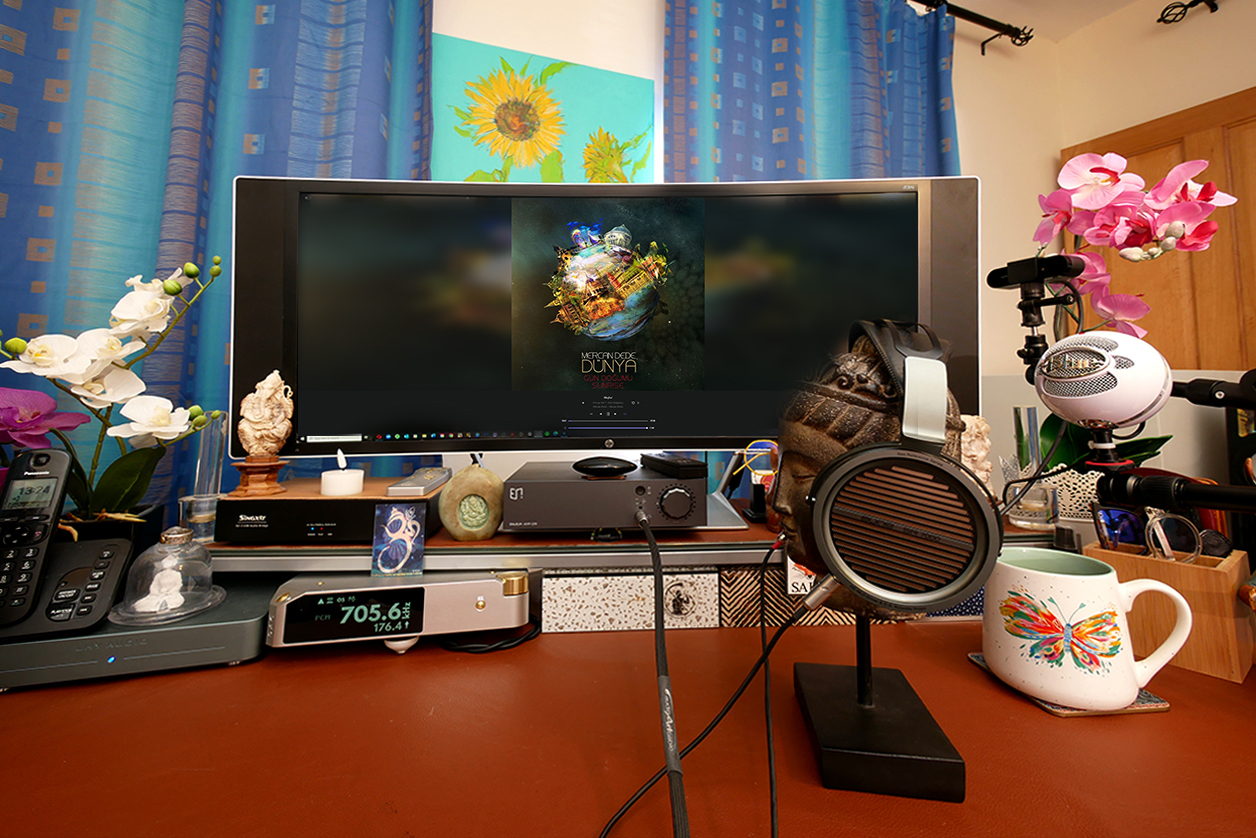 The headband extension atop the Budda head is the minimum of the very first click stop.
 Perhaps because these drivers angle severely to beam more directly into our ear canal and minimize entry reflections like speakers we toe in sharp to not see their sidewalls, the SR7000 images and times precisely. The first aspect means properly sorted soundstaging. The second creates well-focused snappy transients for percussive perspicacity which won't smear. That's particularly desirable on electronica whose very low synth beats aren't generated by resonant cavities like a double bass, piano, kettle drum or conga. Yet our aune isn't an open-baffle chamber-less Raal SR1a ribbon. Whilst its "absorbers" are clearly effective, we're still trapping air in a sealed chamber. This creates textures not as dry or explicit as open-backed ribbons. There's thus a residual element of attractive comfort sound on tap. I won't call it warmth when I conflate that with sloppy timing and a contoured frequency response; or thick 2nd-harmonic THD. I prefer residual comfort. An unavoidable side effect of trapping air around our ears whilst levelling up SPL is more ear-drum pressurization. Though the dragon scales do scatter and exhaust acoustic reflections and their droning, they aren't magical pressure eliminators. Loud playback still causes quicker ear fatigue than open headphones which don't trap pressure in the first place. On that score the dragon scales aren't miracle workers. Miracles and implausibilities are for the HBO TV series. Saying so just keeps us honest before we return to more listening enthusiasm.









Embedded in my loudness comment is the plausibility that you will play these louder. It's easy if a 'phone doesn't distort or brighten when prolonged high SPL raise voice-coil heat and with it, electrical resistance. That causes dynamic compression particularly in the lower freqs. Those can make the less demanding treble comparatively louder. Et voilà, a brighter nervier sound as loud sessions prolong. The main point of this brief detour was to extricate the SR7000's loudness potential built in by its lack of distortion from a long-throw robust driver. It will not only go 'permanently' loud on badly compressed fare but also 'briefly' when intermittent peaks and accents demand more output. And that means good dynamics which scale the macro range and flicker the micro domain. Dynamic potential and robust tone create image density without the blurry fatness of many planarmagnetics where window-shutter magnets across diaphragms cause deleterious bounce and turbulence. Whilst a planar's raw surface is bigger, its excursion potential is just the central stretch of the edge-clamped thin film. By contrast, a dynamic driver's suspension moves the entire diaphragm, ideally like a piston sans deformation. That gives the type greater air motion and from it, superior dynamic differentiation. The SR7000's driver seems to have been particularly groomed for this.
That chunky charged demeanour and tonal balance dominate over subjective resolution. Across the bandwidth, all details are present if we focus on the planktonic. But taken at ear value—easy listening without any mental grasping for particulars—this is no resolution-first tuning. What one hears first is a dynamically expressive tonally rich midrange bracketed by complete bass and treble on either side. To be speed first, we'd want less tone mass to emphasize leaner reflexes. That's not the SR7000. Neither is it super airy, glossy or ethereal. The solid anchor deep in the sub bass countermands such top-down aspects. It's back at a natural tuning without special effects. FX only enter because it's been accomplished with sealed loading. And they're not special effects but unusual means which avoid the 'special' effects of typical sealed headphone behaviour. Now we have the overall feel or personality of the SR7000 to set the stage for comparisons.

How the AR5000 compares sonically I cover in its own mini review. Here we see how it compares visually: same build, different colour scheme, different material mix for the pads, no hard case which here shows beneath the two aune, Meze 109 Pro in foreground.