For €639 incl. VAT in the EU through their German site, aune's SR7000 promo materials suggested serious engineering on offer. My ears couldn't wait to hear the results. It seemed that I wouldn't have to wait long. "Thanks for your time, this is Candy from aune. Yes, we really look forward to cooperate with you to review our SR7000 on your website. We will send you a sample maybe already this week if possible."
In this excellent YouTube video which their domestic competition really could—and ideally would— learn from, aune give us an overview of their company then the genesis of the AR5000. An intrinsic part of branding is story. The prospective buyer wants a very clear idea of a brand's ethos, what it stands for and how and why it does things. This requires that its story be (cough!) told. Sadly most companies are terrible at it. As such, their story becomes a composite of discontinuous facts and outright fiction as reviewers, clients and forum posters share partial insights mixed with plain assumptions. It's far more effective and factual whenever a company takes charge and tells its story in its own words. Having reviewed a plethora of Chinese products and owning more hifi from China than any other country, I must give a big shoutout to aune for the best such presentation I've yet seen. Bravo!
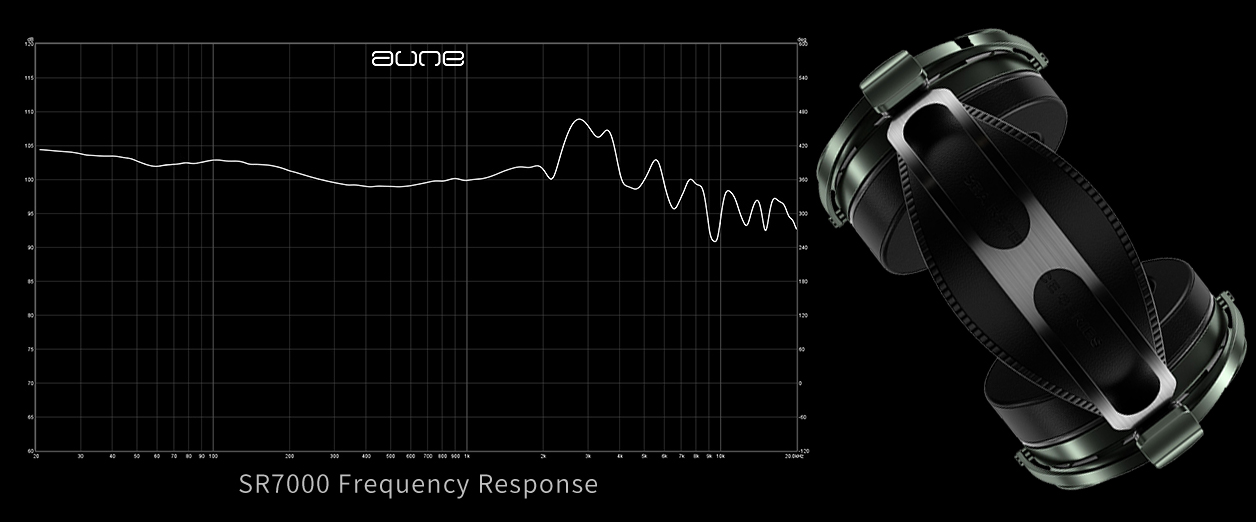
To understand the somewhat contentious subject of the ideal headphone target response—what it should look like on a graph relative to the ear's own nonlinear 'gain' to add up to a perceived 'linear' or 'flat' or 'preferred' response—Google for Harman curve. It explains why rather than being grossly distorted, the overall shape of aune's published response actually approximates it. Unless we're experts on the topic however, there's no way we could predict our subjective response from these gross 2kHz+ squiggles. Coming from speaker measurements, all we can relate to is what happens below 2kHz. Here that looks admirably even whilst exhibiting the gradual up-tilt in the bass exactly as a 'preferred' in-room speaker response would have it. Another aspect no pretty pictures can touch is comfort. Yet it's arguably the #1 concern with any headphone purchase. No matter how good a can may sound, look or measure, if it's uncomfortable, naught else matters. From their video we learnt that aune understand how vitally important this aspect is. How successfully their design's size, weight, geometry and adjustments adapt to our own noggin we can simply learn only by getting ears on. But it certainly helps if we have from five to ten review or owner comments to predict just how universal a given mechanical tuning might be. "Be thy wide" tends to be the first commandment for any respectable headband. That more evenly distributes weight and pressure. In this photo we already saw how the SR7000 conforms with that mandate. One exception to the general width rule are Audio-Technica's wings. Those don't touch the sensitive skull crown at all. To reduce weight we appreciate how aune took out big chunks from their curved metal bridge. We also saw how the asymmetrical ear pads create their own angle before the driver's own steeper rake adds itself to the strategic rotation.











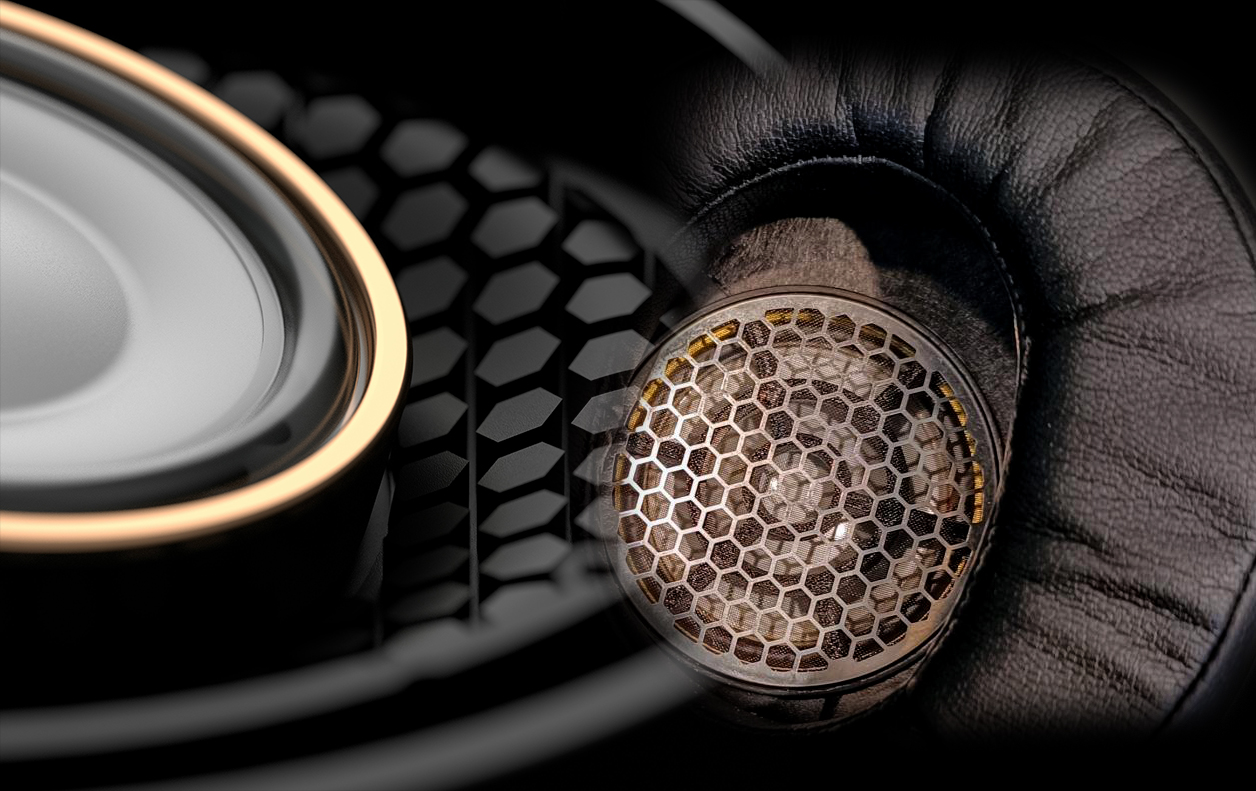
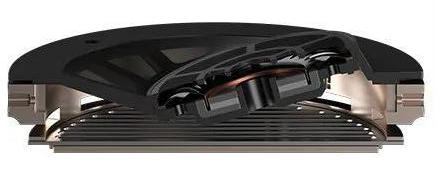
As expected, the drivers are protected behind a dual-concentric frame. The surrounding dragon scale hides behind a thin dust cover. The plush pads with the oval opening are nearly twice as wide on one long side than they are on the other. This maximizes the contact patch with the flat skull surface in front of and behind our pink bits. More contact equals wider distribution of clamping force for superior comfort. Ditto for cups that swivel and tilt for better conformity with our head shape. Of course most of that is Headphone 101. Executions simply vary wildly. That devil's in the details. Those are down to R&D, engineering prowess then proper vertical integration to get all the required parts to the required quality and tolerances whilst keeping a keen eye on the virtual bomb—the 'bill of materials bother'—to not price the end result beyond the means of one's target audience. On their transducer R&D curve, aune began with the in-ear Jasper before progressing to the circumaural AR5000, now the SR7000. That sequence from small IEM driver to freely vented big dynamic driver to fully sealed dynamic version suggests a strategically tiered escalation of engineering difficulty. So the SR7000 didn't just fall off the tree but benefits from significant prior in-house experience.
The SR7000's industrial design elevates rather more timeless elegance than bling. Only the lower writing on the earcup detracts from old-money understatement with big verbal bling of 'HD MLD Driver & D.S. Acoustic Prism'. Whilst common sense deciphers it as 'High Definition Multi-Layer Distributed Driver & Dragon Scale Acoustic Prism', why is this nouveau-riche mouthful there? Each owner will have thoroughly devoured the online descriptions to know all the published details. Now this excess signage mirrors driving a car whose model name continues 'with special combustion engine & proprietary tyres'. I'm overstating to make my point. Less is more. Brand name and model number would suffice perfectly.
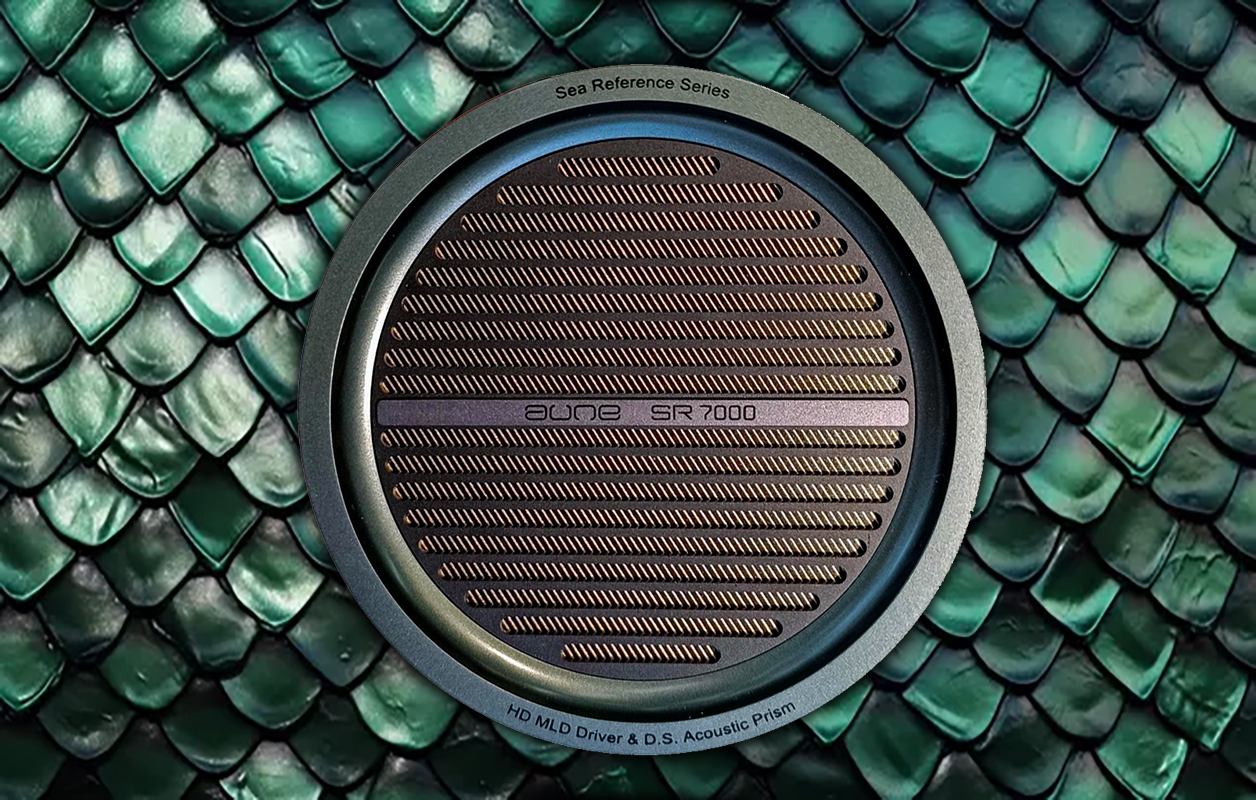
 At this juncture I was still hazy on the meaning of aune and how to pronounce it: awn, awn.eh, awn.ee, a.oon. a.oon.eh, a.oon.ee? So I asked Candy. "The aune logo is inspired by the Yin-Yang, our Chinese philosophy of balance. The rounded design of the letters conveys peace and gentleness; the openings on all four sides inclusiveness. And yes, you can pronounce it A.U.N.E. if you wish." This wasn't the same as actually learning how aune themselves pronounce their name. But without the benefit of hearing it spoken, a phonetic approximation from Chinese to English was perhaps asking too much? It shall remain a mystery then. Pronounce it as you will. With no clear explanation for Sea Reference and Air Reference in SR7000 and AR5000 respectively, let's presume that they refer to two of the classic five elements so air, water, fire, earth and ether/space. Today is on water; fitting for a man with six planets in Aquarius who lives in rain-heavy Ireland within sight of its biggest river, the Shannon whose lakes were home to the Oilliphéist dragon of medieval myths.
Here we look at what the driver would 'see' without the dragon scale geometric absorber; a solid plate from which rear radiation would reflect to make its way back through the driver. Any such leakage would obviously delay in time to cause smear and potential troughs and peaks of certain frequencies where in/out-of-phase elements interact.