Action! Be it Dutch&Dutch, Genelec, GGNTKT, Goldmund, Grimm, Kii or Sigberg, ambitious DSP-optimized active speakers have long since breached our sector's upper blockade. Just so, communal conditioning about separate electronics and passive speakers continues to counter bias many buyers who were reared on legacy high-end audio media. Now chat with speaker designers off the record. Without fail they'll admit that active drive and electronic crossovers have undeniable performance advantages. The problems are perception and related buyer preferences. For 'serious' apps, passive speakers preceded by a punter-picked gear mix remain the gold standard of desire. The one exception are computer/gaming speakers. The reasons are limited real estate and lower expectations. Few home offices have the room or desire for a classic hifi. If their owners want some sound—here most apply lower aural ambitions than for their main rig—suddenly fully active streaming speakers of compact dimensions are not only acceptable but the smartest buy. It's where we start today before scaling up ambitions, room size and listening distances to learn whether a <€1K pair of small active speakers can do more than communal conditioning expects.
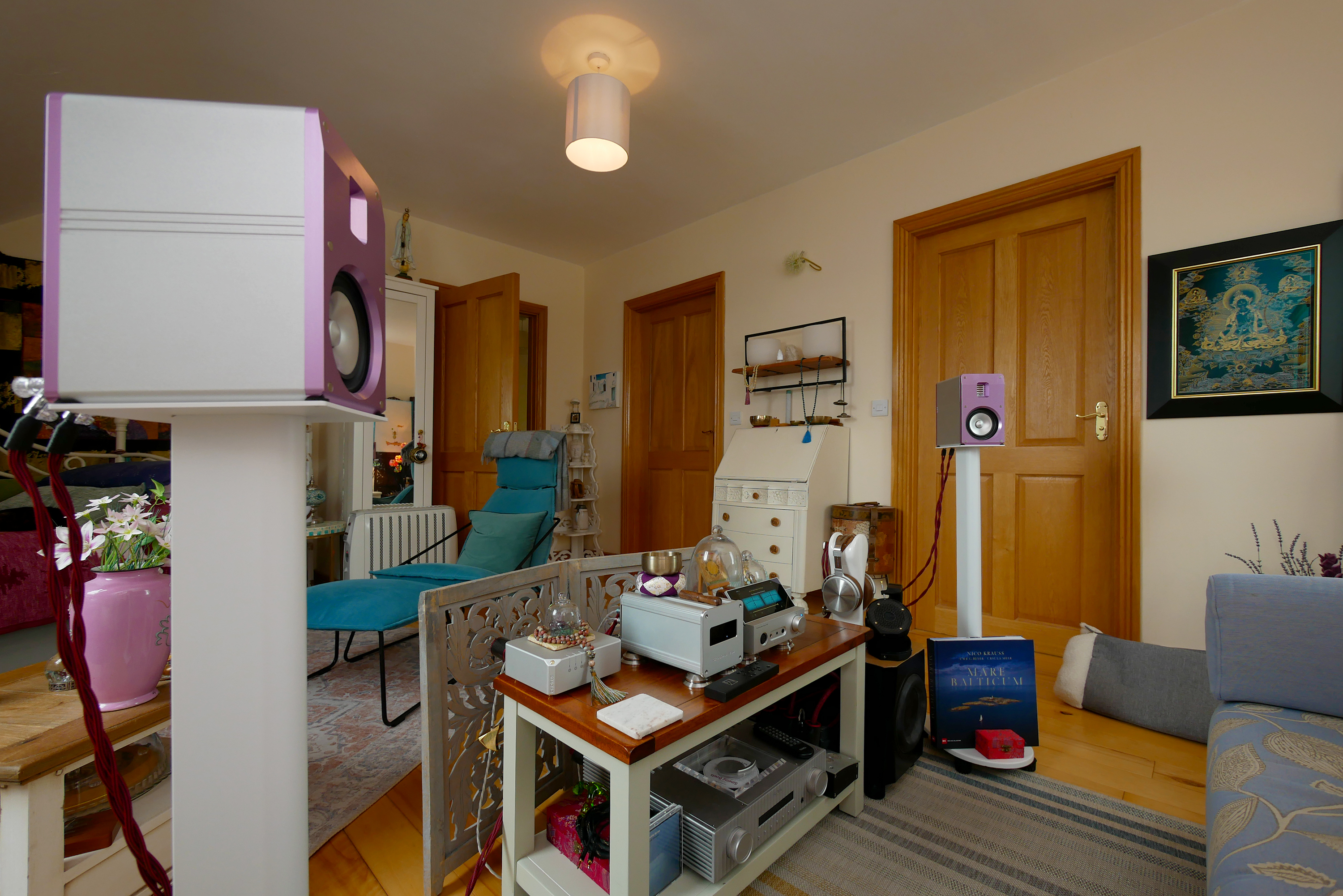
I'm well versed in making advanced sound with compact speakers now that four of my five active speaker systems are of the stereo 2.1 persuasion. What you just saw is my bonsai rig of isobaric 4" widebanders with 15kHz auxiliary AMT dovetailed via a 120Hz/4th-order active analog hi/lo-pass crossover with a dual 9½" active force-cancelling subwoofer. The tunes live on a 1TB microSD card inside a Shanling EM7 Music Centre. That connects fixed line-out to a Lifesaver Audio Gradient Box II xover with remote-controlled master volume. Its XLR hi-pass drives LAiV Chorus GaNFet monos, its RCA low-pass a Dynaudio 18S. Moving the aune here would bypass the monos; and possibly the sub in which case the variable XLR outputs of the Shanling would drive aune's actives.







When I cracked into my Wuhan carton then popped off the curved black grills, the white vinyl wrap on one speaker showed black contact lines from the cover's plastic frame. Even aggressive bathroom-cleaning chemicals didn't remove those marks. The 'b' in aune's benign budget couldn't net an 'a' for invisible magnet attachments. These grill posts sit in classic well-hated rubber grommets. Also, the green power indicators are quite large and bright but tone down behind the grills which given their fasteners, really look better on than off for a change. In the nude I'd have preferred less conspicuous mounts and LED particularly for non-office appearances. Since mine would use classic speaker stands, on the desktop I first parked the AS5 on tilt-back supports when many offices should want to do likewise. Below is that setup. Incidentally, the included generic power cords terminated UK style; the correct plugs for my Irish digs. Someone in aune's shipping department had paid close attention. Bravo!
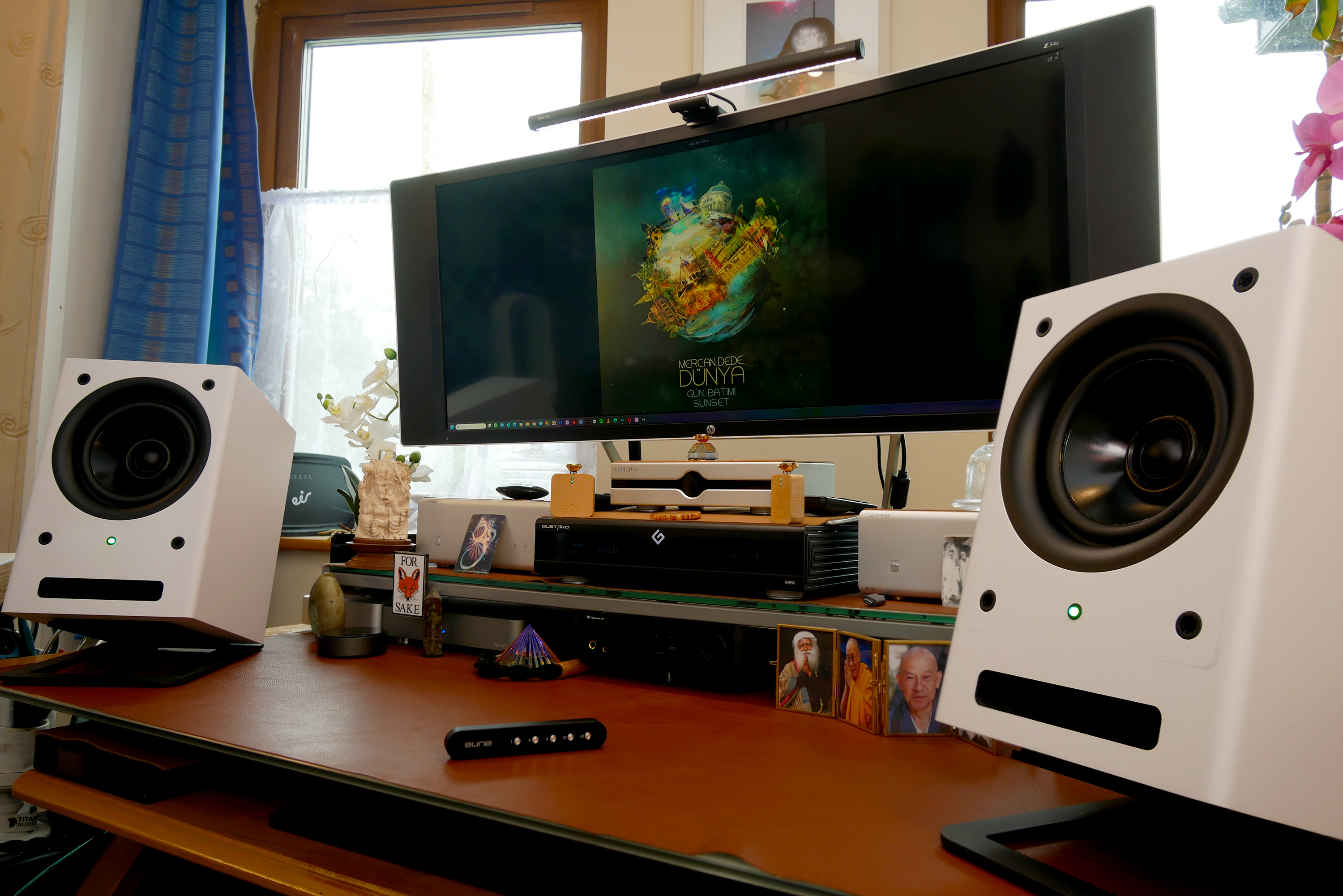 The power rockers sit on the rears which maintains a cleaner look but depending on install could involve a bit of fiddling particularly when the frontal ports encourage close-wall placement.
Despite my Gustard DAC's 5Vrms output voltage on XLR, standard nearfield SPL had me at far less attenuation than expected. The same proved out for the 4Vrms XLR of my COS D1 DAC in the neighbouring 2.1 video system. Civilized levels sat at 9/10th of its throttle. Off went an email to Shelly Chen to inquire about their voltage gain which in practice seemed rather low. That tends to be good for S/NR but can prematurely run out of juice. Whilst an active preamp could easily increase overall gain and with it achievable loudness, how many shoppers of this target audience will have one? As it happened, I had aune's own N7 head/preamp at hand whose €399 ask felt permissible in this context. So I added that to subsequent desktop rounds which also parked the AS5 on my office stands to show that option and with it generate a rather wider soundstage. "Input sensitivity is 1Vrms, voltage gain ~21dB." The unofficial standard for power amps is 26dB of gain whilst integrated amplifiers often operate at ~35dB. Coming off standard source voltages—2Vrms for RCA, 4Vrms for XLR—the AS5 could thus want an extra 10dB of gain by way of an active preamp or unusually hot source.