"Sonic spatiality and cerebral plasticity: reflections from research on the soundstage as a measurable phenomenon. Several years ago I took part in the analysis of an experimental study on auditory spatial localization in orchestra conductors, pianists and non-musicians. Based on recordings of event-related potentials (ERPs), the work addressed a very specific question: does long-term practice in orchestral conducting modify the cortical processing of spatial sound? The experimental design constructed a two-dimensional sound field using six loudspeakers distributed along a frontal and lateral arc. Subjects were required to detect 'deviant' stimuli presented at specific spatial locations while ignoring the remaining stimuli. Reaction times, hit rates and false alarms were recorded together with cerebral electrical activity. The results revealed clear differences between groups particularly in the processing of peripheral spatial information. All three groups showed good frontal discrimination. However, in the periphery significant differences emerged: conductors exhibited fewer false alarms and a finer attentional gradient. In the ERP recordings, conductors displayed a posterior positivity (P3) of greater amplitude for attended stimuli together with a differential pattern for unattended stimuli, suggesting more efficient spatial processing. Most relevant was not only the difference between musicians and non-musicians but also between musical specializations. Functional specialization appears to leave a measurable trace in cortical processing.
 "In this context neuronal plasticity is not an abstract concept. Sustained training in a complex auditory task like orchestral conducting appears associated with a functional reorganization that enhances spatial discrimination. The soundstage is an active construction of the brain: source segregation, temporal integration and selective attention operate in a coordinated manner. A perturbation in one element alters the perception of the entire ensemble. In high-fidelity reproduction we speak of imaging, depth and focus. If we accept that spatial discrimination is an experience-dependent trainable process, preserving spatial coherence in reproduction is no mere aesthetic concern. Whilst it does not equate to professional training, a precise stable soundstage demands richer perceptual processing than a flat collapsed reproduction. In professional practice it is common to observe that closing one's eyes facilitates the detection of sonic irregularities. Attention is a limited resource and visual dominance can interfere with the full exploitation of the auditory channel. Prolonged experience and sustained attention appear to shape the functional organization of the auditory system. The soundstage is neither a subjective luxury nor a purely aesthetic attribute associated with the audiophile world. It is structural information contained in the recording: spatial, temporal and dynamic relationships that the brain must actively organize to construct a coherent representation. If we accept that auditory perception is a reconstructive process rather than simple passive reception, spatial fidelity acquires a different dimension. It is not merely about 'greater depth' or 'better imaging' but about preserving the conditions that allow the nervous system to operate with the highest possible coherence.
"A system capable of maintaining image stability, temporal precision and consistent spatial relationships is facilitating a task for which the brain is evolutionarily prepared: the analysis of complex acoustic environments. Reducing this complexity by collapsing the soundstage or degrading its coherence not only impoverishes the aesthetic experience but simplifies the perceptual challenge. Those of us who design high-fidelity systems are inevitably constrained by the recordings we must reproduce. We work with material we do not control. However, this limitation does not diminish our responsibility. On the contrary, it obliges us to do everything possible to preserve spatial architecture, temporal coherence and structural integrity of the signal with the ultimate goal of elevating the listening experience to the highest level allowed by available technology and knowledge. Because, ultimately, designing high fidelity is not merely about reproducing sound. It is about respecting the complexity of the auditory phenomenon and offering the listener the most favourable conditions for the brain itself to complete the experience."












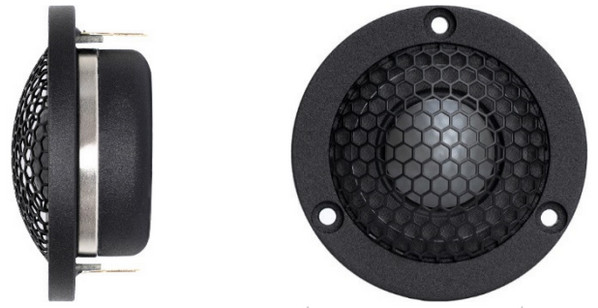
 From Josep's explanations I still didn't grasp how ultrasonic radiation from Pandora's piezo tweeter operating beyond human hearing broadens the dispersion of the standard tweeter whose horn-widened radiation it mixes with. I also didn't correlate specific design choices with his aim of "preserving spatial architecture, temporal coherence and structural integrity". I understood what he is trying to achieve. I just didn't yet see how this speaker goes about it. Does temporal coherence simply imply 1st-order filters? Do ultrasonic emissions provide our brain with cues to reconstruct three-dimensional space? "I fully understand your point. The question is not what Pandora aims to achieve but which specific design decisions force it to behave accordingly. Pandora is not built around a single ideological priority such as perfectly flat amplitude response, strict minimum phase or constant directivity. It is built around energy control in both the amplitude and time domains and how the human auditory system reconstructs spatial information from direct and diffuse sound fields. The mid/woofer operates with a 12dB/octave slope, the Bliesma T25A uses 18dB/octave. This asymmetry is intentional. The 12dB low pass limits upper-band intermodulation while preserving natural decay behaviour. The 18dB high pass reduces excursion and distortion below the crossover region to improve transient clarity. A parallel notch filter suppresses woofer breakup energy, reducing stored energy and ringing. The baffle-step compensation is treated explicitly, maintaining tonal balance in real rooms without disturbing crossover phase behaviour. The objective is not theoretical symmetry but controlled energy release and reduced temporal smearing.
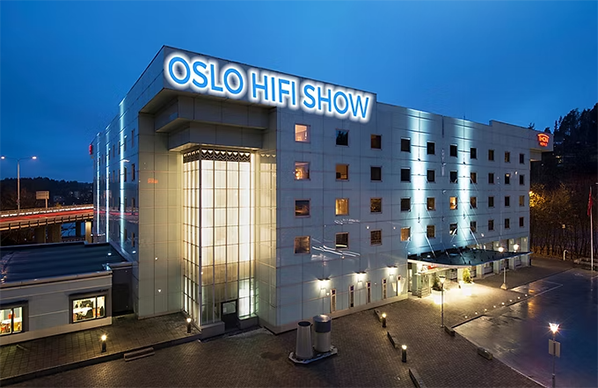
"The T25A mounts 25mm behind the front baffle plane. This introduces a small acoustic delay which compensates for relative acoustic centres and phase rotation from asymmetric slopes. Pandora does not pursue geometric time coincidence. It pursues effective acoustic alignment in the perceptually critical band of ~1–4kHz. Curved side walls reduce parallel internal surfaces, lower standing waves and stored energy. Externally the absence of sharp lateral edges reduces diffraction discontinuities in the mid and high frequencies. The rectangular reflex port (2×10cm, 9.5cm depth) was chosen for controlled airflow and reduced peak velocity, minimizing compression and turbulence. The Taket super tweeter operates without an electrical filter. Its mechanical behaviour and natural impedance limit its effective contribution. It's not intended to extend audible bandwidth in the conventional sense. The brain reconstructs spatial perception by integrating direct sound, early reflections and late diffuse field. The piezo's extremely low energy storage modifies the structure of the diffuse field by introducing extremely light wide-dispersion energy. It's not about hearing 30, 40 or 100kHz. It's about modifying the relationship between direct and reflected high-frequency energy. Perceptual coherence depends on the critical band where localization and timbral identity are formed. The super tweeter isn't designed to sum as a classical crossover partner but to function as an independent spatial contributor. Externally Pandora may appear as a conventional bass-reflex loudspeaker. Internally it's an exercise in energy control and spatial field shaping." When I was given the option between a brand-new and show pair, I opted for the demonstrators used at the March 21-22 Hifi Show Oslo. They would arrive fully pre-conditioned and were planned to ship straight from the hotel. But then, "the Oslo event exceeded our expectations and this success led to several appointments with prospective buyers to keep this pair in the city for about an extra 1½ weeks. Originally we wanted to ship it to you directly but given the subsequent private auditions, Josep prefers to get it back to Barcelona to personally confirm that everything is perfect prior to shipping it to you. This means the shipment will be about 2-3 weeks later than first planned. I will keep you informed throughout the process."
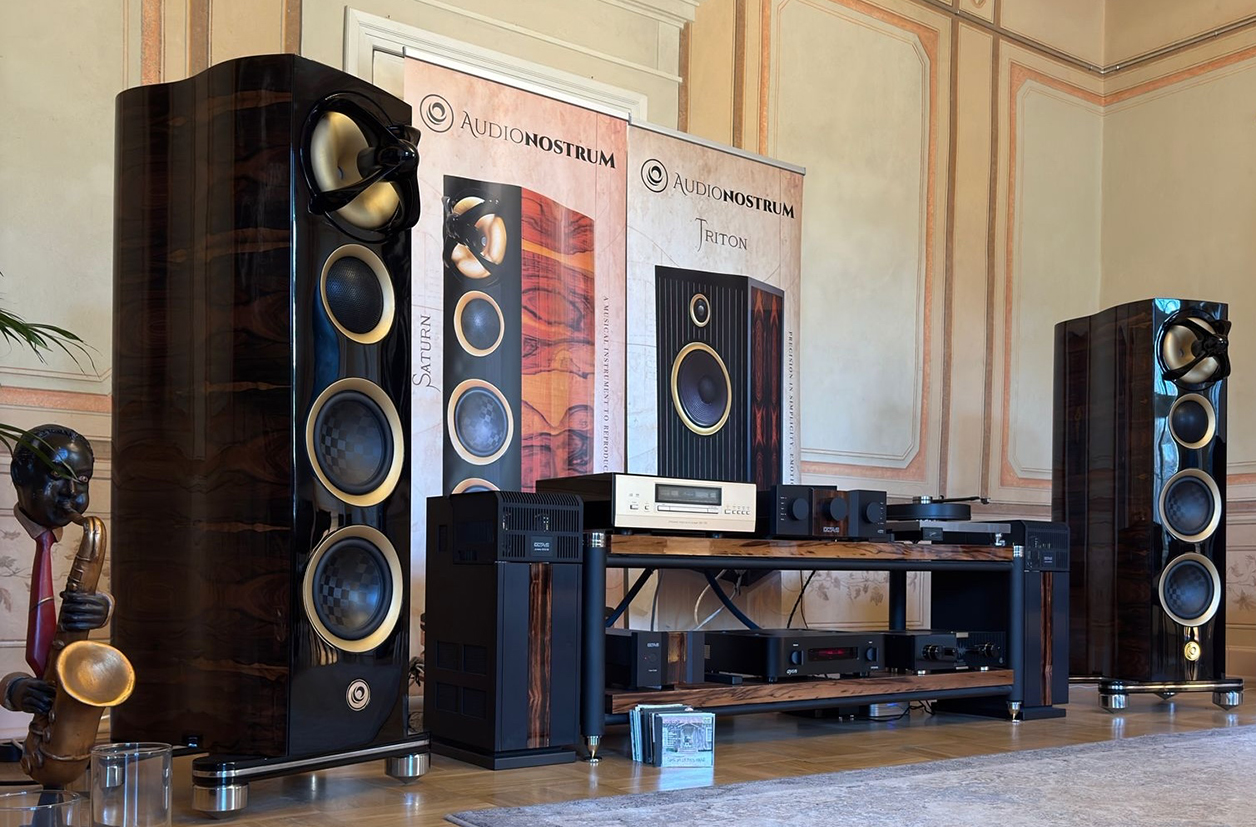
From HifiPig's show report, "well, I managed until 14:30 on Saturday before I ran into what is fast becoming the new 'Audiophile Show Demonstrator Cliché Track': Big Bad John, courtesy of Sentrum Audio. There was a lot of unfamiliar kit in this room but at least some familiar tracks were getting played, as they followed up with Tin Pan Alley. Noughts and ones were being handled by the Denafrips Arcas and Pontus 15th and amplification was the Kora TB140 integrated. The Audio Nostrum Saturn Pandora is a very striking-looking speaker—and with a name like that, one feels it has to present with some bold character. The sound they produce is also pretty striking; there's something very visceral and tangible about the way they make the music sound in the room. They also image very well indeed; you really lose track of where the speakers themselves are if you shut your eyes, which is always a good sign." I rather doubt that this writer was familiar with the ODS concept. That in a small hotel room the speaker for him performed specifically as Josep's design brief promises without knowing anything about it was an excellent sign indeed. Meanwhile the above system Poland's Nautilus distributor set up for a weekend at Warsaw's 18th-century Baroque Pałac Przebendowskich played on the other side of that fence. It saw one of Josep's bigger guns team up with Accuphase, Crystal Cable and Octave Audio. Whilst for many readers Audionostrum will still be a newer brand they've heard and seen less of, being featured in a bonafide big-boy system suggests that they've arrived already. They look and must sound the part to be considered a member of the genuine high-end club which routinely champions Magico, Rockport, Stenheim, Wilson and YG. In that company of aluminium, carbon-fibre and phenolic resin cabinets, Josep's builds follow a different path. If Spain was still off your map for the very high end, Wadax of Madrid might just make the best digital source there is. For top Spanish speakers I already mentioned Audionostrum, Kroma Atelier and Lorenzo Audio Labs. I've also reviewed models from bonySound of Malpartida de Plasencia and Sottovoce of Valencia. The latter city also hosts Alsyvox and Beyma.