"Our ODS could theoretically work with any square, rectangular or multi-faceted horn but when double-tasking as reflector for a rear-aimed super tweeter, a round horn's lesser directionality is obviously best. Its diameter is the usual function of its loaded driver's bandwidth. Its geometry or flare rate aka T-factor had to pick from three basic shapes. A hyperbolic shape with a T-factor of 0 would have a long throat with moderate expansion. An exponential horn with a T-factor of 1 has similar expansion but a shorter throat. The hyper-exponential shape we use has a T-factor of 2. Around their central emission axis, both ODS drivers exhibit low directivity. A hyper-exponential geometry too is less directional with respect to the emission axis. That distributes HF sound pressures more effectively and allows for greater off-axis listening to prevent the loss of subtle treble detail. The shorter horn throat positions the super tweeter at the correct distance relative to the crossover frequency, that is at an even multiple of its wavelength. We use a multiple of 8. At 7'500Hz or 4.58cm, the distance between driver diaphragms becomes 36.69cm (4.58 x 8). This has both drivers in phase for maximally summed output. By now inverting super-tweeter phase, we achieve the most effective cancellation at the crossover point for a linear smooth transition between both drivers. This 3dB/octave cancellation adds itself to the 6dB/octave filter roll-of on both drivers. The result is a 9dB/octave filter function with just a high-pass cap on the super tweeter and a low-pass inductor on the standard tweeter. Typically the chief disadvantage of a highly exponential horn is its low acoustic gain. For us that becomes an advantage since our two ODS drivers exhibit from 108-112dB sensitivity whilst the mid/woofer below 500Hz only reaches 94-96dB to enforce the usual tweeter padding resistors. Now their values can be lower."
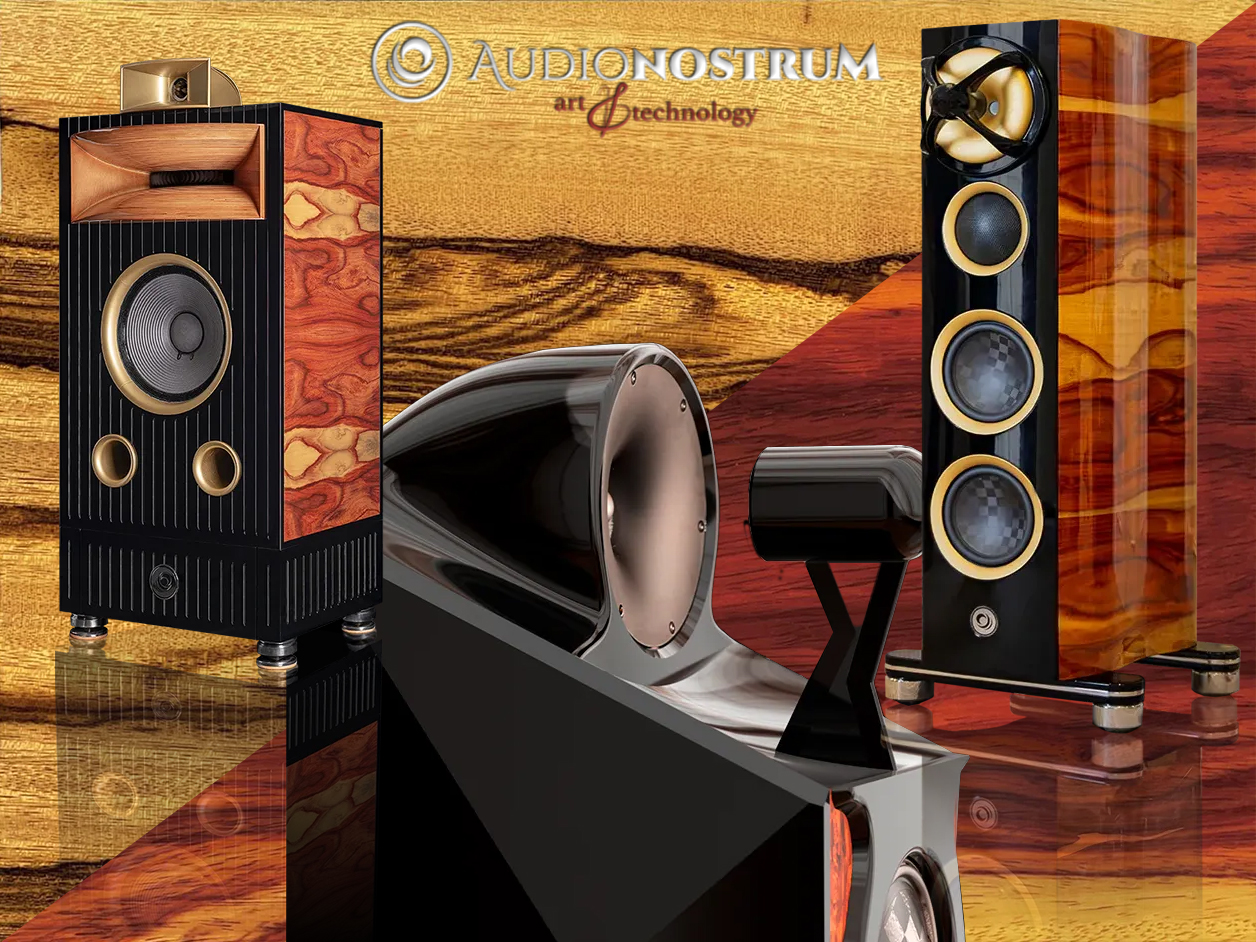 A love of vivid Padouk Bariole veneers and clear attention paid to floor decouplers.
 From this explanation we understand that the super tweeter's reflected radiation counteracts usual HF beaming for a broader off-axis treble response. This led to my next questions for Josep.
• What core insights from neuroscience reflect in your speaker designs to distinguish them from the competition?
• Wouldn't the ODS system also work with two conventional tweeters when many will cite human hearing's 20kHz cut-off as rendering 100kHz response superfluous? Against the usual opinions, what is your rationale for a super tweeter?
• We also gleaned from the above paragraph that you pursue high sensitivity. What are the reasons for that other than broader amplifier compatibility and greater dynamic contrast?
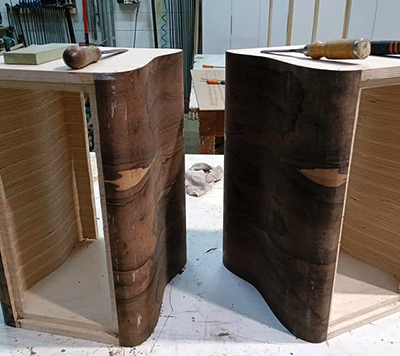
About the orange flames in the particular Pandora pair's veneer below, "those are natural features of the Ziricote wood. Its striking grain patterns enhanced by the finish can create areas that appear lighter, darker or even show warm orange-like tones. Each speaker is unique so these patterns vary naturally and are part of Pandora's character."
At left we see these still raw cabs without finish lacquer clearly showing stacked Ply construction to achieve the wavy sides and flowing transitions into the front and rear baffles still to be set in. Folks with long memories recall that Alon Wolf's very first Magico monitor also championed this approach. Likewise for some TAD reference speakers. Both brands subsequently abandoned sliver-stack builds because their layering proved too difficult to finish without eventually showing through surface treatments.
My dual 15-inch sound|kaos RiPol sub too exploits stacked Ply construction for the extra strength it applies to the build. It's a proven but labour-intense approach well beyond the usual flat-panel jobs.
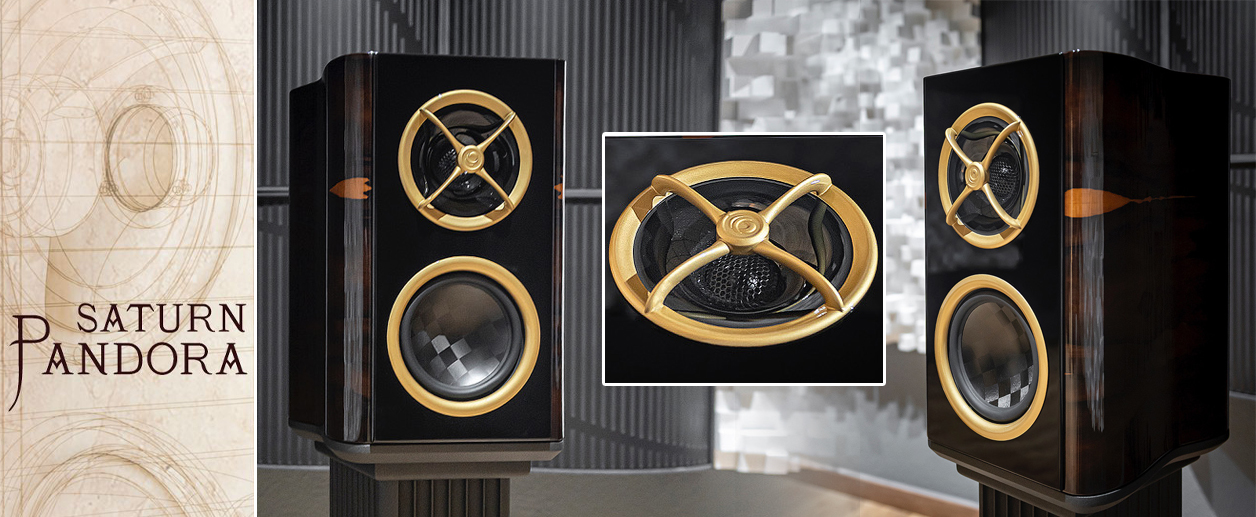










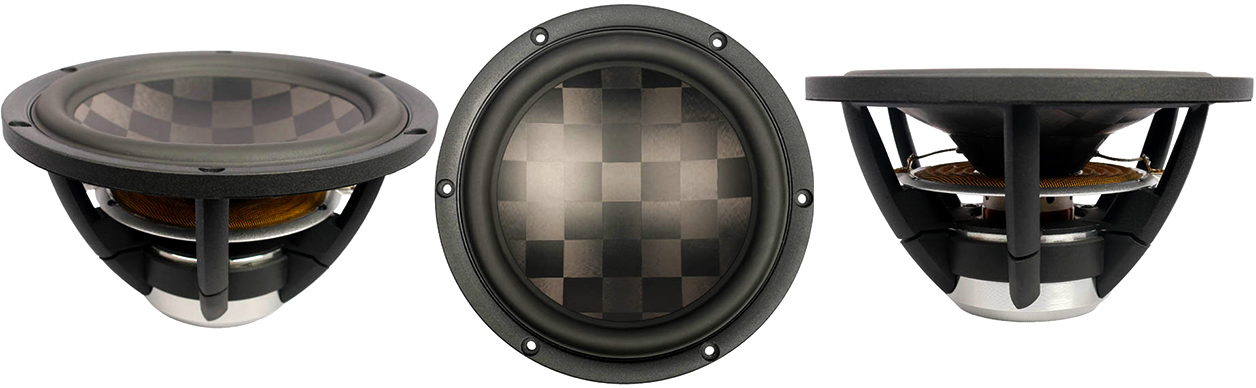
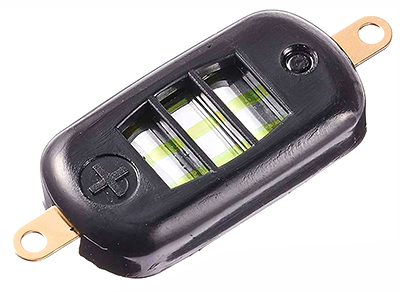 From Josep. "Pandora: spatial precision in compact form. Pandora is a high-performance compact monitor specifically conceived for rooms between 12-25m². Its development is based on a clear premise—to maintain image stability, tonal coherence and genuine depth in environments where early reflections and wall proximity influence spatial perception strongly. Rather than attempt to replicate large-system scale, Pandora focuses on preserving structural spatial integrity within realistic domestic conditions. The system employs the SB Acoustics Satori TXtreme 7.5" woofer selected for its low distortion in the mid-bass region and its linear behaviour under load in compact enclosures. Its integration with the Bliesma T25 aluminium-magnesium dome tweeter allows for a clean controlled transition through the critical presence region, maintaining off-axis coherence—an essential factor in small listening spaces. The enclosure features curved side panels to reduce diffraction and promote more uniform dispersion. Each pair is finished in individually selected natural wood veneer chosen and composed with aesthetic and structural intention. The rear bass-reflex port has been optimized to provide low-frequency extension without exaggerating energy in modal regions, a crucial aspect in rooms of limited dimensions where excessive low-frequency output can compromise image stability. Pandora incorporates a variant of our ODS system with a Taket Batpure super tweeter facing the Bliesma T25.
"Unlike other models in the range where crossover points between 7kHz and 10kHz place the super tweeter well within the audible band, Pandora's ODS operates in the uppermost region of the spectrum. Its purpose is not to introduce directly perceivable ultrasonic content but to subtly influence radiation behaviour at the highest frequencies, improve angular dispersion and enhance the reproduction of spatial micro information. In a compact monitor where listening distance is shorter and spatial cues are more immediate, this refinement contributes to a more stable, open and coherent soundstage without altering tonal balance. In compact form, the goal remains the same as for our larger systems: to respect the complexity of the recorded acoustic architecture and to provide the listener with the most coherent conditions for perception. Pandora is not about scale. It is about control, precision and spatial intelligence in environments where those qualities matter most."