
Country of Origin

Reviewer: Srajan Ebaen
Financial interests: click here
 Main system: Sources: Retina 5K 27" iMac (i5, 256GB SSD, 40GB RAM, Tahoe 26), 4TB external SSD with Thunderbolt 3, Audirvana Studio, Qobuz Sublime, Gustard U26 USB bridge, LHY Audio SW-8 & SW-6 switch, Sonnet Pasithea; Preamp: Hattor Audio ARP-S; Active filter: spl Audio Crossover MkII; Power amplifiers: Vinshine/Kinki Dazzle & Audiophonics NCx500 on subwoofer; Loudspeakers: Qualio IQ [on loan]; Subwoofer: sound|kaos D15; Cables: Exact Express Flame, Furutech; Power delivery: 2 x Kinki/Vinshine Tai Hang on amps and source stack, Furutech DPS-4.1 between wall and conditioners; Equipment rack: Artesanía Audio Exoteryc double-wide 3-tier with optional glass shelves, Exoteryc amp stands; Sundry accessories: Acoustic System resonators, AudioQuest FogLifters; Room: 6 x 8m with open door behind listening seat; Room treatment: 2 x PSI Audio AVAA C214 active bass traps
1st upstairs speaker system: Source: Shanling EM7 into Soundaware D300Ref SD transport to Cen.Grand DSDAC 1.0 Deluxe with POW; Preamp/filter: Lifesaver Audio iCon 4SE & Gradient Box 2; Amplifier: Kinki Studio EX-B7 monos; Loudspeakers: sound|kaos Vox3awf; Subwoofer: sound|kaos D12 on twin Nord Acoustic NC500 monos; Cable loom: Exact Express Earth; Power delivery: Vibex Granada/Alhambra, Akiko Audio Corelli Corundum & Castello Solo; Equipment rack: Hifistay Mythology Transform X-Frame [on extended loan]; Sundry accessories: Furutech cable lifts, Furutech NFC Clear Lines; Room: ~3.5 x 8m
1st upstairs headfi system: DAC: Cen.Grand DSDAC 1.0 Deluxe with POW; Headamp: Cen.Grand Silver Fox; Headphones: Raal 1995 Magna, HifiMan Susvara
Desktop system: Source: HP Z2 workstation Win11/64; USB isolator: LHY UIP; LAN distributors: LHY AS6 Pro & SW6-SFP; Ethernet reclocker: Stack SmoothLAN; DACs: Gustard R26II & Audalytic DR70; Preamp: Topping A900; Speaker amps: Topping B200 monos; Headphone amp: Enleum AMP-23R; Loudspeakers: Virtual Hifi Viper; Headphones: Final D-8000, aune SR7000, FiiO FT7, HifiMan Susvara Unveiled
2nd upstairs headfi system: Shanling EM5; Headphones: Meze 109 Pro, Fiio FT3, HifiMan HE1000 Unveiled
2nd upstairs speaker system: Source: smsl PL200T CD transport; DAC: Shanling EM7 w. 1TB microSD; Crossover: Lifesaver Audio Gradient Box II; Amplifiers: LAIV Crescendo Chorus monos; Loudspeakers: MonAcoustic SuperMon Mini with Dynaudio S18 subwoofer
2-channel video system: Source: Oppo BDP-105; All-in-One: Gold Note IS-1000 Deluxe; Loudspeakers: ModalAkustik MusikBoxx; Subwoofer: 2 x Zu Method; Power delivery: Furutech eTP-8, Room: ~6x4m
Review component retail: €16'890/pr
 |
 |
 |
 |
 |
 |
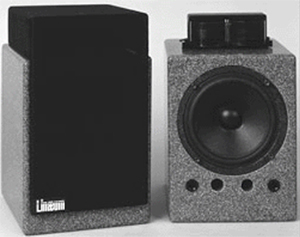 Linæum mausolæum? North Americans with memories good to 1983 may remember Paul Paddock and Ben Stutz's unique bending-wave driver which later commercialized with Linæum of Oregon. Mohawkish like the omni CDT on Anthony Gallo's first sphere, the affordable Linæum LFX at right flew the signature twin-cylinder plastic foils on its head. Before this tech licensed to RadioShack, Linæum had scaled it to a midrange driver for broader bandwidth. Doubled up, that bigger driver debuted in their Model 3 floorstander. The store I worked in had a pair. As happened to Oscar Heil's air-motion transformer when patents expired, once RadioShack expired, Linæum's driver tech was suddenly free for all. With their Airfoil 5.2 project, Impact Loudspeakers promised a 2nd Coming which expired in the early 2000s. Ditto the planned Frescobaldi line-source concept by Aero Loudspeakers which had sought investors. Clearly not fated to vanish, Linæum's clever driver idea then crossed the Atlantic. In France it was reborn and developed farther by François Deminière in his Janus 50.
This subsequently 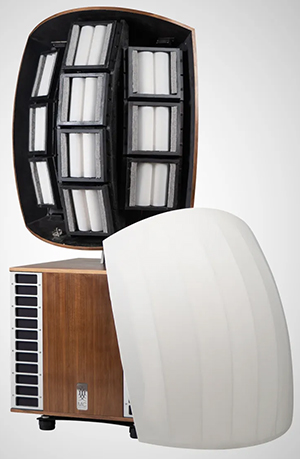 sired a commercial offspring in Serge Schmidlin's Rubanoïde under the Swiss Audio Consulting banner. But it also lit a flame with another French firm, AudioNec of Sainte-Mesmes. It possibly even inspired Zoltán Bay's omni tweeter at Bayz Audio. In the words of inventor Paul Paddock, "it is a class of devices called 'traveling wave' drivers. With a linear voice coil along one edge of the diaphragm, you basically set up a shock wave which ripples through the membrane. Unlike with a traditional driver, you want this device to break up immediately but in controlled fashion. There is no pistonic motion but a wave which moves smoothly and dissipates as it moves around."
Other bending-wave drivers of very different makeup can still be found with Ohm Walsh and their descendants at German Physic; and Manger. The early Göbel version has since been abandoned. The most visible European champions of a Linæum-inspired widebander must be the French team around Hervé Brasbin and Francis Chaillet. Back in the American colonies meanwhile, in 2018 Mark Conti teamed up with Paul Paddock for a second go after Impact Tech. This netted MC Audiotech and leverages Paul's latest iteration of his floppy driver. It's called the wideband line source because he multi-parallels them as shown.
"I continued to develop and improve the concept, resulting in the WBLS transducer which exhibits greatly enhanced bandwidth, sensitivity and reliability. Its flexible plastic membranes are about paper thick. The wire loop bonded to the central area interacts with the magnets and drives the central area forward. The physical action sets up wave motions in the membranes which radiate through the plastic expending their energy as sound. Curvature, size and physical qualities of the plastic membranes define the transducer's predictability. In practice, its operational width changes with frequency. It becomes larger with decreasing frequency, narrower with ascending frequency. This is shown by its extremely even broad polar pattern, smooth response and non-reactive impedance curve."
Fast forward from AudioNec's 2010 founding to early October 2026. Reader Robert emails me. "I very much enjoyed your latest musings about the similar effects that dipole freedom from box loading has with single driver freedom from crossovers. On that subject, are you familiar with the AudioNec OBi Mini? It is a short open-baffle 3-way with a 400Hz-10kHz Duopole driver, a 12" woofer and a super tweeter in a short horn. That could be an opportunity to test your hypothesis and hear a combination of no central crossover plus no box? It's very small for a dipole with 30Hz reach and could suit your current focus? I would love your take on it if you get the chance."
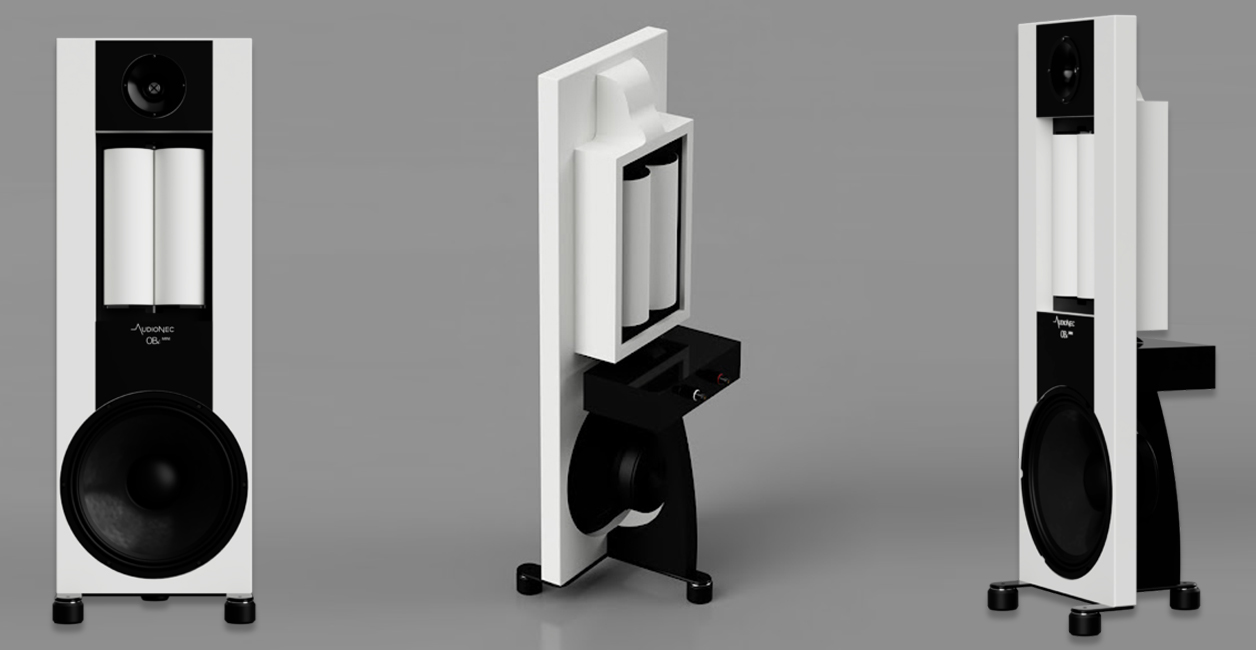
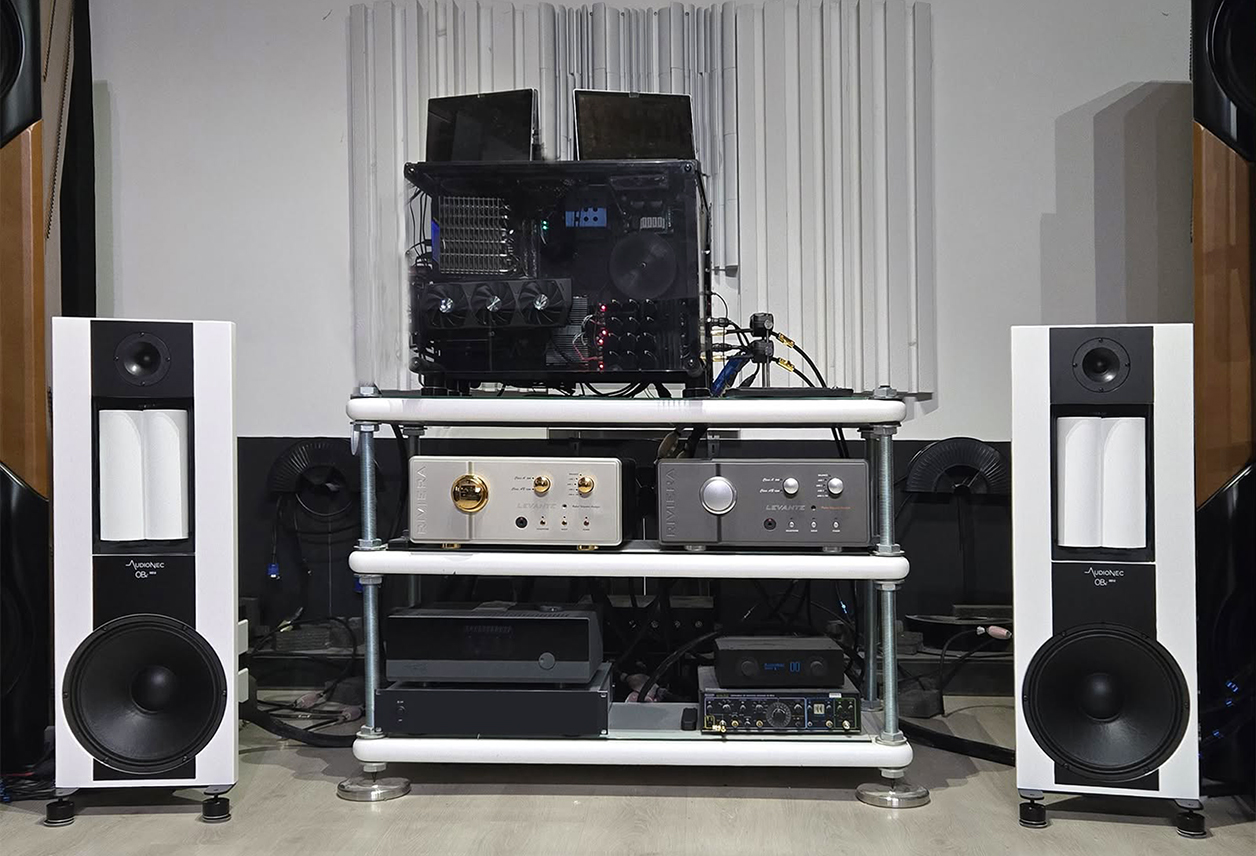
I had been aware of AudioNec but slept on their newer open-baffle range. Robert's note was timely. My main speakers are hybrid dipoles. I'd just written up Virtual's Supernova open baffle and Daudio's compact M1. Lined up for later in the year were Matter Audio's dynamic open-baffle Axiom; and a new dipole by Poland's Verseo. When I couldn't find proper reviews on the French Mini, I spotted a potential opportunity. Inquiry. Off. Adjacent to the two-tier rack below, we appreciate how 90cm height is stumpy for a passive full-range open baffle. The 35x31cm WxD footprint isn't severe either; nor is the 23kg weight.







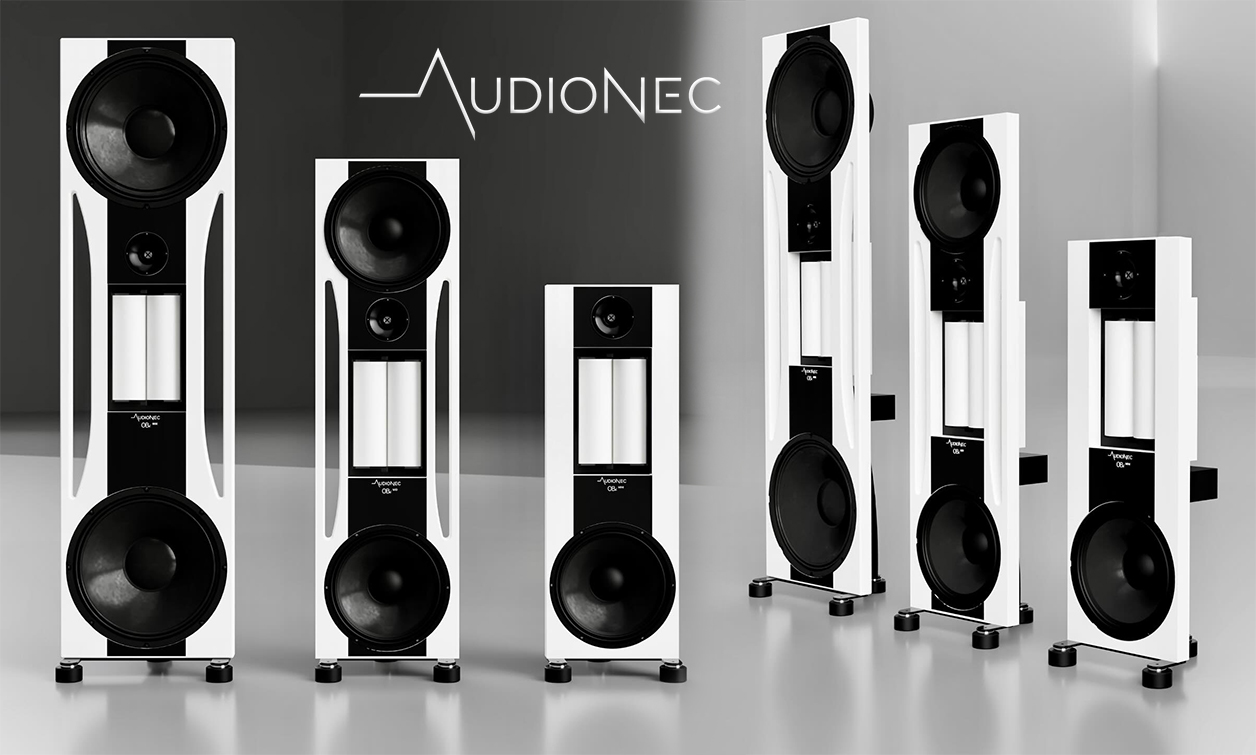
Unlike ported woofers' 24dB/oct. acoustic roll-of below resonance and the 12dB function of their sealed brethren, dipole woofers fade more gradually at 6dB. Entering at 400Hz, AudioNec's 12-incher must span four octaves before hitting 25Hz. Common sense expects that for linear sub bass, we might either want a counter-goosing digital slope as I could easily write in Audirvana Studio; or a dedicated sub for some bottom-end fill. After all, dynamic open-baffle competitors aiming for linear 30Hz apply twin 15-18" weaponry. Dual 15ers are also what the French dipole line's Max of the opening collage brings to bear. AudioNec's flagship Diva XL then forgoes dipole LF in favour of dual sealed 15-inchers. Physics. She be a cruel mistress. With 2×15" and 2×12" RiPol subs in my house plus active outboard analog crossovers for seamless integration, I could augment should need or desire arise.
In a recent review I wrote that "even a beginner's hifi won't mistake a violin for a cello. All basics are recognizable even if more sketchy than fully formed. The pursuit of better gear tends to fill out these first sketches. Bare outlines acquire colour hues and textures even if much restricts to two dimensions. Later the emptiness between shapes better separates them. Then this seeming emptiness begins to exhibit planktonic content of its own. Space becomes audible in performer halos and recorded reflections. We gain a clearer impression of the depth domain. We polish up dimensionally sorted soundstaging. Our eyes applaud. Hifi lingo for these aspects uses visual terms like focus, contrast ratio, imaging, location specificity, structural mapping, depth of field. Yet even at this more advanced stage we needn't have mastered yet the energetic realm. It's where playback expresses a higher electrical charge from superior timing. Now direct-coupled unfiltered widebanders can be advantageous. So can dipoles without time-smeared thru-cone reflections. Our audiophile vacation has many scenic attractions and rest stops. It's in the region of immediacy or energy transmission that many systems still hang." It's precisely why AudioNec's open-backed widebander for unfiltered dipole action had my attention. It eliminates time confusion two ways: no crossover anywhere between 1-6kHz; no cavity resonances or bleed of internal reflections. AudioNec just had to be game. But just to satisfy the curiosity of one man, why should they—really? Fingers crossed. Let's throw in some toes, too. Whilst I await the cramps, a quick parallel to Oscar Heil's air-motion transformer. Like Linæum's foil driver, it started as tweeter. Just as Shanghai's Mark & Daniel have consecutively lowered their top AMT's bandwidth to presently 200Hz far beyond classic tweeter scope, so has today's floppy twin cylinder. And yet, both types still need add-on woofers though for headfi, HEDD of Berlin have a wideband AMT which stands on its own like Raal 1995 have full-bandwidth ribbons. AudioNec's Duopole also requires just a little assist in the top octave by way of a dedicated 'super' tweeter whilst for their 51cm tall Duopole, the lower bandwidth drops to 200Hz thus gains an extra octave. In the OBi Mini, 400-10'000Hz bandwidth is amazing breadth for one driver whose dipole propagation neatly mirrors in the open-backed woofer. Only the >10kHz tweeter works as monopole.
… to be continued; maybe…

AudioNec's webpage
