My current LampizatOr Pacific DAC had to face opposition roughly €10'000 ahead but at this level the price difference didn't mean much. As a fully balanced circuit the Audio Phonique would ideally connect to my Trilogy 915R preamp's XLR input but I didn't do so right off. I first wanted to hear how the two DACs performed when matched as evenly as possible. So each powered with a captive M2 cord off Boenicke Audio's Power Gate then connected to my reference pre via its RCA inputs. There was no need for volume matching. After each DAC change I only had to reconnect one USB cable; no issue when the Innous Statement server/streamer recognized both instantly. Now let's briefly recap why I purchased the Pacific in the first place. I've been vocal about its profile being built upon speed, openness, accuracy, immediacy and images projected close and personal for spatial envelopment that's quite mental at times. That engaging presentation puts me virtually on stage with the musicians, an effect my sound|kaos Vox 3afw monitors elevate still further. To my ears the Pacific stands second to none on the listed qualities. Prior to its arrival several years ago, I'd already considered its Golden Gate predecessor as very snappy, agile, open and tailored for speed. It wasn't. Their confrontation day stigmatized the latter as lazier on bass, spatially withdrawn and nowhere near as clear, controlled or direct. Against the Pacific its was polite and hooded in ways that no longer sat with me.
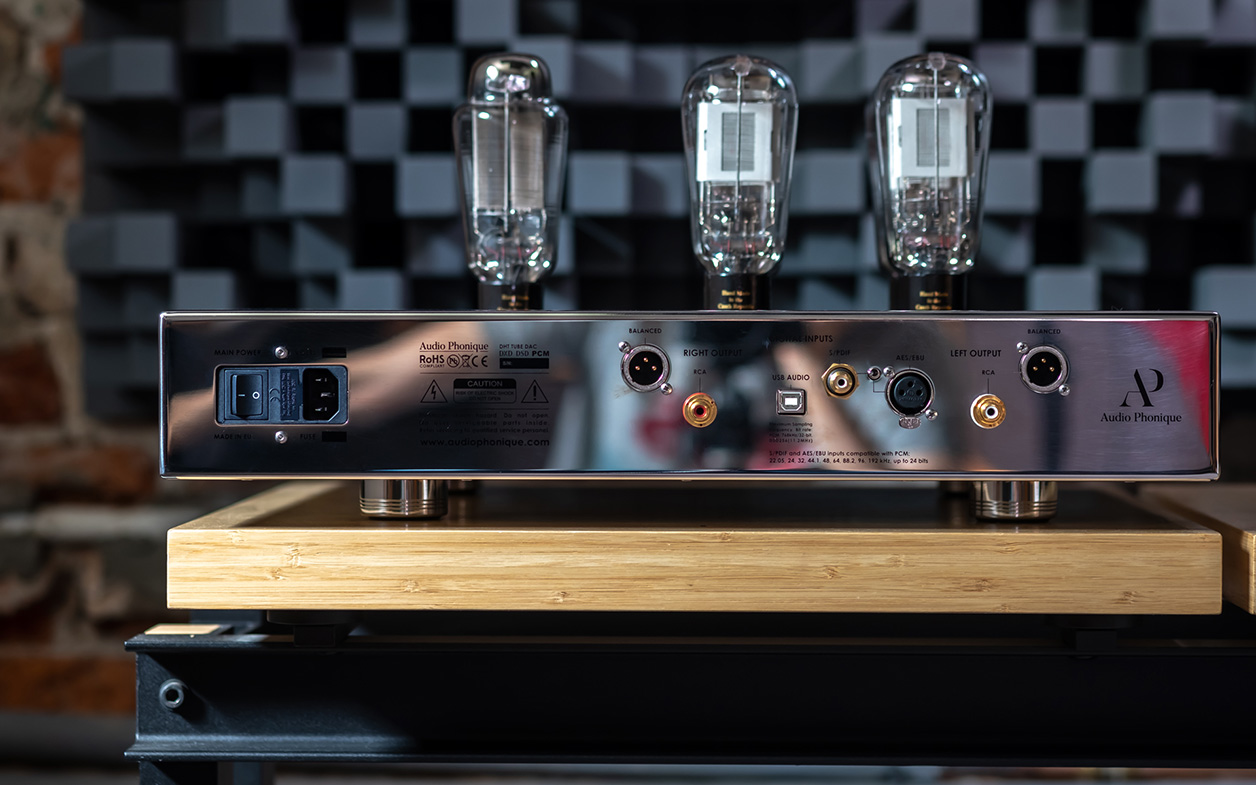
After mapping how the Golden Gate landed against the Pacific, the decision to trade in the former, cover the balance and treat myself to its successor felt fully justified. With a KR Audio 5U4G rectifier and Living Voice-branded 300B it proved substantially more investigative. That made my reviewer's life noticeably easier. Now the Audio Phonique quickly struck me as being voiced in the general GG ballpark yet its tuneful backbone infused by steroids felt significantly more ferocious and fresh. That had a major impact on my showdown. It didn't take long to notice that both contestants prioritized opposite voicings. The Pacific's emphasis was on outlines, immediacy, accuracy, radiance and acceleration. The DAC DHT pursued outline filler, relaxation, connective tissue, boldness and textural saturation. One A/B sufficed to map without fail that the latter's massive tone and juiciness were its key strengths though it didn't feel abnormally warm, stuffy or thick so not fuzzy or bloated. Maciej's strategic vitamin shot clearly worked its magic. As the leaner and more contoured of the two, the Pacific naturally punched harder and quicker while the DAC DHT was rounder, beefier and more massive. Still, this rather simplified description only partially tells the story.








Audio Phonique's highly saturated sonic landscapes were just distanced enough to feel a touch mysterious yet still vibrant, full of charm and clear. The Pacific's perspective was closer and more finely sketched so higher on precision, more striking but less generous on pigmentation. If the former pleased my virtual eyes with expressive content that was most enjoyable to look at, the latter leaned heavily towards higher realism and detail. Casual artsy brush strokes versus firm precise pencil swings, a distant mystic feel as opposed to a sunnily happy vibe across the same canvas size… that was the general idea. Pick what suits you better. Although that's exactly what I did, for the first time since acquiring the Pacific, that was no easy call.
The outcome of any tussle between a lean charged component and one tonally loaded and voluptuous triggers listener biases which are nigh impossible to switch off. Those biases can view the former as skinny and dry, the latter as slow and veiled. At a performance level this high, such simplistic reactions simply no longer apply. Here being outstanding at certain traits to determine a core voicing no longer comes at the cost of crippling other aspects. One pays a lot to get it all. Accordingly both Pacific and DAC DHT sorted nicely across the board free from obvious weaknesses. Each then expanded from there to emphasize distinct profiles. The Pacific being voiced very much up my street didn't devalue or overwrite the Audio Phonique. These were equals on maturity and refinement. The more comparisons I put under my belt, the more I enjoyed both according to mood and repertoire. How we perceive sound is fluid and my take radically changed after each swap. Both offered sound complete enough to keep a craving for the other at the door. That was meaningful. I'd gotten so used to the Pacific that returning to it always had some urgency since I didn't know another DAC of equal quality. On some recordings now the DAC DHT did noticeably more pronounced enough to enforce attention. The newcomer had the early rumble of drum kicks and electric guitar on Tool's "Jambi" more hefty, meaty and slamming. Yet it remained elastic, tight and dynamically charged. That was a fair forecast of things to come. The same band's "Prison Sex" reinforced these observations. The more I increased SPL, the more tactile and swift the DAC DHT became. Its inherently full-bodied nicely rounded personality remained in charge but with heavy music nothing about it felt slow, polite, woolly or fuzzy. Its rounder edges and lower focus on detail and edge limning made poorer recordings on my playlist more manageable, too. That wasn't surprising given that such tuning usually does that.