Infinite expanses? The spatial cast. This begins with quite expansive space between and sometimes even outside the speakers. This panorama clearly exceeded my Accuphase E-213 which kept images strictly between the speakers. Puccini was more expansive. Where a recording permitted, the Audio Analogue didn't stare down a sound engineer's peephole but presented the music in a cinemascope manner. The Italian cast this broader than deep although this latter point shouldn't be viewed as underdeveloped but rather average for this class. Some amplifiers are flatter, others eliminate the front wall to the neighbour. In terms of depth, Puccini occupied healthy middle ground. This was particularly impressive in the first movement of Mahler's Ninth [EMI, Berlin Philharmonic, Sir Simon Rattle]. When a few minutes in the timpani far in the back pick up the opening motif, they actually located far back in my room but still present so not as remote or distant as I've experienced with other amplifiers but believable and natural enough that I wondered whether more extreme spatial illusions don't overdo it a bit. Puccini situates individual instruments quite accurately. Not dryly defined in a studio-like manner, it imbues them with a light sonic aura and above all, wonderfully integrates them into a picture of clear colours. The Accuphase outlines them more sharply but also depicts them in a smaller less "energetic" fashion. A Cayin Jazz 90 on earlier review exaggerated every sonic event, offering more of an experience than clear information. In terms of placement perspective, the Audio Analogue picks a very appealing middle ground between sound-engineering rigor and enjoyable nonchalance. It situates the primarily soundstage layer at the baseline or slightly in front. Objectively, the soundstage on a whole corresponds to a truly good class standard.
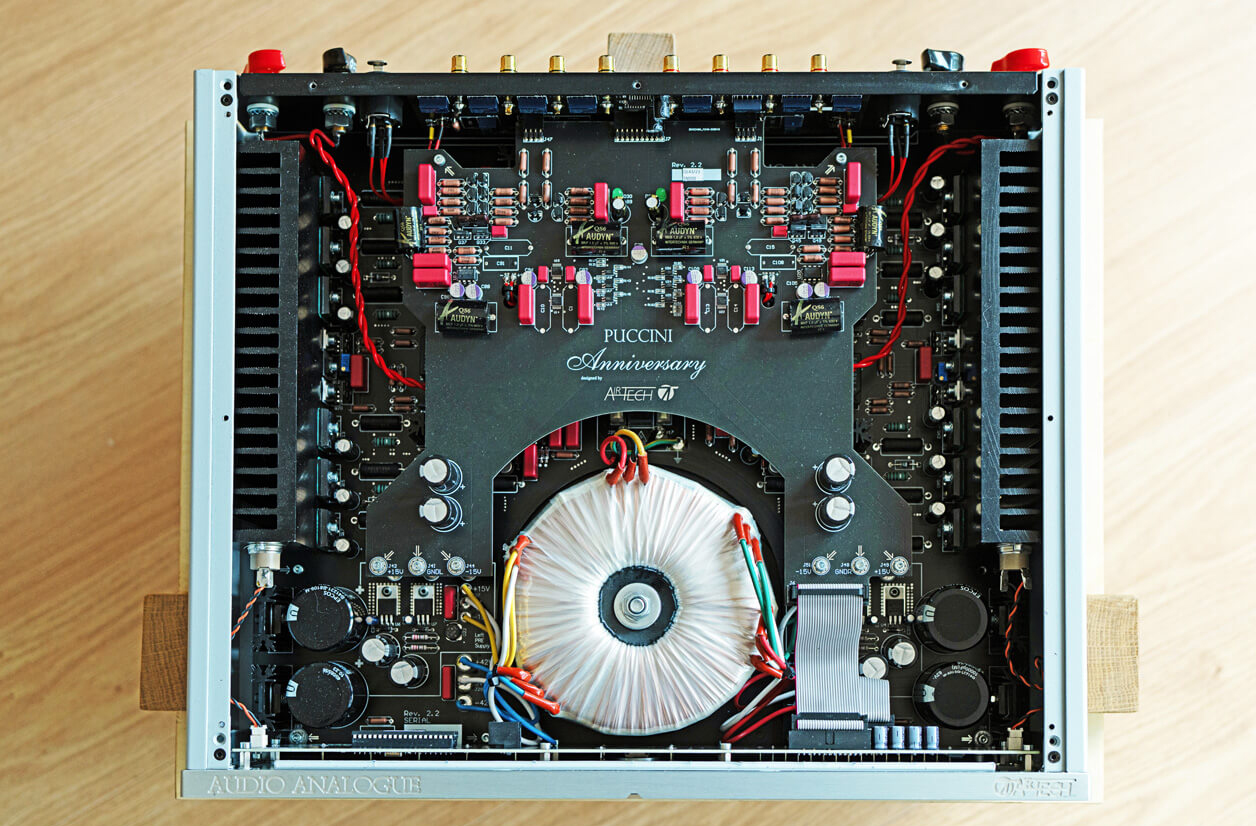
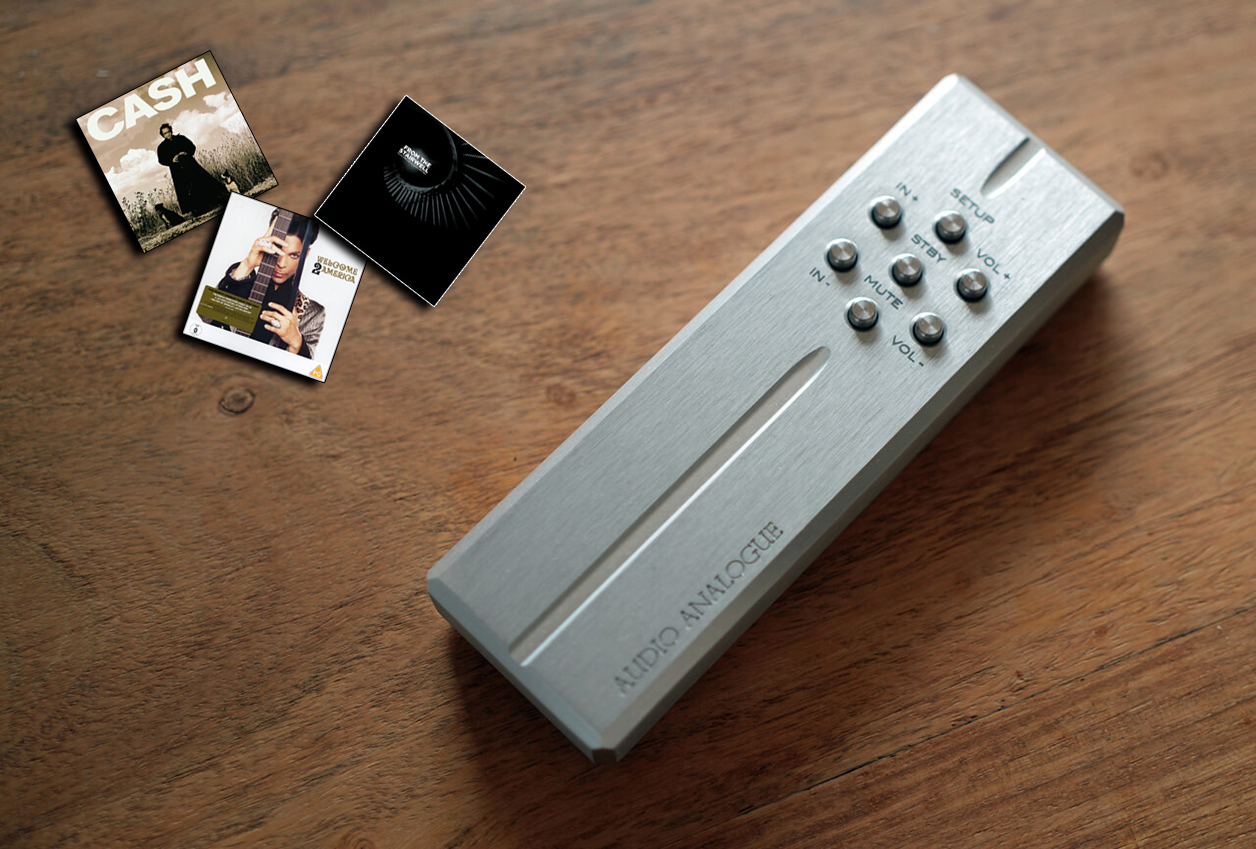
Punch it. Let's move onto dynamics, a real strength of Puccini. It's hard to explain how this integrated managed to sound louder than its competitors at measurably the same SPL. In a way I can't quite put my finger on, Puccini conveyed the impression that everything was a little louder, sharper and fuller. Dynamic voltage shifts didn't just come easy but joyfully as though no minor emphasis was treated with any indifference. Call it superior dynamic range. Hence the transients on Prince's exemplarily well-produced album Welcome to America struck me as more gripping than with other familiar amplifiers. Puccini Anniversary charged these attacks to such an extent that I wondered how an otherwise honest amp could sound so involving? The range between quiet and loud seemed a bit wider. From the fundamental region up to a good 8kHz, tones exploded seamlessly to simply be present. Whenever I gauge macodynamics, I like to talk about Massive Attack or more precisely, the well-known album Mezzanine. Here too Puccini made clear that experiencing it with all of our senses including the gut is the goal. The integrated got off to a fantastic start regardless of price. The lower midrange felt extremely fast and controlled. Beneath it was slightly rounded thrust that still sent chills through my body. Because all impulses rendered so easy and nothing felt even remotely strained, I repeatedly found myself listening louder and longer than usual. The Italian has mastered the joy of an almost physical in-room presence and I started to fear how its bigger siblings would handle my speakers.












The bass foundation. Said punch needs a foundation and here Puccini Anniversary isn't stingy either. The amplifier goes all out right down into the cellar but always prefers meat to bone. If a little edge sharpness and control must be sacrificed for an involving physical bass, the Italian is happy to go along. In the very lowest regions it becomes increasingly soft which isn't a bad thing since edge sharpness of the lowest bass is always shaped by its overtones. Thankfully this relaxed depth isn't accompanied by a bloated lower midband. Here the reins tighten again so the entire bass never wavers or drones despite its opulence. The strange and wonderful sounds of the Kilimanjaro Darkjazz ensemble on their CD From the Stairwell are one such case. Deep partially synth-generated soundscapes shift lazily into or over one another, flooding the speakers with all necessary opulence yet never booming in the room. I've heard amplifiers wave the white flag on both my Wharfdale Super Linton and Sky Audio Verdade. With Puccini it sounded powerful, threatening to overwhelm while at the same time the piano's lower registers came across unaffectedly clear. Even the double bass blending with the synthesizers delivered tangible con-arco textures within this primordial sonic ooze. Another advantage of this LF tuning lies in the rhythm. Bass drums and electric basses had defined powerful attacks followed by rather soft decays. This created a relaxed musically flowing groove. Low notes blended organically rather than stood aloof, a quality that befitted less precisely produced recordings which found their groove more quickly.
Microdynamics. String quartets are ideal for testing these. When a string player changes bow direction, it's always preceded by a slight change in muscle tension. That results in a minimally changed usually more intense bow pressure on the string. We can hear the bow change fractions of a second in advance through a minimal increase or decrease in intensity. That's if a system cooperates. It requires far finer differentiations than for example the intimate representation of a dryly recorded foreground voice. The system must extract this extremely subtle change in level and colour amidst a wealth of other information. Puccini Anniversary ensured wonderful musical flow on Dvorak's Fourth String Quartet with the Panocha Quartet from Prague. I listened spellbound to the development of the themes, the interweaving of voices and subtle nuances of timbre. It's not all that easy to separate two violins side by side whose lines occasionally cross. Thanks to its talent for timbre, the Audio Analogue excelled. The slightly resinous sound of the second violin, the more sinewy tone of the first where string sound dominates tone wood were all there. Only those aforementioned subtle dynamic details which hint at the upcoming bow change were something I've heard more clearly with the Accuphase which then provides less flow to the proceedings. No light without shadow. Many amplifiers sound dry, jerky or stiff if they are too meticulous in their presentation of the finest dynamic nuances. Puccini preserved the flow by creating wonderfully organic connections which subordinated details to the overall sound. Combined with highly expressive macrodynamics, this created a very motional sound. The fact that the finest micro levels were treated with a bit more charm was easily overlooked given the pleasant musical flow. In this price range it's usually the designer's decision which side receives more emphasis. For full illumination, you'll have to dig considerably deeper into your pocket.