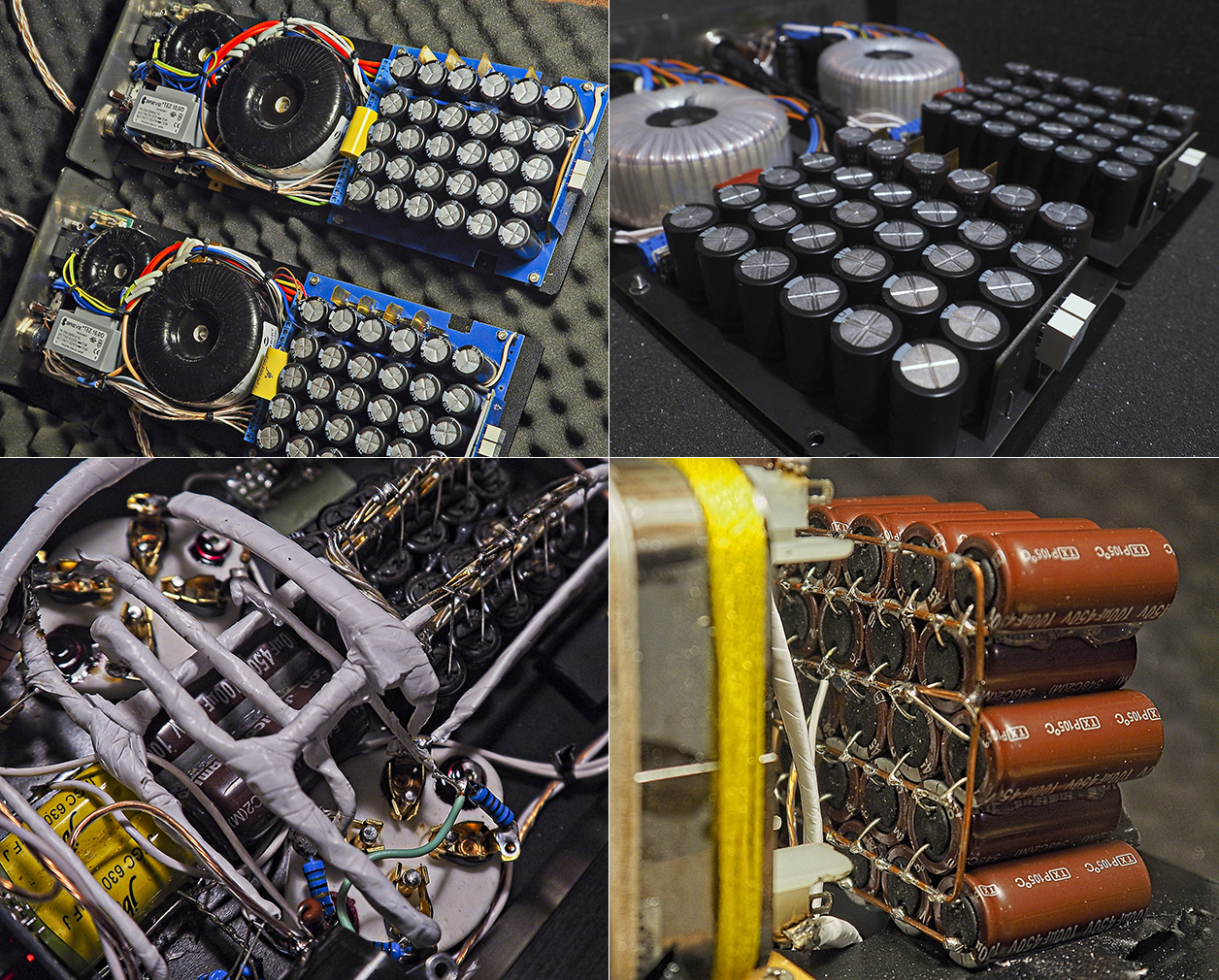
As its name and photos indicate, the Silver Grand Mono II is a monaural tube amp which offers 16 watts per channel. Unlike many of this type, these are quite compact because their power supplies offboard as they already did in the first incarnation. Since direct-heated tubes are quite susceptible to noise, shielding them from the power supply as a source of noise can be challenging. So here we get four boxes of identical 25x35cm footprint. Two each can stack; or separate the PSU further on a lower shelf perhaps. Jarek isn't precious about it either way. Brand fans immediately noticed the switch from granite to black-anodized aluminium chassis sourced from Taiwan. Their rubber footers do a surprisingly good job though considering price, one might prefer dedicated isolators. I used Omex Symphony 3S. The PSU sections are heavier than the amps and connect via solid umbilical terminated with screw-on multi-pin connectors. Both chassis sport a simple display. The amp shows tube bias which ought to be 5 or 6 vertical lines. The PSU confirms power status. In its back we get the expected IEC power inlet and multi-pin outlet. The zero-feedback amp has an RCA input, speaker terminals, multi-pin inlet and on/off switch. Its top hosts four tubes seated in Teflon sockets with gold-plated contacts. The pair in front are an NOS E88CC input buffer and ECC83 driver. The two behind them are basic Psvane 300B operating in parallel single-ended mode. Like Mr. Ashizawa of Kondo, Mr. Waszczyszyn supplies basic bottles which are easily sourced. Owners are welcome to roll exotica to tweak the performance. Behind the tubes sits the custom output transformer's black housing with a small silvery logo plate on top. Like its windings, the hookup wiring is silver but now a Teflon-insulated ribbon type. We remember that the total silver consumption per mono is one kilogram. Signal-path capacitors are top V-Cap Teflon/tin-foil types. The power supply runs 30 small capacitors for 160'000µF total capacitance and three transformers, two of them toroids. All voltages are stabilized. The PSU uses a circuit board, the amp vintage point-to-point wiring.
I adore 300B amplifiers and my first choice would be SE mode but magnificent push/pull variants exist too. As with every audio category, there are brilliant, average and poor implementations. For Ancient Audio, a typical setup would include one of their own CD players with variable outputs to eliminate a separate preamp. I used a LampizatOr Poseidon instead for a still full Polish collab and to excellent effect. Alternatively I had the fabulous J.Sikora Standard Max turntable with KV12 Max Zirconium Series or KV9 arms; and GrandiNote's Celio MkIV phonostage via Bastanis Imperial RCA interconnects to the Poseidon's analog input. The Silver Grand Mono II saw three different speakers: my trusty high-efficiency GrandiNote Mach 4; the sealed 3-way Ubiq Audio Model One Duelund Edition; and the new AudioForm M200 stand mount. Having reviewed many 300B amps over the years, I can tell you categorically that there is no such thing as 'a' 300B sound. Whilst certain qualities overlap, they still span the gamut of warm midrange-centred versions to others easily confused with modern transistors whilst most set up camp somewhere in-between. I quickly heard that today's do not belong to the warm, super-lush cushy type. These in fact sound far more like a Kondo Kagura not Souga. Those are 211 and 2A3 types of top pedigree yet quite different from each other. The 211 is better overall and more versatile with its higher power, precise, powerful and dynamic. The 2A3 is more intimate, beautiful, silky, smooth, a touch sweeter yet still incredibly resolving, with an emotionally engaging performance that grips a listener's heart and soul. Though Kondo's Kagura is push/pull and the Ancient Audio PSE, the music regardless of genre delivered with ease and panache. It had proper scale and impressive dynamics not just in the micro realm where all good tube designs excel but also on the macro scale. Hence I was equally impressed by David Helbock's intimate solo piano and Mussorgsky's orchestral Pictures At An Exhibition.








The piano seemed truly grand, its powerful sound creating a close encounter of being in the same room with it. Already with the Mach4 speakers which don't reach as low as the sealed Ubiq I could feel not just hear the lowest octave. Simultaneously all the tiny subtleties when David slows down delivered clearly to appreciate his talent. The Polish monos excellent not just with dynamic but tonal contrast to enrich my experience. They more than once surprised me with their rapid attacks but handled the sustains just as diligently and naturally. What truly distinguished them from not only most other 300B SET but most tube even some solid-state amps then were the sheer scale and macro swings on the Mussorgsky. On such symphonic fare they behaved far more powerful than 16 paper watts let on even when SPL pushed way up. Ultimate treble refinement remained unblemished. This combined ultimate purity with just a hint of sweetness filled an expansive soundstage with lots of air as another hallmark of the best valve designs then added still more class and life-like qualities.
The Gladiator soundtrack may not quite meet highest audiophile standards but remains a good recording of great music performed well. What's more, the tracks range from slow and peaceful to powerful and dynamic to be played loud hence often feature in my auditions. Atop the already discussed qualities, the II now showed another very special one: unconditional control. Even during the most complex, dense and dynamically broad tracks, they remained effortless yet laden with electrifying emotions. The sound had exceptional clarity and though the music in such moments sounded a bit brighter than I'm used to, it never turned harsh or bright per se. It felt effortless and full of momentum without signs of clipping or compression. Granted, my Mach4 are easy loads and my room isn't grand but I did push the Ancient Audio rather hard. I'm not in the habit of listening that loud yet certain Gladiator tracks made me and I was surprised that nothing came apart at the seams. On the slower peaceful vocal tracks, the Silver Grand Mono II showed more of their slightly hidden non-overt tube nature. They manage to sound both natural and neutral at once, a feature I only hear with the best of the best. While they sounded more neutral than most tube amplifiers, vocals still came off most vibrant and vivid. Unlike the best SET amplifiers, this did not "3D print" singers in the middle of the stage where the aforementioned Kondo Souga went deeper into palpability yet their presence was just as convincing. Hence the final result was similar and at least equally as persuasive but achieved by different means.