
Country of Origin

Reviewer: Srajan Ebaen
Financial interests: click here
 Main system: Sources: Retina 5K 27" iMac (i5, 256GB SSD, 40GB RAM, Tahoe 26), 4TB external SSD with Thunderbolt 3, Audirvana Studio, Qobuz Sublime, Gustard U26 USB bridge, LHY Audio SW-8 & SW-6 switch, Sonnet Pasithea; Preamp: Hattor Audio ARP-S; Active filter: spl Audio Crossover MkII; Power amplifiers: Vinshine/Kinki Dazzle & Audiophonics NCx500 on subwoofer; Loudspeakers: Qualio IQ [on loan]; Subwoofer: sound|kaos D15; Cables: Exact Express Flame, Furutech; Power delivery: 2 x Kinki/Vinshine Tai Hang on amps and source stack, Furutech DPS-4.1 between wall and conditioners; Equipment rack: Artesanía Audio Exoteryc double-wide 3-tier with optional glass shelves, Exoteryc amp stands; Sundry accessories: Acoustic System resonators, AudioQuest FogLifters; Room: 6 x 8m with open door behind listening seat; Room treatment: 2 x PSI Audio AVAA C214 active bass traps
1st upstairs speaker system: Source: Shanling EM7 into Soundaware D300Ref SD transport to Cen.Grand DSDAC 1.0 Deluxe with POW; Preamp/filter: Lifesaver Audio iCon 4SE & Gradient Box 2; Amplifier: Kinki Studio EX-B7 monos; Loudspeakers: sound|kaos Vox3awf; Subwoofer: sound|kaos D12 on twin Nord Acoustic NC500 monos; Cable loom: Exact Express Earth; Power delivery: Vibex Granada/Alhambra, Akiko Audio Corelli Corundum & Castello Solo; Equipment rack: Hifistay Mythology Transform X-Frame [on extended loan]; Sundry accessories: Furutech cable lifts, Furutech NFC Clear Lines; Room: ~3.5 x 8m
1st upstairs headfi system: DAC: Cen.Grand DSDAC 1.0 Deluxe with POW; Headamp: Cen.Grand Silver Fox; Headphones: Raal 1995 Magna, HifiMan Susvara
Desktop system: Source: HP Z2 workstation Win11/64; USB isolator: LHY UIP; LAN distributors: LHY AS6 Pro & SW6-SFP; Ethernet reclocker: Stack SmoothLAN; DACs: Gustard R26II & Audalytic DR70; Preamp: Topping A900; Speaker amps: Topping B200 monos; Headphone amp: Enleum AMP-23R; Loudspeakers: Virtual Hifi Viper; Headphones: Final D-8000, aune SR7000, FiiO FT7, HifiMan Susvara Unveiled
2nd upstairs headfi system: Shanling EM5; Headphones: Meze+++ 109 Pro, Fiio FT3, HifiMan HE1000 Unveiled
2nd upstairs speaker system: Source: smsl PL200T CD transport; DAC: Shanling EM7 w. 1TB microSD; Crossover: Lifesaver Audio Gradient Box II; Amplifiers: LAIV Crescendo Chorus monos; Loudspeakers: MonAcoustic SuperMon Mini with Dynaudio S18 subwoofer
2-channel video system: Source: Oppo BDP-105; All-in-One: Gold Note IS-1000 Deluxe; Loudspeakers: ModalAkustik MusikBoxx; Subwoofer: 2 x Zu Mission; Power delivery: Furutech eTP-8, Room: ~6x4m
Review component retail: $89
 |
 |
 |
 |
 |
 |
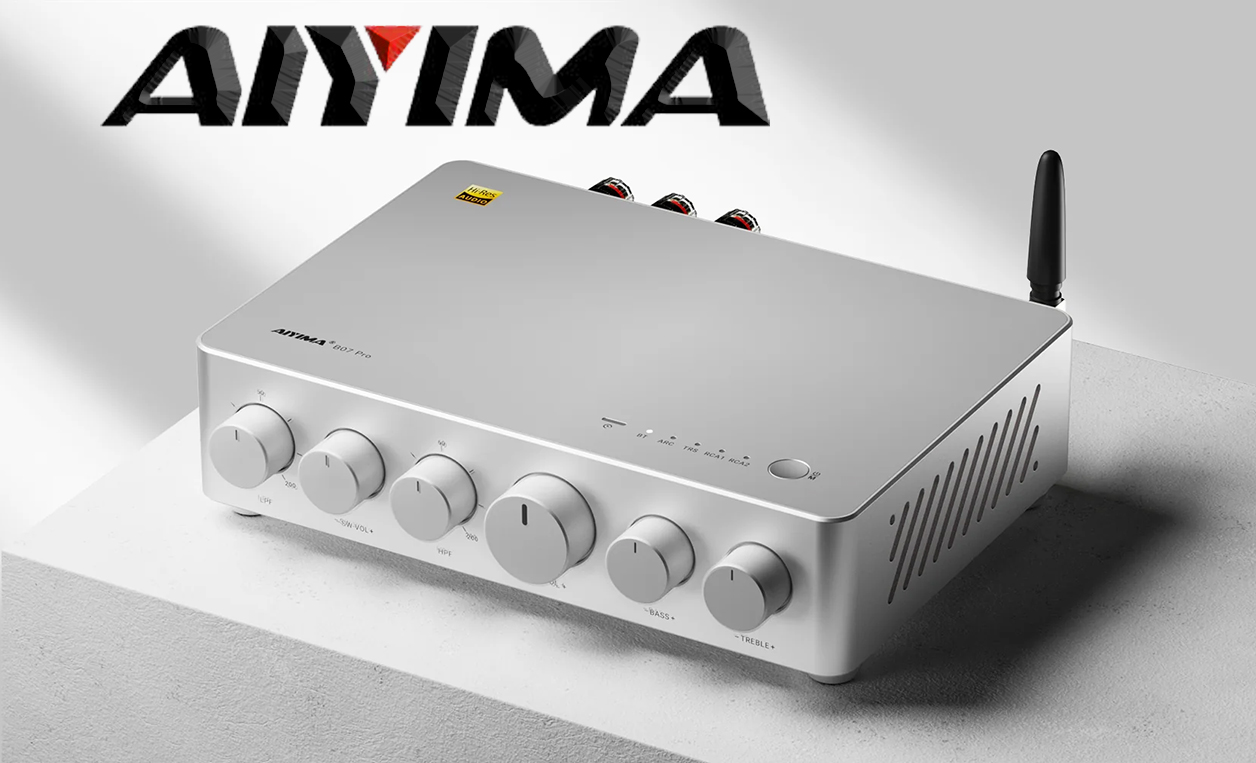
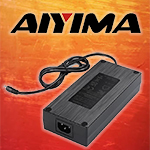
Wtf? Today it unpacks as what if. Really. That indeed can be an energizing question. As reported, this little Aiyima TI TPA3255 chip amp in class D ships standard with a 48V/5A laptop-style switching brick. In the hinterlands of its accessories page lurks a 10A version. It's compadre with this dual-chip mini. Of course it'll only tap into extra current on demand. We'd expect that inefficient speakers plus using the 3rd binding posts into a passive subwoofer to actually tap the second chip could load up current draw. Now working with twice the reserve should assist in developing full power during crunch hour. However, my sub is active. It runs line level off the 2.7V mono RCA sub out. So my 2nd TI chip sits idle. It's unemployed. Then my speakers are these tiny isobarically doubled 4-inch unfiltered widebanders. Their baby AMT kick in at ~15kHz for some extra sparkle. What's more, the Aiyima high-passes these lilac minis at 120Hz. Zero stress in that lane. Add my nearfield setup and its lower SPL needs. I surely never listen to more than low double-digit watts—at best. Them's ideal conditions to drive a modest $259 amp at its very lowest distortion. With part-time work halfway in vacation mode, could the 48V/10A brick make any difference whatsoever? Would it be untapped overkill? The question intrigued me enough to want to find out. Amazon had the easy answer.
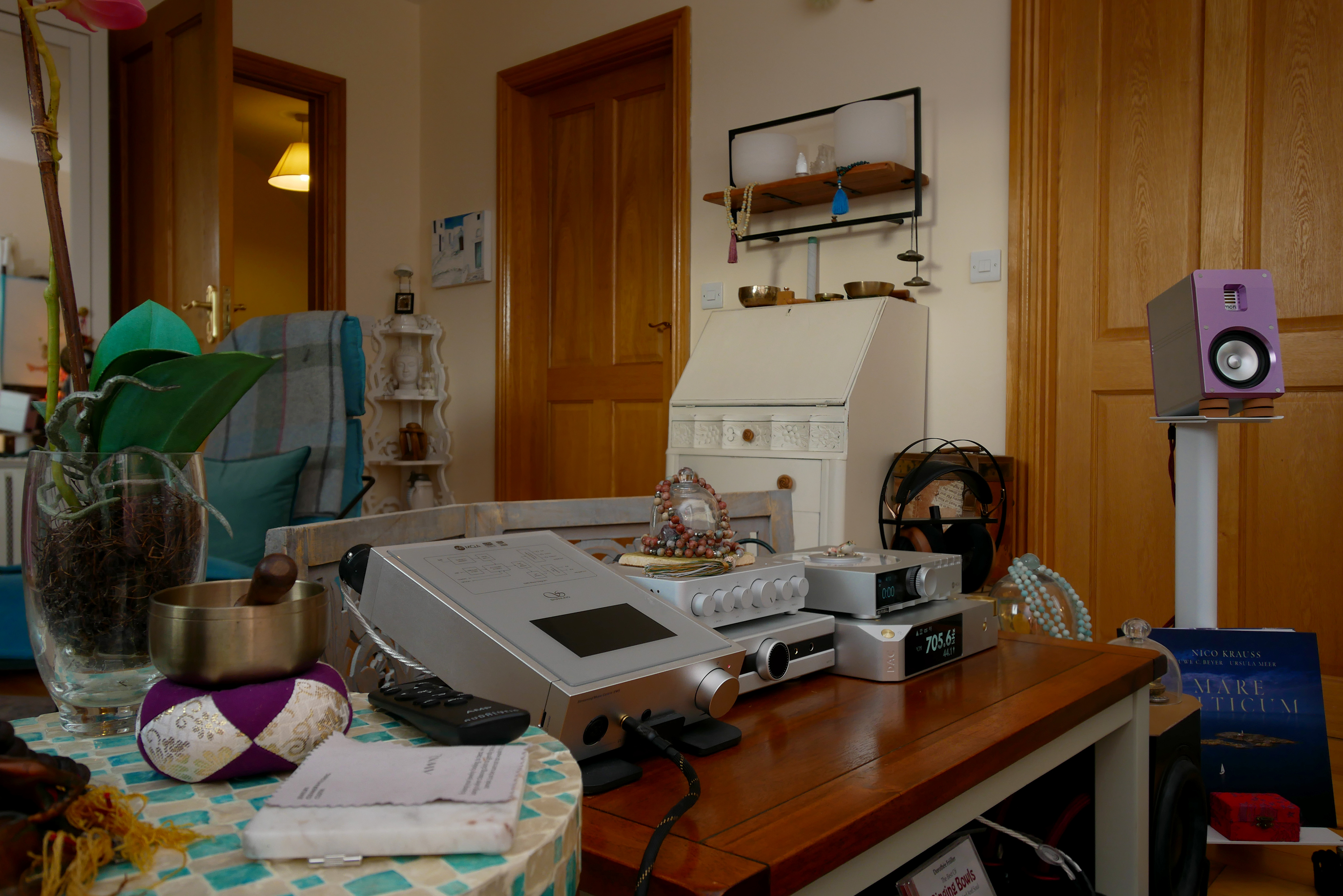 With Audalytic HP70 as preamp.
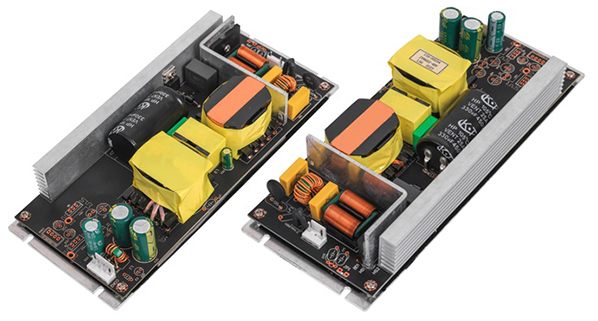 To be sure, if it did make a sonically worthwhile difference, extra current reserves probably had no say. Being a different power supply could mix in other differences. After all, current is drawn not pushed. Our gear only pulls the current it needs. A supply of higher capacity won't force its extra current into our device. Extra current headroom for transient power spikes can minimize voltage sag. But with my dynamic power demands offloaded to an active sub with its own 500W PSU, it was highly unlikely that spare current would be a difference maker. Meanwhile if the 10A supply is simply better, it just might—for other reasons, perhaps lower noise. Voilà, some hifi entertainment perfect for a drizzly November afternoon. I wasn't searching for definitive answers, just a yeah or nay on more subjective sonic satisfaction.
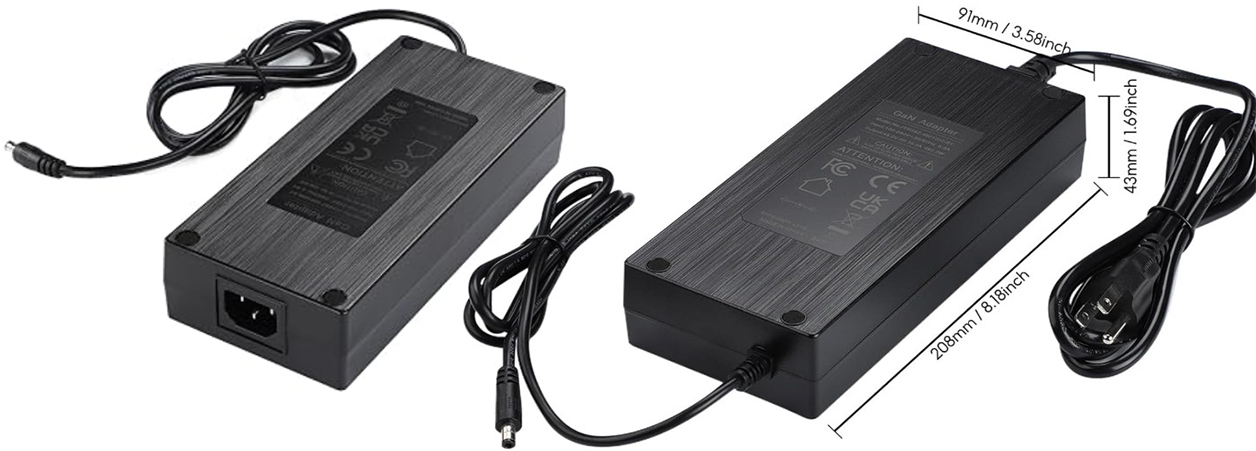
To those who view linear power as the superiority default, it's affrontery how Aiyima manage such fine results already with their 48V/5A GaN brick. The innards of the 10A GaN also from Ju Yuan Hai will look similar to this. It's from the JHY site; for a model with equivalent rating. Says AI, "because JYH produce as an OEM¹, you'll frequently find this exact power supply bundled with or sold under hifi brand names, most notably the Aiyima GaN adapter or paired with 3e Audio² TPA3255 amplifier modules."
_________________________
¹ "We offer flexible power adapter OEM/ODM customization services, fully meeting diverse market demands up to 1'000W. Our clients decide on appearance, size, colour, plugs and safety certification. We supply for applications in consumer electronics, smart home, security monitoring, household appliances, industrial control, network communication etc."
² 3e Audio are a Shenzhen OEM/ODM specializing in TI amplifier modules who recently expanded into turnkey consumer products like the A5 and A7 series. Claims AI, "whilst both 3e Audio and Aiyima operate out of China and make compact desktop audio gear using similar TI chipsets, they are distinct entities. Audio enthusiasts view them as competitors not collaborators."









Wtf! A quick rerun of the usual meaning. It'll be your reaction after first laying ears on this Aiyima. Its sound is ultra crystalline; high summer noon with no shadows in sight. It's lit up all over. Supremely lucid. Uncongested. Quick. Keen. A deluxe unfiltered widebander. Premium faceted stemware. Whatever we pour in, the liquid won't change colour or take on even a subtle hue of difference. That's nearly the definition of neutrality—or better yet, transparency. Fill the B07 Pro with something thin, dry, crisp or edgy. That's what'll come out. In its ultra-budget league, nested feedback and deep op-amping are popular for their excellent lab specs. So precede it with something of low/no feedback for more fluidity and breath. My quick Aiyima education went from source direct to fronting it with first a €349 Audalytic HP70 preamp then layabout €2.5K Simon Audio Lab i5 via pre-out. Once at my 3rd step, I muttered the three words—repeatedly. Certainly nobody who shops this sector picks such ancillaries. Once armed with their coin, they drift into pricier brands of higher street cred. All true. It simply doesn't untrue Aiyima's aim. Armed with my 25wpc Enleum AMP-23 for a hefty $6.5K contrast, I found the i5+B07 Pro combo to outclass it on insight and immediacy, depth layering and resolution. Then it quadruples power and piles on smart stereo 2.1 features Enleum never even heard of. TI state that their TPA3255 power IC outperforms discrete implementations. Hearing the B07 Pro, that claim seems leggy. Of course to get serious, class D must run proprietary tech. That then positions itself at the very top like AGD, Ixycore, Merrill or Mola Mola. Discrete modules from Hypex, IcePower, Pascal, PowerSoft and other OEM slot in below. They factor in decks from Aavik to Marantz, Bel Canto to NAD. The dim beat of the Texas Instruments chip restricts itself to scrappier brands like 3e Audio, Aiyima, Fosi, smsl, WiiM & Co. It's most unlikely that higher-end shoppers ever enter this lowliest zone. Its secret is safe. At that, to fancy ears it only taps fully once crossbred with more unreasonable ancillaries. For a few so inclined, that's subversive fun. The grander scheme takes no notice. It continues as per usual. From the untouchables to the high priests, the sanctity of the class divisions remains unshaken not stirred. Having exercised our three letters the normal way, onto the alternate meaning—what if. Could an $89 Amazon bolt-on mod squeeze a few more drops?
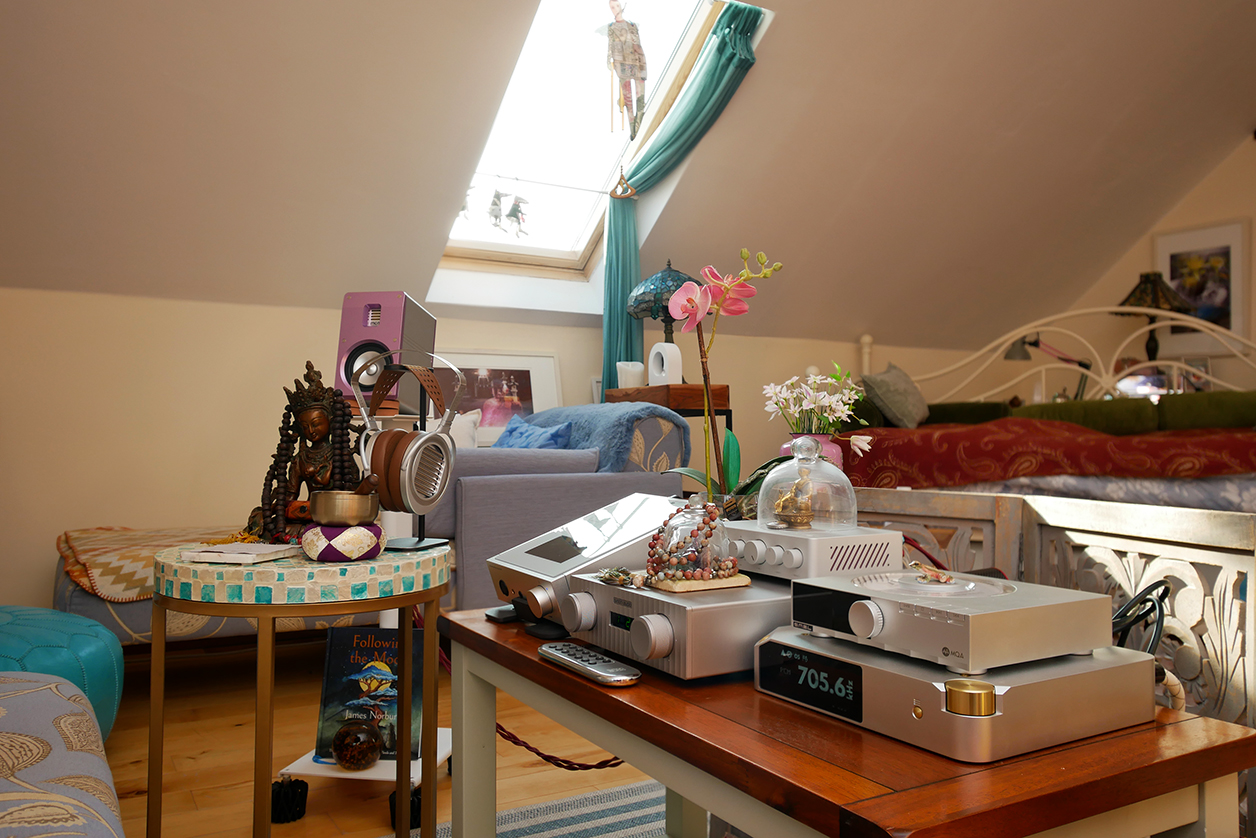 Shanling EM5 1TB microSD server ⇒ 1st-gen LAiV Harmony DAC ⇒ Simon Audio Lab i5 as preamp ⇒ B07 Pro as amp for speakers + sub
The 10A brick was certainly bigger and heavier. It also had a standard C14 IEC, not the 5A's Mickey Mouse C8. With it came a generic EU cord of lower gauge than the stocker's thin wire with its figure-8 plug. Upgrading the bigger brick's power cord is far easier. Who inventories C8 cables? And why uprate a power supply's current delivery then choke it with a resistive shaver cord of higher impedance? It's audiophile religion 101. The bigger brick knew it. But did it matter? The English religion derives from the Latin religio. Its exact root remains debated. Lactantius and St. Augustine saw it as religare—to relink humans with the Divine. Cicero thought relegere—to read over, go through again, consider carefully. Let's apply the latter even if to link up with our tunes for a more compelling experience is the end game. On that score already the 5A brick had my undivided attention. I won't claim that the bigger supply changed the quality of my experience. Its contents did a bit; if that distinction communicates. At 10A the sonorous matter acquired a bit more weight and substance. Yet the musical continuum didn't thicken. The high NFB low-distortion gestalt of crystallized clarity didn't waver. The bigger brick's small injection of body didn't mar it. No warmth, no blur, no peach fuzz, no water-colour transitions. Instead a bit more gravitas. From it, a subtly more relaxed feel. Again no overcast on transparency, no energetic braking. The presentation's high-cardio physique accumulated no fat. My other upstairs system around the Swiss sound|kaos Vox3A with companion D12 sub is beefier. It presents more sonorous, warm so temperamentally chilled. Today's nearfield system is all about forward-leaning intelligibility. Think premium headfi just cast out of the skull's cave. It's that perspicuity which the B07 Pro aced; which Simon Lee's compact integrated-as-preamp deck didn't upset just intensified materially. The 10A brick veered a bit farther in that direction; enough to notice, not enough to hype. Applications of higher impact and amperage draw could well widen my delta. In my easeful use, I was rather content though with these returns on a tidy $89 expense. It just doesn't imply anything insufficient, tawdry or stop-gap about the stock supply. In fact, I'd first guide an Aiyima shopper chasing to shine up their B07 Pro at Audalytic's HP70 preamp to undermine source-direct thinness. Should that or something equivalent hit the budget, it'll make a bigger splash. With the baby Gustard it even adds the convenience of a remote. As a perfectly clean glass, our Aiyima simply shows what we pour into it. Polish up what precedes it to your standards et voilà, you'll get that sound whilst spending shockingly little on the actual amplification.
Wow, that's fantastic—the winningest alternate for our three little letters…

Aiyima's website
