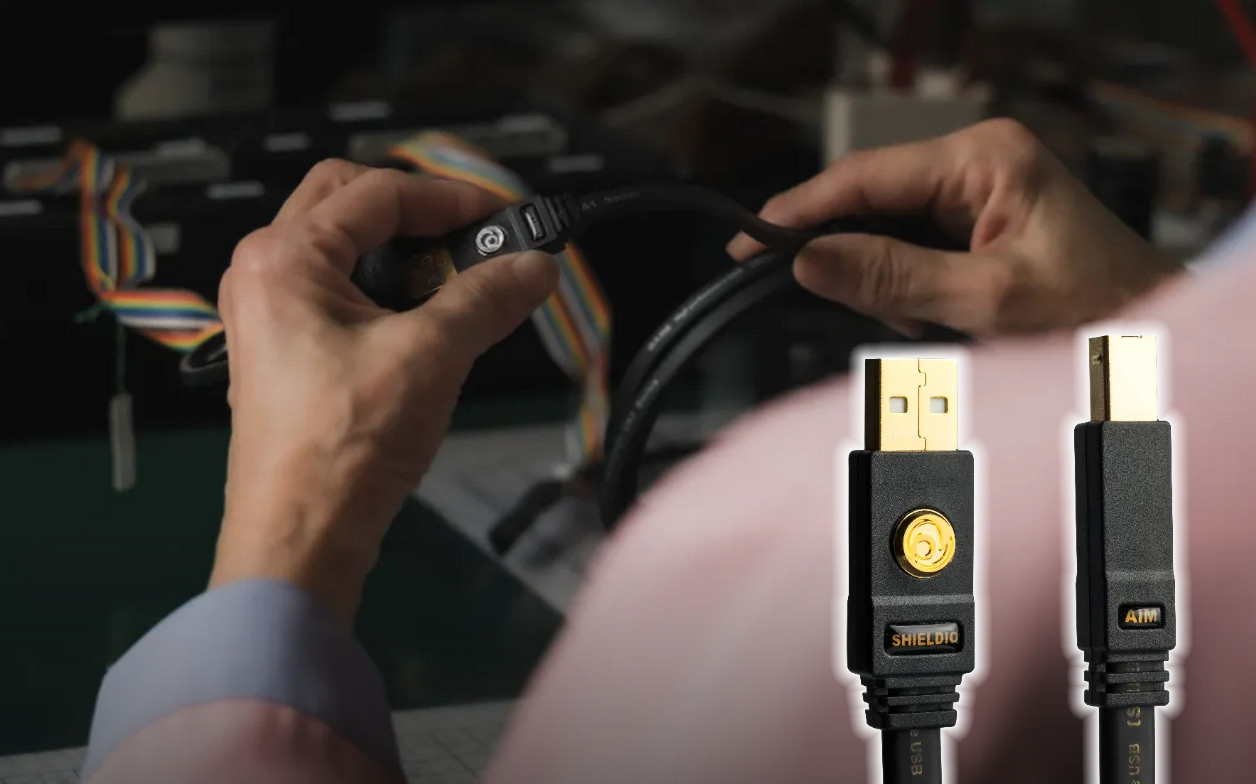
The change versus my Furutech was subtle enough that I initially wondered whether I imagined it. Then I removed UA3 and put Furutech back in. There it was. The stage hadn't collapsed. The tonal balance hadn't changed dramatically. Nothing had become artificially brighter or leaner. Rather, an intervening haze had returned, acoustic instruments sounded ever so slightly less like themselves. Tonal textures took on a slight sheen that I never knew was present in the first place. Voices were particularly revealing. A good recording of an intimate singer like Callas' recording of French Arias transferred from tape to digital by HDTT can tell you everything about a digital chain's manners. Too much emphasis on edge and the singer acquires a hard little perimeter. Too much smoothing and the human being inside the recording disappears. UA3 found a rather appealing middle ground. Breath remained breath, sibilants remained sibilants. But the voice had more connective tissue around that information. This is where AIM's noise control begins to become musically interesting. Rather than hearing a spectacular tonal transformation, I heard fewer little interruptions to the illusion of continuity. The music flowed. There, that dangerous word. Flow. Audiophiles use it whenever adjectives fail but at times the adjective does fit. NAX takes AIM's argument and puts it through the Japanese equivalent of a hydraulic press. This is no longer just a nice LAN cable. NAX uses an OFC conductor coated with pure silver, a low-loss foamed dielectric called Air 2 and AIM's four-layer Hoplon shielding incorporating Pulshut Mu, aluminium foil, copper foil and a dense copper braid. It also has heavily shielded Telegärtner connectors. And then there's directionality. Yes. Your LAN cable has a preferred direction not because Ethernet packets suddenly learnt which way is forward. The network protocol remains bidirectional. The asymmetric construction concerns the management of shielding and noise currents. AIM mark the direction accordingly. At this point the skeptical reader is entitled to log off. And no, I didn't try to reverse the cable to figure out if it made any difference just like I don't mount my tires backwards to see if I can increase my chances for a wreck.
The first encounter with NAX was no firework. This seems to be AIM's trick. You don't insert one of their cables and Diana Krall suddenly sings into a bigger microphone. Instead the room becomes more explicit. Reverb tails hang around longer. Low-level information no longer seems to compete quite as fiercely with the principal event but blends seamlessly as part of it. On dense material these improvements were more persuasive, micro textures more audible without feeling disconnected. A guitar line became easier to follow, a bass player's articulation clearer. Room ambience detached itself from instruments producing it and gave them more substance, more credibility in the recorded space. The impression wasn't more information so much as less interference between bits of information. That's a much more interesting achievement. Here we enter audiophile cliché for a moment but hopefully it takes us somewhere useful. The background became blacker. There, I said it. But blackness isn't really what I heard. Silence became more informative. That's actually different. True silence in a recording doesn't really exist. It's not mere absence of sound. It establishes contrast against which tiny sounds become perceptible while capturing the feel of the recording space itself. A hall's acoustic trails. The intake of breath before a phrase. The faint resonance of a guitar body. The decay around a piano. These things live very close to the noise floor. If we lower apparent contamination, they emerge not as added detail but part of the musical environs. NAX was very good at this. What surprised me most is that the NAX Ethernet cable sitting between my LHY SW6 switch and Lumin U2/X2 actually achieved that magic trick to a greater degree than a fibre-optic SFP connection between these components. It shouldn't be possible, optical transmission being theoretically immune from the very contaminants AIM target. I'm not exactly sure how an electrical LAN connection did this better but it did. To a small extent. I simply can't emphasize enough how the SW6 was a critical element to the result. Without it NAX had no chance to show its strengths: garbage in, garbage out even with an über cable.










Interestingly, the two AIM cables didn't sound identical despite shared DNA. UA3 is more obviously generous. It brings density, continuity and a slightly relaxed sense of musical organization. NAX is a bit more severe, more spatially explicit. Where UA3 makes the music feel more cohesive, NAX makes the acoustic environment easier to inspect. One improves the conversation, the other removes people talking in the next room. Now comes the unpleasant paragraph. NAX costs a lot—a lot. Almost $4'000 for a 2m LAN link. At this point the appropriate response isn't to ask whether it sounds any good. Of course it does. So does a $6.99 CAT8 generic from Amazon. The appropriate question is: does it sound $4'000 good? Of course it doesn't. No cable does. Ouch. At this level, price/performance curves have long dropped off the cliff and frolic somewhere in the valley below cheerily waving at us. NAX is not a component upgrade. The price of NAX takes you from an excellent Rivo+ streamer to the outstanding Lumin U2. That's the better upgrade every single time; unless you already live with electronics from the upper 0.1% strata. In that scenario NAX becomes your last polishing cloth. If your streamer, DAC, amplifier or speakers have obvious shortcomings, spend the money elsewhere. If your system is already highly resolved and ruthlessly optimized, the calculus changes. Now NAX becomes one of those irritating final-percent products that will make you hear the difference. You just won't necessarily want to pay for it.
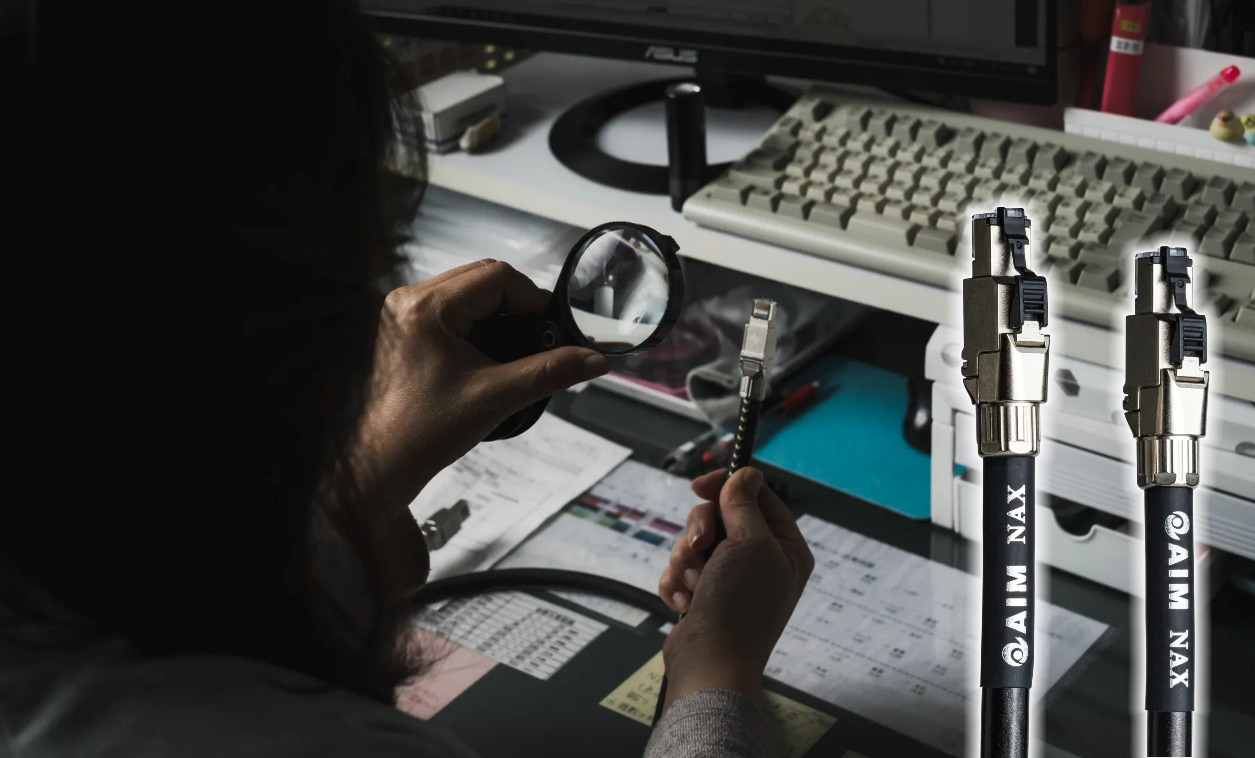
This makes UA3 the easier recommendation. The price is still decidedly high for USB but its engineering is coherent, its musical effect sufficiently broad that I could imagine keeping it permanently in a serious system. It's subtly but audibly better than my Furutech where the $240 surcharge seems almost like a bargain in our audiophile world. UA3 is more forgiving of the accountant. NAX is what happens when the accountant has been fired already. I began this exercise prepared to be skeptical. That remains the only healthy approach. Digital cables deserve skepticism because the claims surrounding them routinely outrun the mechanisms used to justify them. But then AIM aren't really asking us to believe that silver makes ones and zeros more accurate. Their argument is more modest: Control the electrical environment surrounding the data to minimize interactions with the analog components in the chain. That's a proposition I can work with. Here listening suggested that something useful happens when AIM get sufficiently obsessive about it. Their UA3 made digital playback feel more continuous, dense and human. It was the more immediately convincing product and at its price, the one I'd be more inclined to own. NAX went further. Its particular talent was not tonal alteration but organization: spatial cues, low-level textures, reverberation and separation emerged with a bit more ease than over a much cheaper optical Ethernet connection. Then you look at the price and the question changes. Not "does it work?" but "how much do I value the last percent my system is capable of?" For UA3 my answer is "quite a bit". For NAX it's enough to recommend an audition, not enough for blind ownership. And perhaps that's the most honest compliment one can give a $3'840 Ethernet cable that requires the best Ethernet filter fronting it to manifest its benefits. It isn't nonsense. It's luxury-grade nonsense-adjacent economics wrapped around surprisingly serious engineering. The music doesn't suddenly become better. It becomes a little less obstructed. And at the very top where everything else has already been polished to a mirror sheen, sometimes that's exactly what we pay for.