The L9 is a substantial piece of 45x39x20cm WxDxH and weighs over 16kg. Its aesthetic appearance is very direct, almost militaresque. The lighted central logo surrounding the volume knob, of a stylized tube topped by two arrows underlying the company logo, reminds me vaguely of a skull hit by double lightning which in in turn evokes suggestions of Frankenstein, even Fritz Lang's Metropolis atmospherics. The chassis bolts together aluminium panels and the fascia hosts the volume control in the middle, the input selector on the left and at right the power button whose rotary action governs other functions. The selectors are backlit and we get to pick several colour schemes. All functions including the backlight colour and intensity can be controlled by remote. My review sample came with a cheap plastic wand which, while convenient and functional, did not reflect the preamp's pedigree but Ferrero assured me that a more appropriate design will be available shortly. At the back of the unit we find the usual connections, here 5 inputs and twin outputs. The precise mix of RCA and XLR is customizable when ordering. The circuit being deliberately single-ended implies that the XLR are for convenience only. A selector can change how the L9 is internally grounded: floating, high or low impedance. We should choose the setting for the least hum. I had zero hum in any position. Given that the L9 is a full-tube design, I was impressed by how silent the machine is mechanically and electrically. My 93dB/6Ω Diesis Audio Aura SE speakers were almost totally silent.
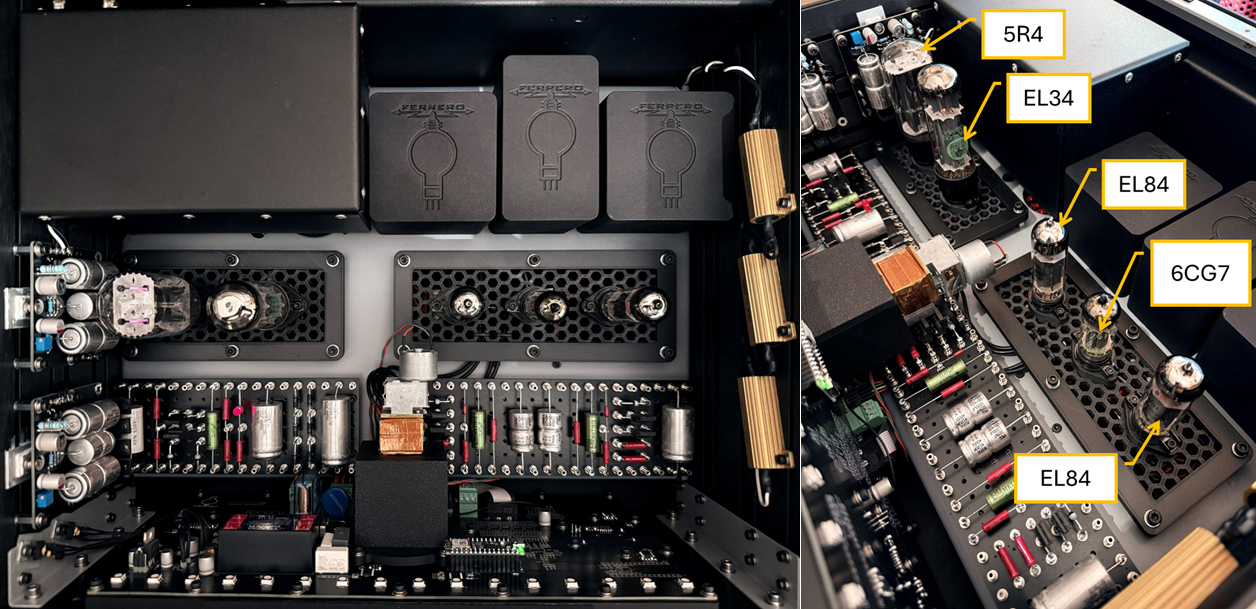
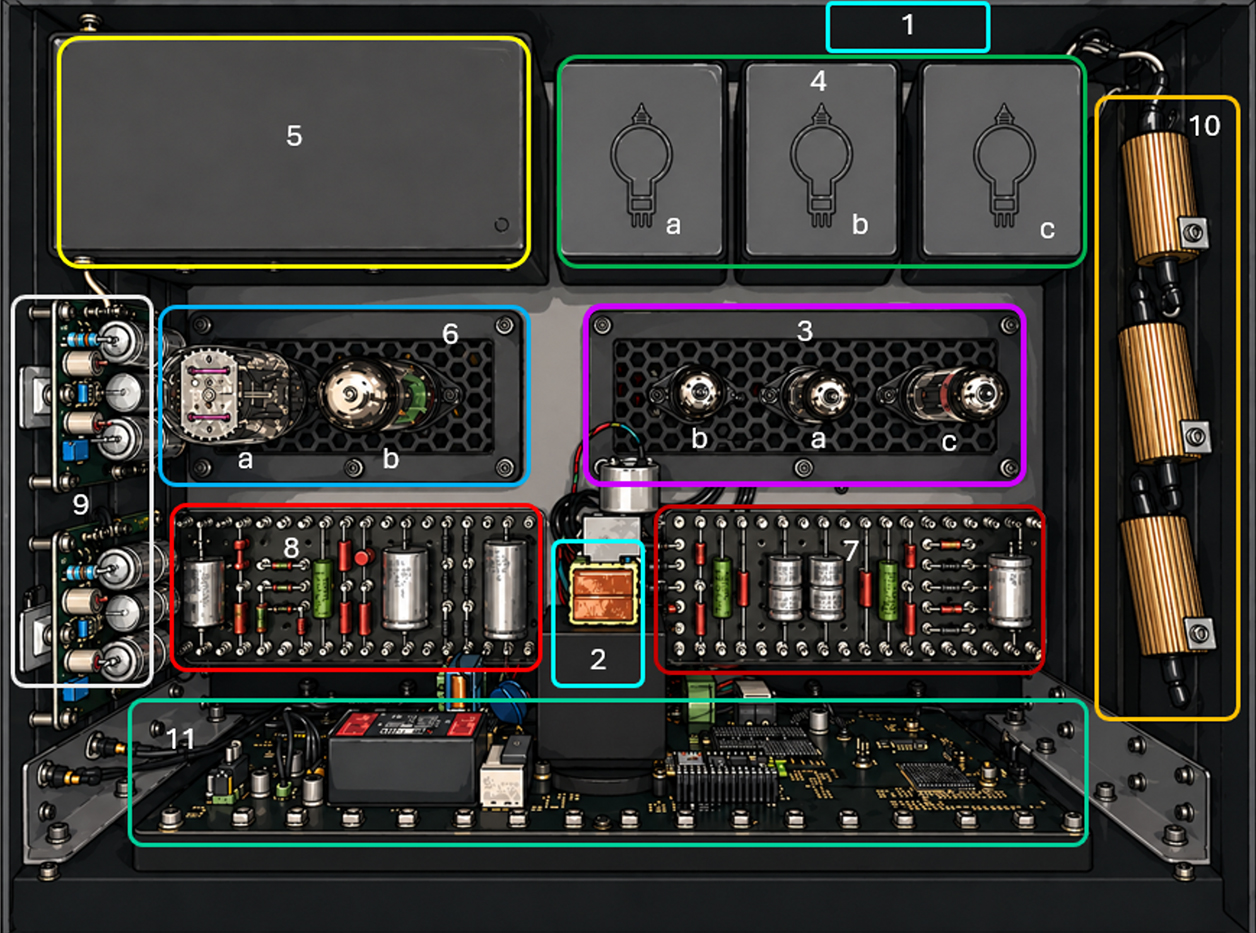
Mechanical vibration isolation informs the whole design and the aptly selected damped footers are just the tip of the iceberg. The internals of the L9 are far more interesting than the exterior. I was intrigued by the claim of an innovative design with unprecedented technical solutions where vintage tube elements meet new parts to form an unusual topology. I was not disappointed when I popped the lid to be greeted by a very clean, well-organized display of including tubes I wouldn't expect in a preamp. I was happy when Alberto himself provided us with a guided tour. Again, the L9 shuns all global and local negative feedback. 25dB of voltage gain, 100kΩ input impedance and 100Ω output impedance are all unusual values for a valve line-level circuit. The first noticeable step of the signal path is that the input (1) connects directly to the volume pot (2) with no intermediary circuitry or transformers. This Alberto remarked on as being one of the elements of a minimalist very transparent design and was especially relevant to my use case where a LampizatOr Horizon 360 DAC of a reported if never openly confirmed 5V single-ended output can saturate very sensitive input circuitry on downstream electronics as I experienced in several cases to first require attenuation via its own volume control. When using a preamplifier, it is expected to include volume control, making a second upstream control not ideal but I was happy to learn that the design of the L9 did not require any signal cut in the source. I could use the Horizon unattenuated with no hint of overdrive distortion. The volume control on the L9 is a motorized rotary Alps Blue enclosed in a custom EMI-shielding cowl further strengthened with copper and Kapton layers on the outside of the potentiometer itself.











The general layout of the L9 has the power supply stages on the right (3 + 7), the rectification and input stage on the left (6 + 8). (4) are the filtering and regulation modules, (5) is the power transformer, (9 +10) form the power supply. Lastly (11) is the board for the control, display and logic and as such fully decoupled from the signal path. In both input and gain stages, EL34 and EL84 pentodes are far more common in power amplifiers. Here they plug into high-quality Bakelite sockets with gold-plated tulip pins which install on custom carbon-fibre reinforced plastic honeycomb plates to combine ventilation and stiffness which in turn bolt to the chassis via dampening feet. Temperature control, stability and vibration control are key for consistent performance and minimization of mechanical and electrical noise. The power supply stage (6) is formed by a hybrid rectification stage where the 5R4 works together with a pair of Schottky SiC diodes, a solution Alberto derived from his military designs where these solid-state elements are chosen for extremely low EMI emission, high efficiency and MTBF (mean time between failure).The 500V-rectified tension is handed to the EL34 driven by discrete circuitry (8) stabilized at 300V. The gain stage (3) is formed by a 6CG7 double triode which generates most of the voltage gain and drives an EL84 pentode per channel selected for current gain at low output impedance. The bias current of the 6CG7 is high enough to achieve full class A operation while all operation points and ranges are selected in the most linear part of the respective components to avoid the need for global or local feedback. The power supply to the tube heaters is provided by two (9) boards. The high voltage from the power supply filters and splits into the left and right channels via passive circuitry housed in the (4a + 4c) enclosures while the (4b) housing, a third polypropylene case internally shieled against EMI by copper foil and all internal part embedded in epoxy resin includes the output circuitry which then connects to the rear sockets. A set of three series bleeders (10) complements the inductive bridge of the power supply topology while offering the advantage of very high transient response speed and implies a significant current load even with no input signal. According to Ferrero, a substantial chunk of development effort was spent on the mains transformer (5), a custom toroidal design where every winding is isolated and resin-impregnated to form a single block enclosed in a soft iron housing to provide magnetic isolation mounted via rubber feet on the chassis to kill structure-borne vibration and its associated hum. All wiring is carried out with PVC-free cables. Instead, LSZH rubber-insulated cables are employed to achieve sonic performance while ensuring the safety provided by this type of material.
To pre or not to pre? In contemporary systems, a preamplifier has become a somewhat controversial topic. In an era where high-gain digital sources with 4-12V outputs and sophisticated volume controls abound, a dedicated piece of electronics taking care of the first stage of signal amplification is technically no longer required. The minimalist approach would skip a pre wherever possible to avoid not only the insertion of an extra box but also its power cord and interconnects, all of which come with unavoidable contributions to sonic colorations, EMI emissions never mind cost. 'The best pre is no pre' narrative along with the 'straight wire with gain' qualifier in HiFi circles are hard to escape since they read most rational. However, a preamplifier may be necessary or be the most practical equipment to handle signal routing in a complex system with multiple sources to switch from and multiple outputs (multi-amplification, active subwoofers) in which case the driver of the preamp investment will be more about system topology than ultimate sound quality. Opposing the minimalists are the separatists. They believe in a system made up of dedicated hardware for each task. Claimed advantages include EMI isolation, dedicated power supplies and the possibility to both physically and on BOM scale up a specific piece of electronics without the compromise of integrated packaging. Personally I am torn between these philosophies as I see merit in both but as in the case of the subject at hand, I leave it to my ears to decide on a case-by-case basis. My system qualifies as a minimalistic proposition or at least against the insertion of a pre as not only my DAC has a more than decent volume control and plenty of gain but my amp is an integrated. However, as already mentioned, I could definitely hear an improvement when I put the Riviera Labs APL-1 preamplifier into my chain.