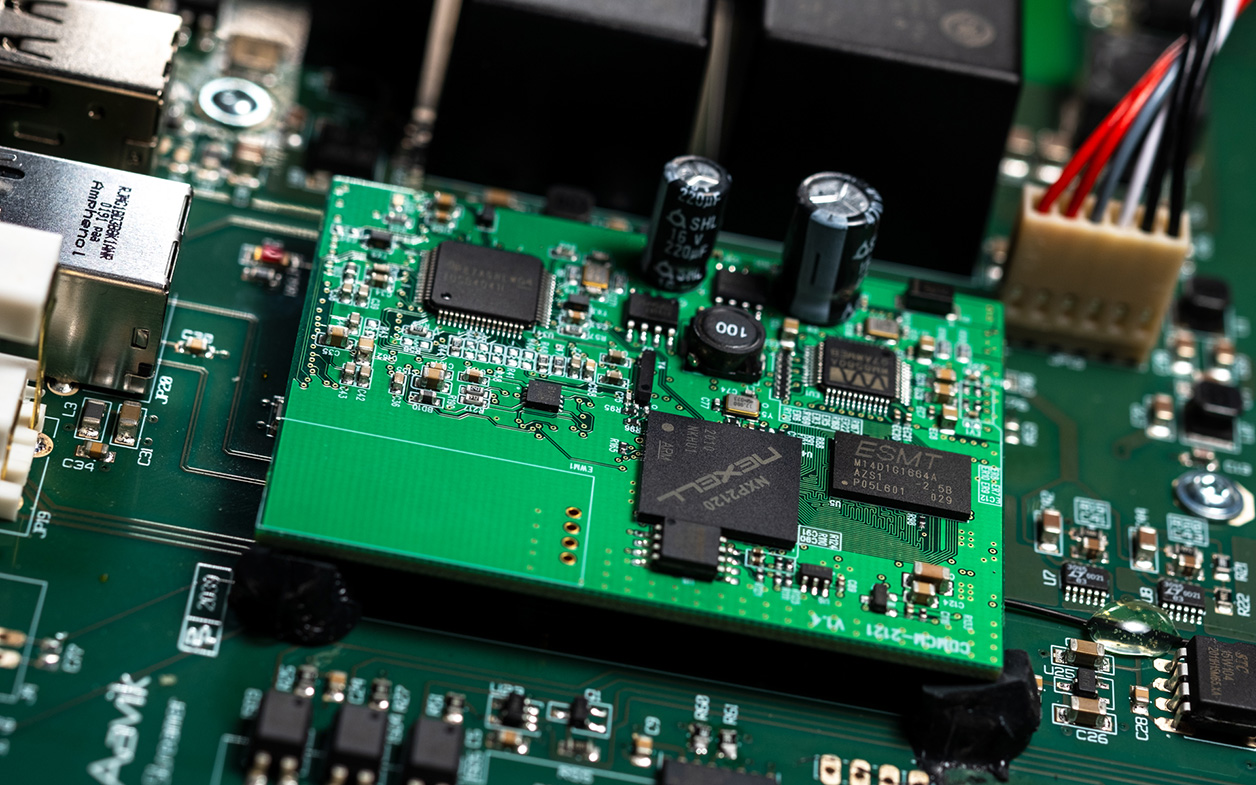
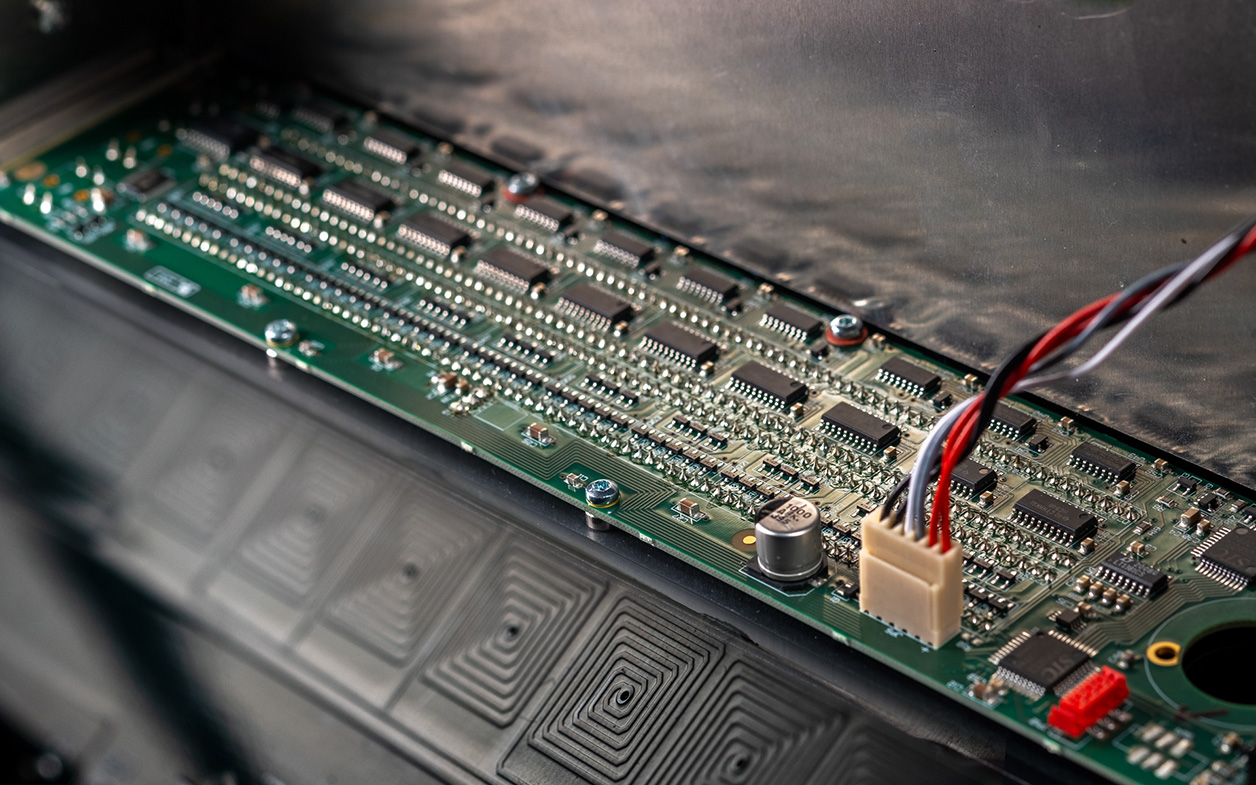
By undoing four discs then bolts on the S-180's underbelly, I easily removed its bonnet for a peek inside. The small customized PCB piggybacked onto the motherboard below was a Conversdigital streaming module with customized software managed via the mconnect app. The main board with its switching power supplies, regulators, clocks and transceivers is Aavik's own. Naturally the S-180 is packed with Audio Group Denmark's signature noise-suppression tech, in this model via 3 dither circuits, 36 active Tesla coils and 92 active square Tesla coils. Spread across two boards, these show up as small IC, spiraled squares and oppositely twisted black wires all designed to combat noise. The more of them are present, the more potent their action. It's how Aavik scale up performance. The €10K S-280 goes to 6x/72x/164x such units respectively while the €20K S-580 maxes out at 9x/108x/236x plus grows an internal copper liner and external X-shaped titanium insert on its hood. A standalone DAC chip was nowhere to be found. This function embeds in one of the many IC. I imagine that some may not find this kosher but if our engineers could add basic DAC utility without crippling the streamer's performance and/or increasing its price, why not? Yet whilst technically being a streaming DAC, to me it was introduced and advertised as just a streamer so that's how I used it
Although the S-180 is Aavik's first streamer, its Convers engine was stable as a rock, responsive and with its infancy days well in the past. Once turned on the S-180 kicked off its startup sequence for about a minute and ended when the lengthening horizontal line had progressed all the way across the screen. Then 'Ready' showed up and now I could access the main menu to update firmware, scan for nearby WiFi networks, connect to them, check wireless signal strength, display LAN status and software/firmware versions, set DSD output (DoP/PCM), MQA unfolding (in streamer/in DAC/off), turn gapless playback on/off, set digital volume control (fixed/variable), dim the display after five seconds, change brightness (10/40/70/100%) and show playback info (active source, codec and sample rate).







The app is Conversdigital's mconnect software colorized to match Aavik's logo. It integrates Tidal, Qobuz, Spotify and vTuner and allows for multi-room control plus streams from local servers and external storage devices. All that was beyond my interest since I used a thumb drive loaded with music for comparative auditions. After several weeks of app engagement, all I can say is that it was as stable as it was easy to use. However, my streaming needs are very basic. It doesn't take much to keep me happy. Take these impressions with a grain of salt. The app relies on an iPad and I had to borrow one to proceed with this assignment since Aavik run outsourced code. They disabled AirPlay and Chromecast originally included in that package for the same reason as USB. Naturally the S-180 had to fight my reference Innuos Statement. Both their IEC saw the Boenicke Audio Power Gate's captive M2 cords. The Aavik talked to my DAC via BNC, the Innuos via USB. That meant two different cables and digital receivers. I had no way of mapping how those factored in. To facilitate this review my Aavik contact Morten also sent over their €2'500 Ansuz Digitalz C2 BNC cable 8.3 x costlier than iFi's €299 Mercury3.0 USB I've used for a while. Both streamers were simultaneously controlled via my iPhone and the iPad loaner. They connected upstream to a Fidelizer EtherStream switch and downstream to my DAC so by turning the latter's input selector, I could instantly and very conveniently compare. Since the S-180 doesn't feature its own storage, its USB port hosted a 32GB Kingston drive loaded with a selection of music from the warehouse of my Innuos.
Many amps, DACs and speakers are built in a way that tells me a thing or two about what to sonically expect. Streamers however always leave me puzzled. Perhaps I haven't yet inspected and heard enough to discern any firm patterns that would allow me to pre-profile them to some extent? Since their internals, enclosures and software still don't form anything I can hold onto, their designers' familiar house sound is the only indicator for what I might possibly hear. Speaking of which, Audio Group Denmark's house sound is fast, transparent, spatially expansive and meticulously stripped of noise to boost colors, smoothness, mass and backdrop inkiness. The more expensive their hardware gets regardless of type, the more pronounced these traits become. By their standards today's subject is an entry-level specimen. It's for customers with limited funds. That should keep unrealistic expectations at bay. Yet their sales director Frits Dalmose had once told me that they suck at downscaling so even their point-of-entry models are infused with the same sonic DNA. After hearing quite a number of their products, I can only agree. By acting accordingly, the S-180 proved that point once again.