Country of Origin

 Reviewer: Srajan Ebaen
Financial interests: click here
Main system: Sources: Retina 5K 27" iMac (i5, 256GB SSD, 40GB RAM, Sonoma 14), 4TB external SSD with Thunderbolt 3, Audirvana Studio, Qobuz Sublime, Gustard U26 USB bridge, LHY Audio SW-8 & SW-6 switch, Sonnet Pasithea; Preamp: Hattor Audio ARP-S; Active filter: spl Audio Crossover MkII; Power amplifiers: Vinshine/Kinki Dazzle & mono NC500 Nord Acoustic amps on subwoofer; Loudspeakers: Qualio IQ [on loan]; Subwoofer: sound|kaos D15; Cables: Exact Express Flame, Furutech; Power delivery: 2 x Kinki/Vinshine Tai Hang on  amps and source stack, Furutech DPS-4.1 between wall and conditioners; Equipment rack: Artesanía Audio Exoteryc double-wide 3-tier with optional glass shelves, Exoteryc amp stands; Sundry accessories: Acoustic System resonators, AudioQuest FogLifters; Room: 6 x 8m with open door behind listening seat; Room treatment: 2 x PSI Audio AVAA C214 active bass traps
1st upstairs speaker system: Source: FiiO R7 into Soundaware D300Ref SD transport to Cen.Grand DSDAC 1.0 Deluxe with POW; Preamp/filter: Lifesaver Audio Gradient Box 2; Amplifier: Kinki Studio EX-B7 monos; Loudspeakers: sound|kaos Vox3awf; Subwoofer: Zu Method; Cable loom: Exact Express Earth; Power delivery: Vibex Granada/Alhambra, Akiko Audio Corelli Corundum & Castello Solo; Equipment rack: Hifistay Mythology Transform X-Frame [on extended loan]; Sundry accessories: Furutech cable lifts, Furutech NFC Clear Lines; Room: ~3.5 x 8m
1st upstairs headfi system: DAC: Cen.Grand DSDAC 1.0 Deluxe with POW; Headamp: Cen.Grand Silver Fox; Headphones: Raal 1995 Magna, HifiMan Susvara
Desktop system: Source: HP Z2 workstation Win11/64; USB bridge: LHY UIP; Ethernet bridge: LHY EFI; Ethernet reclocker: Stack SmoothLAN; DACs: Gustard R26II; Preamp: Topping A900; Speaker amps: Topping B200 monos; Headphone amp: Enleum AMP-23R; Loudspeakers: Virtual Hifi Viper; Headphones: Final D-8000, aune SR7000, FiiO FT7, HifiMan Susvara Unveiled
2nd upstairs headfi system: Shanling EM7; Headphones: Meze 109 Pro, Fiio FT3, HifiMan HE1000 Unveiled
2nd upstairs speaker system: Source: smsl PL200T CD transport, 1TB microSD; DAC: Shanling EM7; Crossover: Lifesaver Audio Gradient Box II; Amplifiers: LAIV Crescendo Chorus monos; Loudspeakers: MonAcoustic SuperMon Mini with Dynaudio S18 subwoofer
2-channel video system: Source: Oppo BDP-105; All-in-One: Gold Note IS-1000 Deluxe; Loudspeakers: ModalAkustik MusikBoxx; Subwoofer: Zu Mission; Power delivery: Furutech eTP-8, Room: ~6x4m
Review component retail ex VAT: €23'500/pr in Cherry, Oak, Ash or Maple; €23'960/pr in Walnut, Bird's eye Maple or Rosewood; add €500 for passive bass filter; add €900 for XO²
 |
 |
 |
 |
 |
 |


A perfect speaker. I have most specific notions on what that is. 3+ decades on the beat shape those in anyone who sampled broadly, observed keenly then arrived at a well-informed opinion. The breadth of speakers on offer obviously signifies precious little agreement. It's a Wild West of opinions. Today, yeehaw, is about mine; no more, no less. One, my perfect speaker should be compact and of manageable weight. As the eternal tenant, I've occupied many homes in Germany, the US, Cyprus, Switzerland and Ireland. Given my semi-nomadic life, I'll likely change address a few more times. That makes one-man manoeuvrability including stairs a key asset. My eyes meanwhile will always fancy a compact visual footprint over an enormity when I don't run a recording studio or cellar mancave but decorated digs. Two, the lion's share of the bandwidth should be free of filter parts with their energy storage and phase shift compromising the time domain. Hello widebander to at least 4kHz to cover music's highest fundamentals of violin and piano. Preferably the widebander extends another octave before segueing into an auxiliary tweeter for the air and brilliance bands.
Three, bass should be active, adjustable and directional. Directionality wants a dipole, RiPol or cardioid. Adjustability should be analog not digital for no latency. Four, as sound-making furniture my perfect speaker would use premium materials to shun saw dust set in resin and sundry plastics. Adding up my shortlist requires any designer of such a speaker to think different. If you're hip to contemporary mainstream speakers, you'll be searching for my perfect speaker well off the mainstream with all this entails: less notoriety, cachet and general visibility; harder to audition and find reviews on; small-scale production with likely long lead times; higher pricing than economics of scale can apply; far harder to turn on the 2nd-hand market than famous in-demand brands. If none of that frightened you off; if my specific qualifiers have you nod in agreement or at least curious – hello sound|kaos Vox5 by Swiss auteur Martin Gateley.

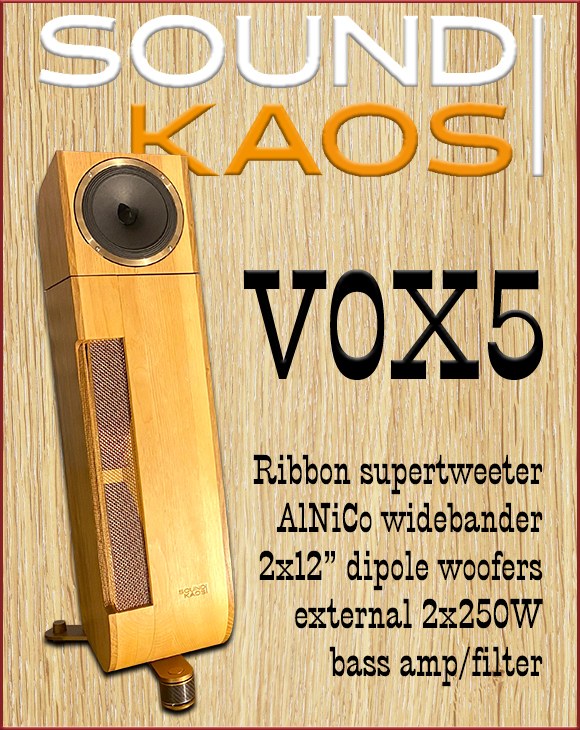
On cosmetic and lower-back impact, dims are 22cm wide, 34cm deep and just 92cm tall so well under a meter. Weight is 32kg, claimed bandwidth 28Hz-35kHz. The 6"/18cm custom Enviée widebander from Germany's Armin Galm¹ uses a paper cone, pleated surround, cast bell-bronze basket, 70mm AlNiCo motor and 13Ω voice coil. It runs wide open so with a steep purely acoustic roll-off at ~150Hz and a shallow equivalent at ~8kHz to span 5½ octaves with a simple notch filter padding down a small 800-2'000Hz plateau. The upfiring Raal ribbon enters on a lone 8kHz capacitor. Taking on the bottom three octaves are dual paralleled basket-modified 12" SB Acoustics woofers with 16Ω voice coils on an active or passive 2nd-order low pass.
_______________________
¹ Armin Galm: "Widebanders make for interesting design challenges. The difficulty in constructing them lies in how to correctly balance various parameters against each other. We began with modal analysis into cellulose and paper cones which, since the advent of metal and plastic cones, have been unjustly neglected. Finite Elemente Analysis and other simulations helped our modelling but with some interruptions, our research still took years albeit was entirely free of commercial pressures. All developments were exclusive to our Enviée driver platform. The mechanically inert basket had to follow the geometries of cone and suspension components whilst remaining acoustically transparent. The induction of the voice-coil gap had to be efficient and linear across the poles to avoid back EMF by shorting out its modulation field. The flux lines of the cast alloy AlNiCo magnet would avoid sonic hardness. The entire moving-mass system is centrally important to the sonic radiation and wanted a light but stiff cone, elastic but mechanically stabilized surround and a precisely centring spider. In the bi-cone versions, the whizzer had to follow the main diaphragm in phase without comb-filter effect or peakiness in the upper frequencies." Through Galm Audio, Armin provides driver solutions to clients like Backes & Müller and Odeon. Another brand which uses his Enviée widebander is Süsskind by Joachim Gerhardt.
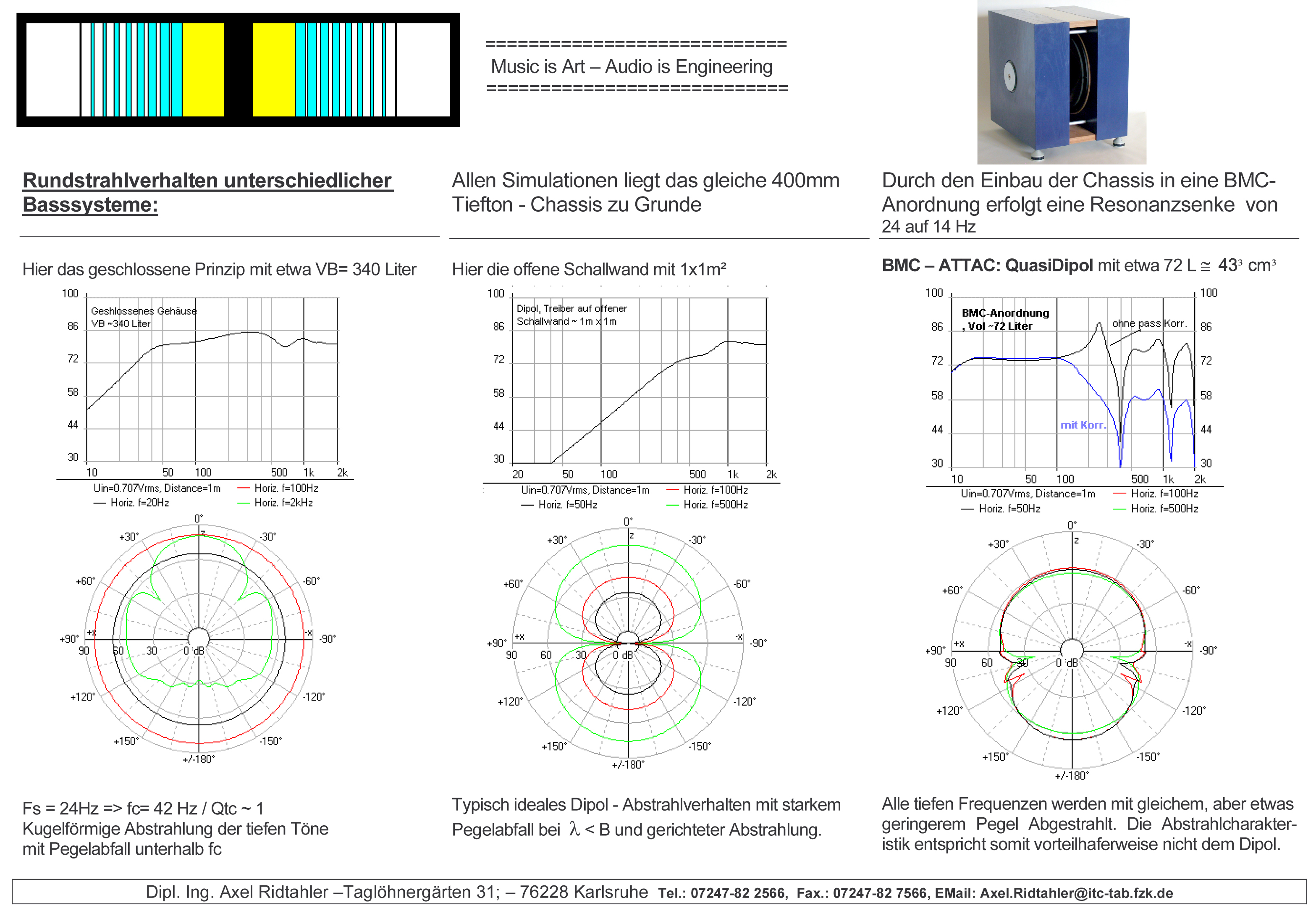 From the original German Axel Ridthaler RiPol patent.







"For larger spaces I had no initial joy matching passive dipole LF output to widebander amplitude so decided on an active bass system. I came across a 200-watt mono solution around a TI TPA 3255 chip which worked better than anything else I tried to activate my bass. This becomes particularly salient for dipoles as cubic room volumes increase. If one remains below 30m², passive works fine. My XO² filter/amp box does 200wpc in class D with dual-mono LF gain adjustments and low-pass adjustments from 40-200Hz, with recommended settings for our Vox3 and Vox5 clearly marked. On the back are RCA and XLR inputs with a loop-through for a second power amp to avoid needing a preamp with dual line-outs. The RCA outputs have a +6dB gain switch. The two external power supplies for the XO² are 48VDC switch-mode types with GaNFets." The Vox5 woofers with their compound 17" surface load as a folded open baffle. A vertical front slot releases the front wave, a matching rear slot the back wave. Like a classic dipole, this creates lateral anti-phase cancellation. Unlike a classic dipole, tight spacing sinks the woofers' resonant frequency and redirects their radiation pattern. Such a bass array mirrors an expired Axel Ridthaler patent for a RiPol aka Ridthaler dipole. Whilst Martin's portfolio already has dual 12" and 15" passive RiPol subs—and my main rig one of the latter—the Vox5 replaces the stand of the Vox3 with a solid bass bin. We get true low stereo bass from neatly docked enclosures which look like standard if stumpy floorstanders. That's a gold star for a sardine-can packing job! For full audiophile religion, think different includes details like Martin's award-winning wire-suspension isolators beneath the outriggers; and smaller variants between head and bass bin. For any sound|kaos fence sitter who eyed a pair of Vox3 monitors plus one or two Gravitas D12 subs, the conservative Swiss Vox5 smartly turns a hot'n'heavy foursome into a twosome and skips right over the saucy French ménage-à-trois. One imagines how dealers and clients beseeched Martin to safeguard their domestic bliss by integrating stereo 2.2 performance into fewer pieces.
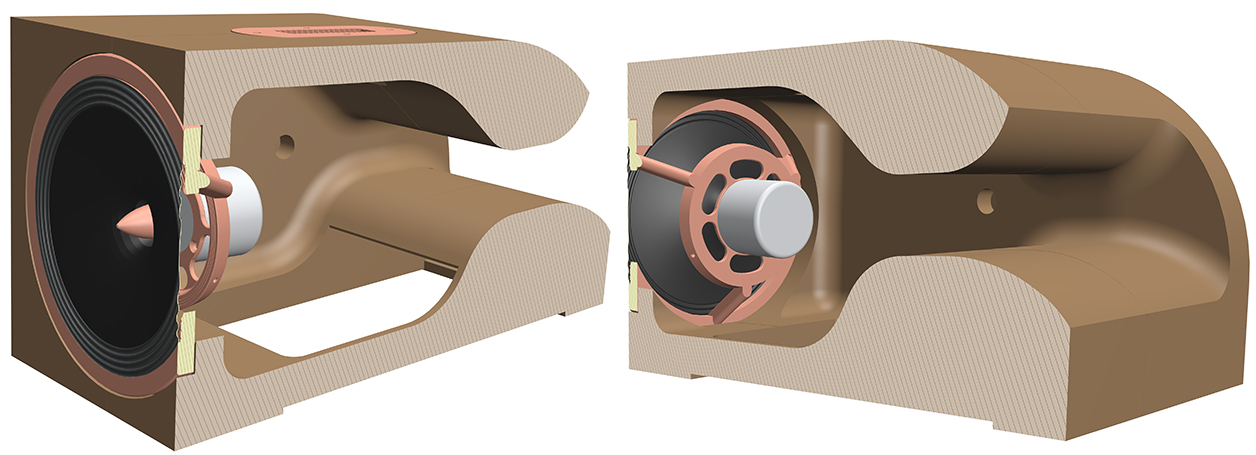
But Martin's different think has another scoop, a flared-port/rear-horn combo to lightly load the widebander which thus works more as dipole than ported/sealed alignment. "I wanted to keep the bass system's box-less openness going so for the Enviée Chris—Christian Ellis who also worked on Node Audio's radical spheroid Hylixa speaker and the popular Q Acoustics range—modelled four iterations of closed, ported and our original 'scooped horn' geometry from my Wave 40 days. We'd learnt at the time that the softer horn port put much less back pressure on the light membrane of the widebanders. I'm really pleased that we went for this semi-open system as it brings that airiness I love so much into the midrange. The Raal ribbon of course is the same as in the Vox3 so sealed." Again, the basket for the main driver is cast in a Swiss bronze foundry specializing in cow bells. Such extravagance I've otherwise only read about with DeVore and Living Voice though the late Eduardo de Lima of Brazilian brand Audiopax too used bell bronze for his amplifier enclosure disguised beneath a thick layer of chrome. To him his tube circuit sounded clearly better enclosed in bronze than aluminium or steel. The other metal bits of the Vox5 are bronze-anodized aluminium.
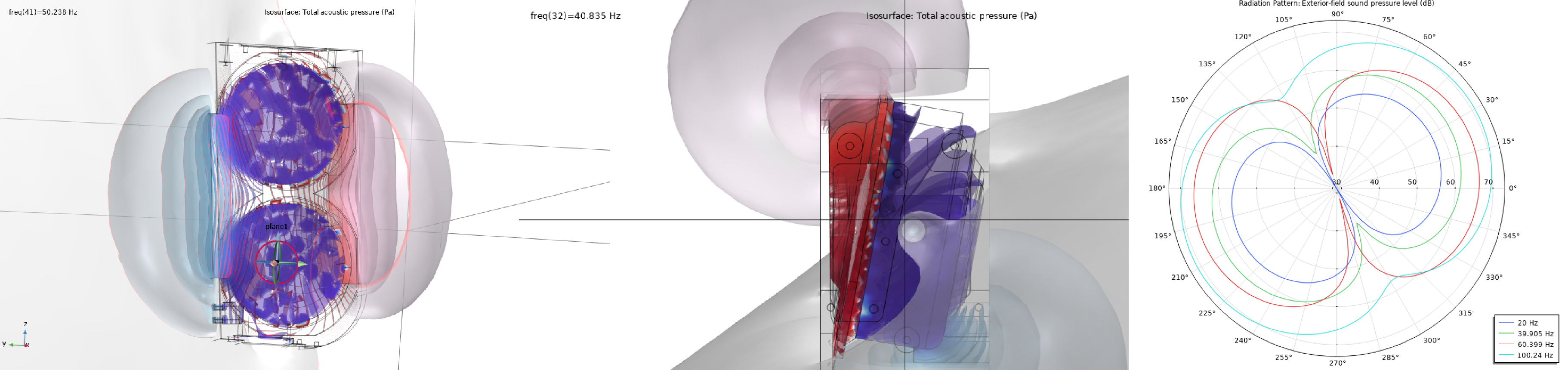
But that still isn't the end of its unique features. "It departs from the opposed RiPol geometry of our subs to work as a pure dipole from 20-80Hz. It starts to let go of this radiation pattern above 100Hz. Chris who modelled our bass system in Comsol and Akabak was really surprised that by creating a diagonal channel across the body of the speaker, we could give the bass direction. It's generally accepted that ported or sealed LF below 80Hz radiate omni and that this directivity can't really be influenced. In the polar plot you clearly see that the dipole pattern exits at around 20º from the 0-180º axis. By mirroring the left/right speakers, it creates a sort of LF bubble between the speakers which is a neat design feature. We also had to deal with the usual ~250Hz standing wave which afflicts RiPol and other folded-baffle bass. Whilst we thought that it derives from the close proximity of two woofers, it's actually their front/back distance. With an open dipole woofer there's usually only the membrane thickness or at most baffle thickness to contend with. By turning our woofers sideways, this distance grows to ~35cm and creates a resonance. So we cross our bass system below 200Hz to put the resonance out of band."