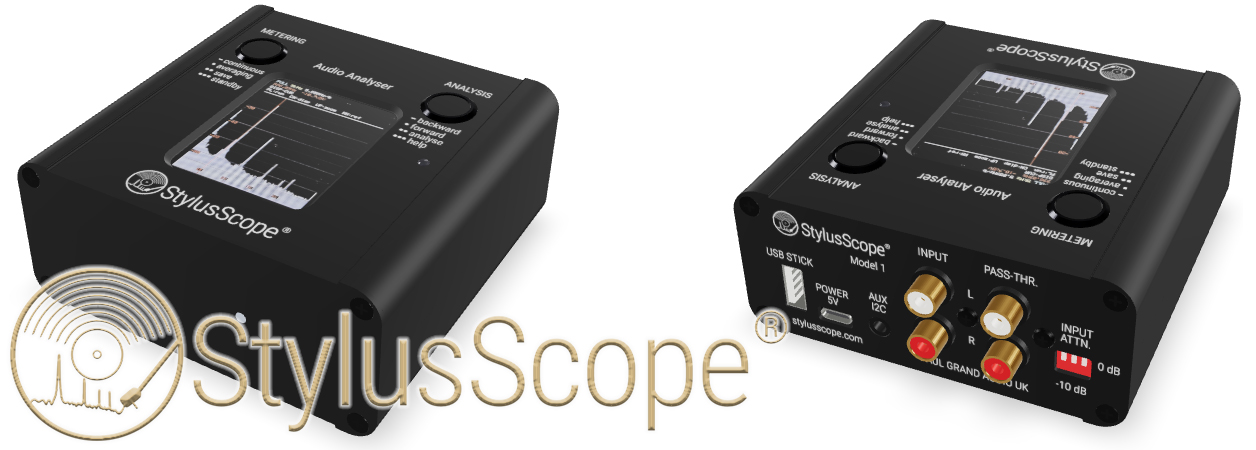
 "After 10 months of intense work and what for us was a significant financial investment, we just kicked off our next chapter as Paul Grand Audio UK, formerly Life-Changer Audio UK. We don't write often. When we do it's because there's something worth sharing. Now there is. 10 years ago I launched the icOn. Then a passive-magnetic autoformer preamplifier with microprocessor control, personal settings and an Apple remote was an unusual idea. Today I'd like to introduce the next one. I have played records for 50 years. One question never had a satisfying answer. How worn is my stylus? Counting hours tells you how long it's played but not what it has become. A microscope shows you a shape you must still interpret. The usual advice is a round number of hours with no evidence behind it. So I built a way to measure it. StylusScope sits between your phono stage and preamplifier. It counts every hour your stylus plays, automatically. When the stylus is new, you play one track of our test record to store a baseline. Every 50 hours a light reminds you to check again. Play the same track, press two buttons and the screen shows you exactly how much distortion and output of each channel have changed. Your own wear curve builds over time. Stop guessing, start measuring—get a number. Compare it with the same number from when the stylus was new. No computer, no software, no microscope. It will never tell you to throw a stylus away. It only shows you what changed. What to do about it and when remains your decision.
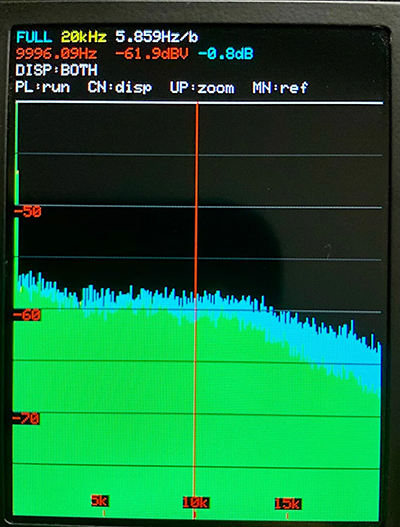
"I measured one conical stylus from new to 1000 hours. Its intermodulation distortion at 13+14kHz rose 2.7 times, its 8kHz vertical distortion three times, its output level declined by less than 3dB. That's why wear goes unnoticed. What it takes away first is the air on top, slow enough for the ear to adapt. One stylus is a case study, not proof. The full report is on our website. Measuring a turntable properly usually means a stylus timer, microscope, azimuth gauge, a handful of test records and a computer with measurement software. I own about 15 test records. Only two or three of them are truly usable. StylusScope puts it in one instrument, with one record cut for it specifically:
"It is simple to use from day one and there's a lot to discover once you start experimenting and fine-tuning. I'm preparing short videos on these hidden possibilities for our YouTube channel. I want to be open about how StylusScope was made. For 10 months I worked with Claude, an AI by Anthropic, as my programming and engineering partner—on the firmware, measurement methods, data analysis and documentation. The ideas, hardware, measurements and all decisions are mine. For a one-man company, the speed and depth of the work would have been impossible without AI. I don't know of another audio instrument built this way yet. 80 years after the microgroove record, there is still no public data on how styli actually wear. Every StylusScope owner can export a wear log and add it to the first open dataset, measured on the same record by the same kind of instrument. Together we can answer the question properly.
"The first 50 instruments are ready to ship – designed and made in Manchester. StylusScope Model 1 is £349, US$449 or €449 with test record, accessories and free shipping. All applicable EU import VAT, US customs duties, tariffs and courier clearance fees are prepaid by us. You won't be asked to pay any additional charges upon delivery except for the rest of the world where your own customs authority will apply import duties and taxes when the parcel arrives. StylusScope needs a separate phono stage with its own output. If yours is built into your amplifier, please write to me before you order and I'll advise on your system." Pál & Agnes Nagy