

Country of Origin

 This review first appeared in the March 2025 PDF issue of Audiophile Magazine. We publish its English translation in a syndication arrangement with the publisher and by special request of the manufacturer. – Ed.
Reviewer: Joël Chevassus
Sources: Esoteric K-03 and N-05XD, Cybershaft 21A, Mac Mini M1, HiFi Rose RS201E, Weiss Helios [on loan]
Power & integrated amplifiers: Coïncident Speaker Technology Turbo 845 monos, Esoteric S-5, SPEC RPA-W3EX, Kinki Studio M7, Red Dragon S500
Loudspeakers: Vivid G1 Spirit , Leedh E2 Glass, Recital Audio Illumine Hefa
Cables: Luna Red series for speakers and interconnects. Vertere HB USB and Esprit G8 USB.
Room: 7 x 7.5 m with high beam ceiling, acoustically treated by Tecsart
Review component retail: €12K with 4TB SSD, add €2K for 8TB
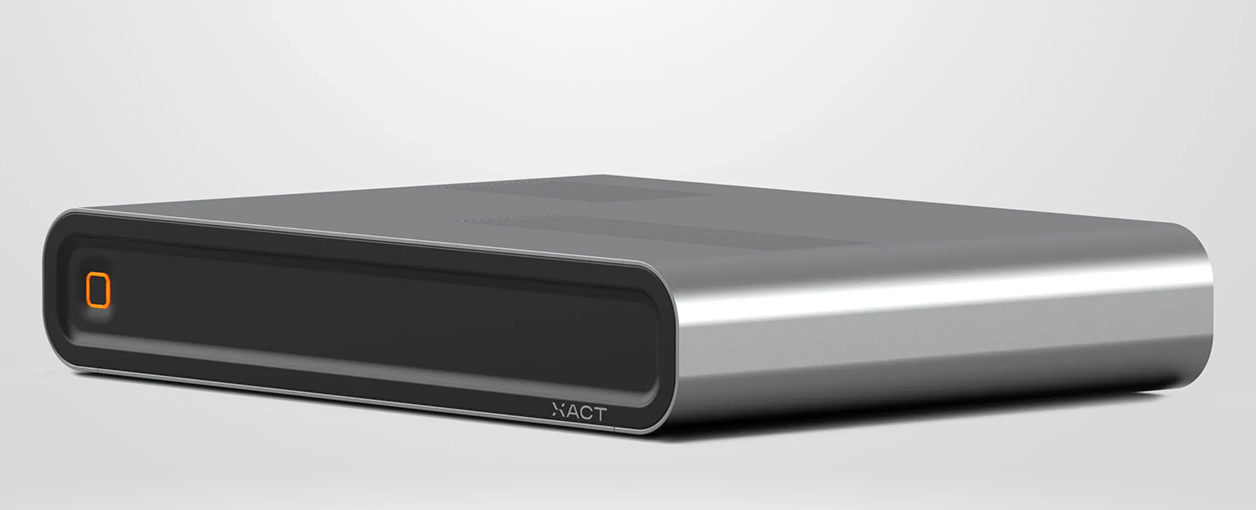
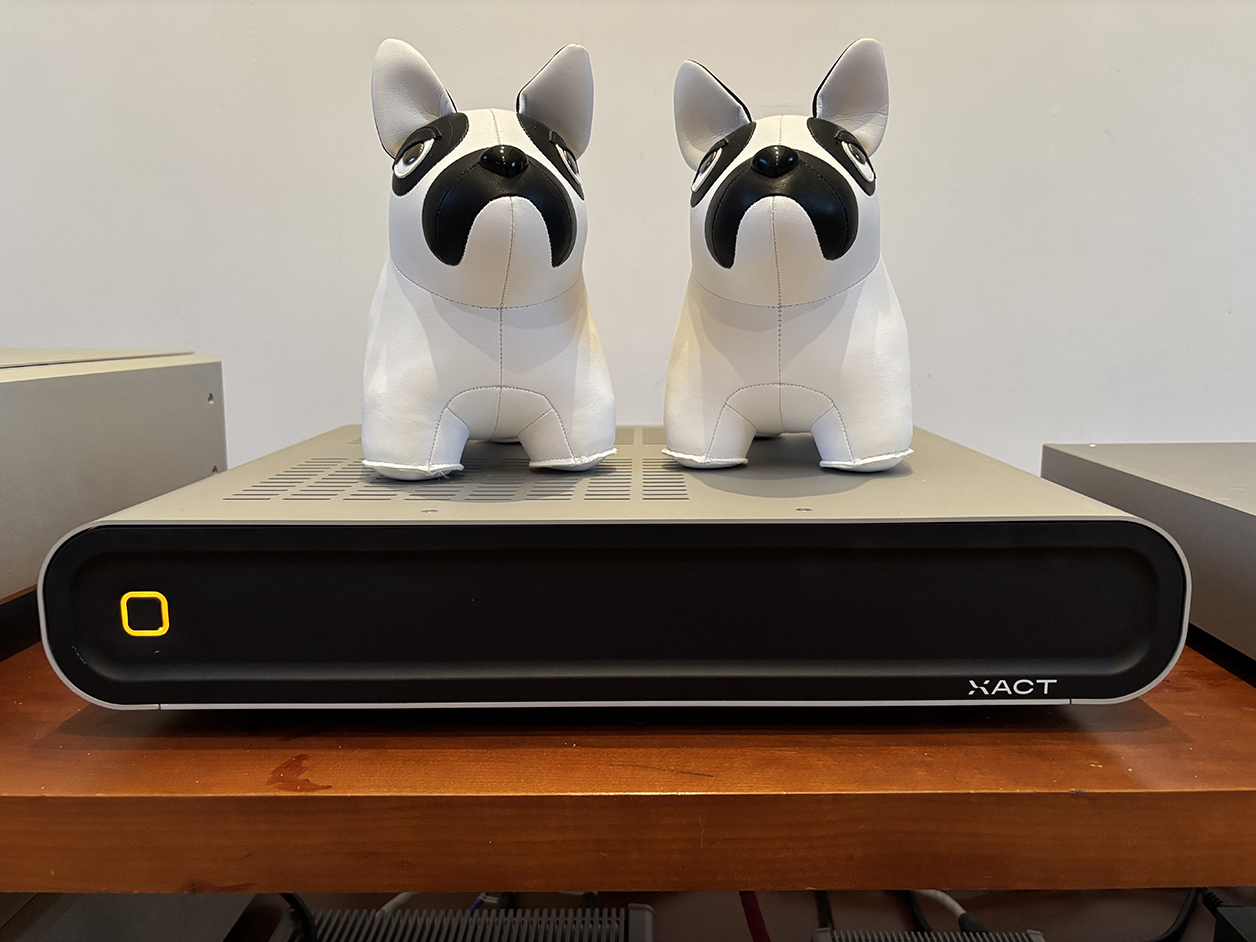
Marcin Ostapowicz undoubtedly belongs to a very exclusive club of actually innovative audio developers. This Polish manufacturer has the habit of designing products for personal use then market them when he believes them fully mature. Per se this approach is rather classic in the niche of upscale micro hifi enterprises. But here R&D takes on a very particular dimension of exploring new perspectives which start with tabula rasa and clearly the stubborn conviction that he can do better by deviating from traditional patterns. Today the XACT brand is the expression of what Marcin has accumulated over the years under JPLAY's software development and its hardware half JCAT. He declares that "XACT today is the best I have to offer". So we expect to be surprised and as it turned out, XACT stuck to its promise of delivering singularity. Its streamer really doesn't look like any competing product. Where some high-end streamers are computers as heavy as large pure class A amplifiers from Pass, Marcin views greater sophistication as authoring his own motherboard housed in a case that suggests more of a large network switch than audiophile streamer. In fact the S1 purportedly took up a full six years of R&D. It's the design he claims ate up the most effort and energy of any since his beginnings in hifi. It took him 3 years alone to develop the motherboard then another three to refine the streamer to his standards. The design of a motherboard specifically tailored for uncompromised audio was obviously the central pursuit. Where generally hifi brands rely on industrial versions for reason of cost, know-how and actual manufacture, Marcin meant to work beyond their constraints of remaining within the confines of noise-riddled PC boards.
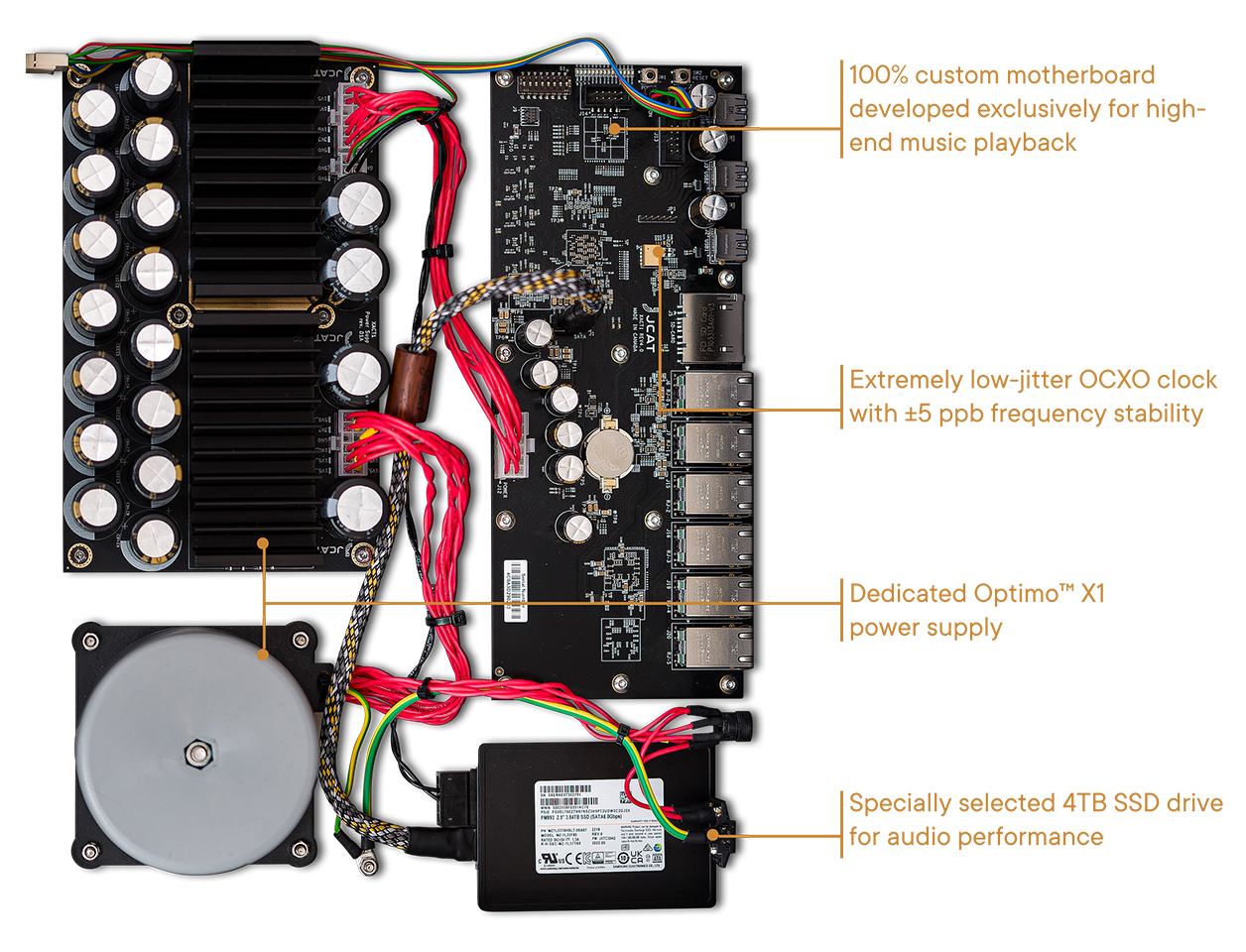
Hence his adopts linear LDO voltage regulators exclusively and a purely linear power supply with zero switching cells. As a blank-sheet effort finalized in collaboration with Canada's Adnacom, he views it as unprecedented in digital audio. His work with Adnacom dates back more than 10 years to the days of launching the JCAT USB and LAN cards. That firm is known for its prestigious clients Boeing, CEA, CERN, NASA, Cisco and Microsoft. Each part on the board was carefully selected to avoid all redundancies in hardware or software. He uses his own oven-controlled oscillator clock and parts like Nichicon Muse caps. Key to the design is perfect synergy between hardware and software, with the latter condensed from his work at JPLAY. It means his own Linux-adapted OS ideally matched to his hardware configuration. It is admittedly rare to meet a high-end audio designer who is equally fluent in advanced code writing and circuit design. Marcin Ostapowicz has surrounded himself with a very small team controlling these two areas to explore paths he believes no one has really taken thus far. Thus his operating system is customized with a real-time core to minimize latency down to the order of microseconds. By concentrating the entire R&D on a single team, he fully controls all aspects of the product's evolution. So he personally tests and signs off on each modification of hardware or software. The power supply is based on the JCAT Optimo X1 with 140'000µF of filter capacitance. The regulators operate according to a controlled voltage model in an open loop based on a highly accurate current source integrated into the circuit. The capacitors of very low impedance are generously oversized to guarantee optimal operation over the S1's lifetime. The magnetics of electrically shielded transformers too are custom to work with reduced inductance and fully linear magnetization traits. They decouple mechanically from the housing with high-quality isolators from the medical industry. All connections use the industry's best gold-plated pins and the power supply connects via top-quality 18-gauge silver-plated copper cables with ATX plugs. The OCXO clock derived from JCAT work guarantees ±0.5ppb stability. Marcin claims the most stable synchronization possible relative to air flow and temperature variances, vibrations, electromagnetic shocks and EMI. The gold-plated connectors are treated specifically for highest EMI rejection. Currently the only digital output is over USB – two type C, one with 5V power and a third USB C to connect an external drive.








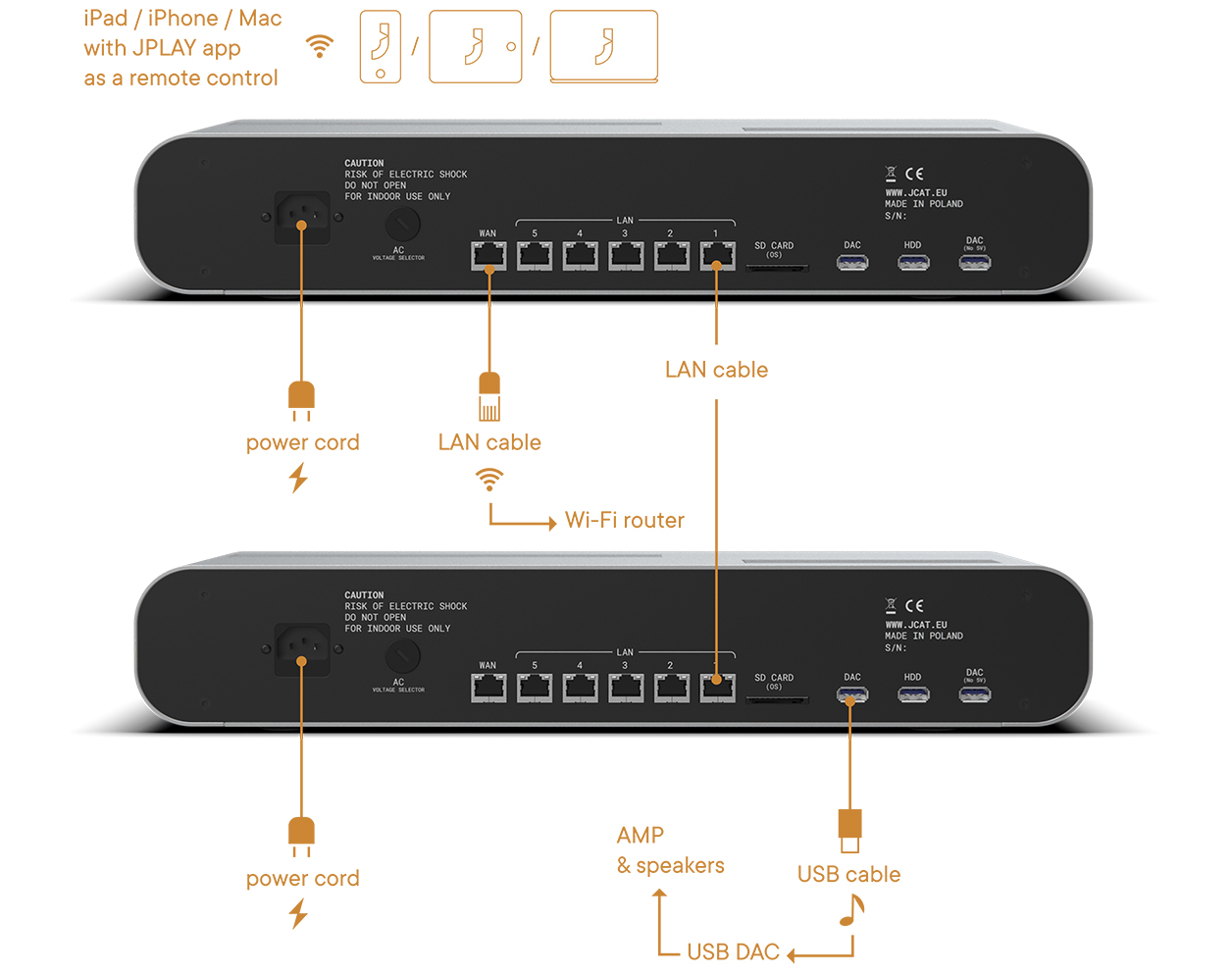
This limitation of USB is a surprise when most streamers offer a wide range of digital outputs. Marcin explains that his choice was predicated on the fact that USB is the only global output that supports all formats up to DSD512. From the point of view of a music server, USB for him was thus the obvious solution. To output S/PDIF, AES/EBU or I²S would first require conversion of the music data on the streamer which he prefers done on the DAC side. AES/EBU and S/PDIF are also limited to 192kHz whilst I²S is far from standardized so not universally compatible. The six Gigabit Ethernet ports benefit from the same surface treatment and anti-EMI shielding. 12 integrated core transformers improve LAN insulation and their LED lights are deactivated to minimize parasitic noise. Curiously, the S1 can't activate its switch functionality simultaneously with that of network player. It must be used either/or so can't perform both tasks simultaneously. The flash memory of its SD card stores the operating system which determines its functionality. Hence the above schematic which shows two S1 connected, one as switch, the other as network player. The technical rationale for this total segregation of functions is not being managed by the same operating system to avoid compromises. In streamer config we must use the first RJ45 port for the network connection as the other ports then disable. But the S1 can obviously process files from a NAS or its own 4TB SSD (8TB optional). Marcin's chosen SSD is from Samsung connected via his own wiring since XACT also specializes in designing and making digital cables. If the aluminium chassis is not as flattering as that of my Esoteric N-05XD or the Pinkfaun 2.16 Ultra I reviewed recently, it is nevertheless perfectly designed for fan-less use and has the good manners of not breaking your back each time you move it thanks to its 9kg featherweight. Data support is up to 32/768 PCM and DSD 512 and the embedded JPLAY license for life.
 The XACT app doesn't burst with config options so is very easy to use. There's no need to procrastinate to get going. The two main options are using an external file server or the internal SSD. I thought it easier to start my comparisons with the same file server so used my NAS Synology with MinimServer 2. The differences were quite blatantly obvious. Overall and compared to my Esoteric N-05XD server, the XACT brought very clear additional transparency that I had never yet obtained with other digital transports. Everything seemed more defined and the structure of the stereo panorama clarified significantly with even a slight spatial enlargement. The speakers seemed even less localizable but it was really the newfound level of transparency which made all the difference. We too often use exaggerated expressions to describe this kind of improvement so I reluctantly use a reviewer cliché but it really seemed that with the S1, my music hoisted an extra sail. This additional transparency brought to life a layer of background information on fairly stunning orchestral music. The N-05XD simplified it by contrast and reduced depth of field. The S1 sounded far more impressively holographic which clearly bigged up the sense of realism of attending actual concerts. On Prokofiev's 2nd Piano Concerto with Abdel Rahman El Bacha, the orchestra felt almost 'degreased' with that much more information present. It revealed all its complexity in the lower midrange and bass while remaining perfectly intelligible across the actual midrange. I listened to the S1 on a number of speakers from €100'000/pr to less than €3'000 and was convinced that the XACT contributed a more significant improvement than changing loudspeakers!

12
