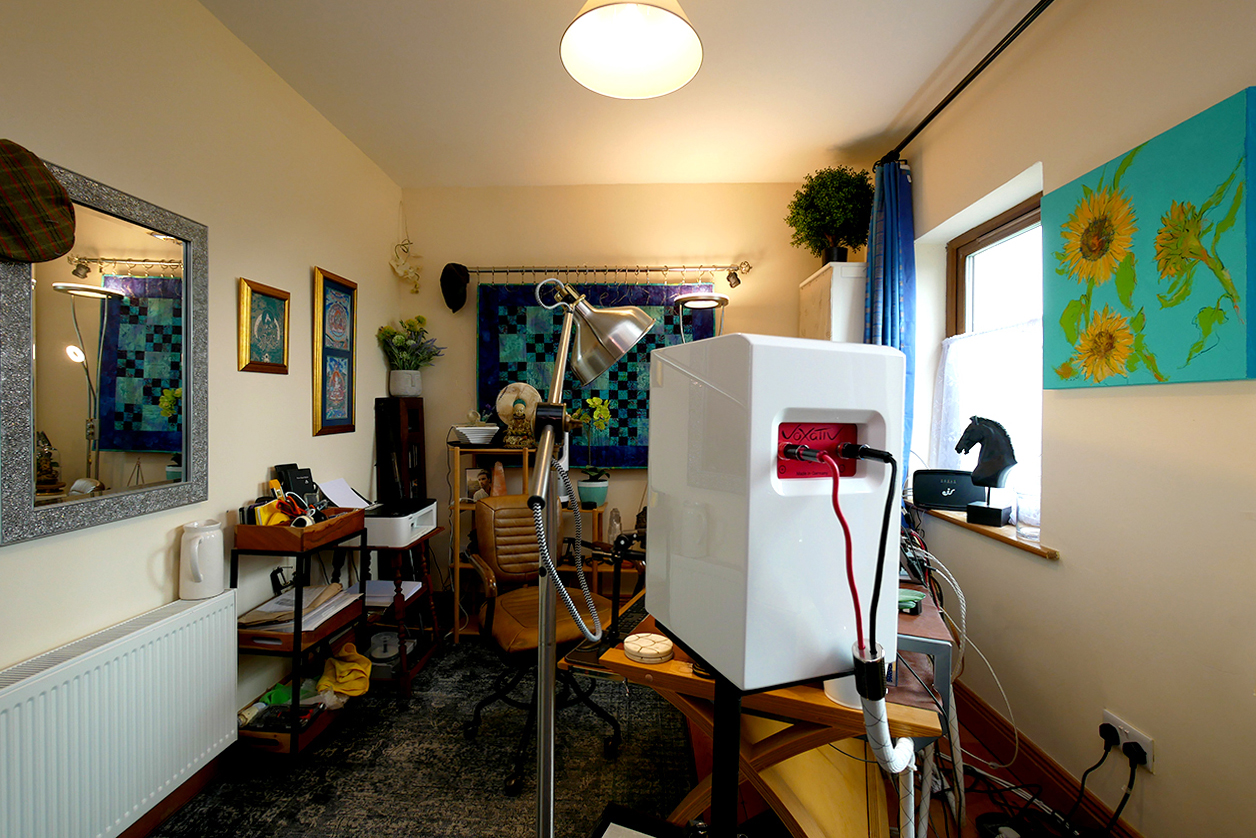
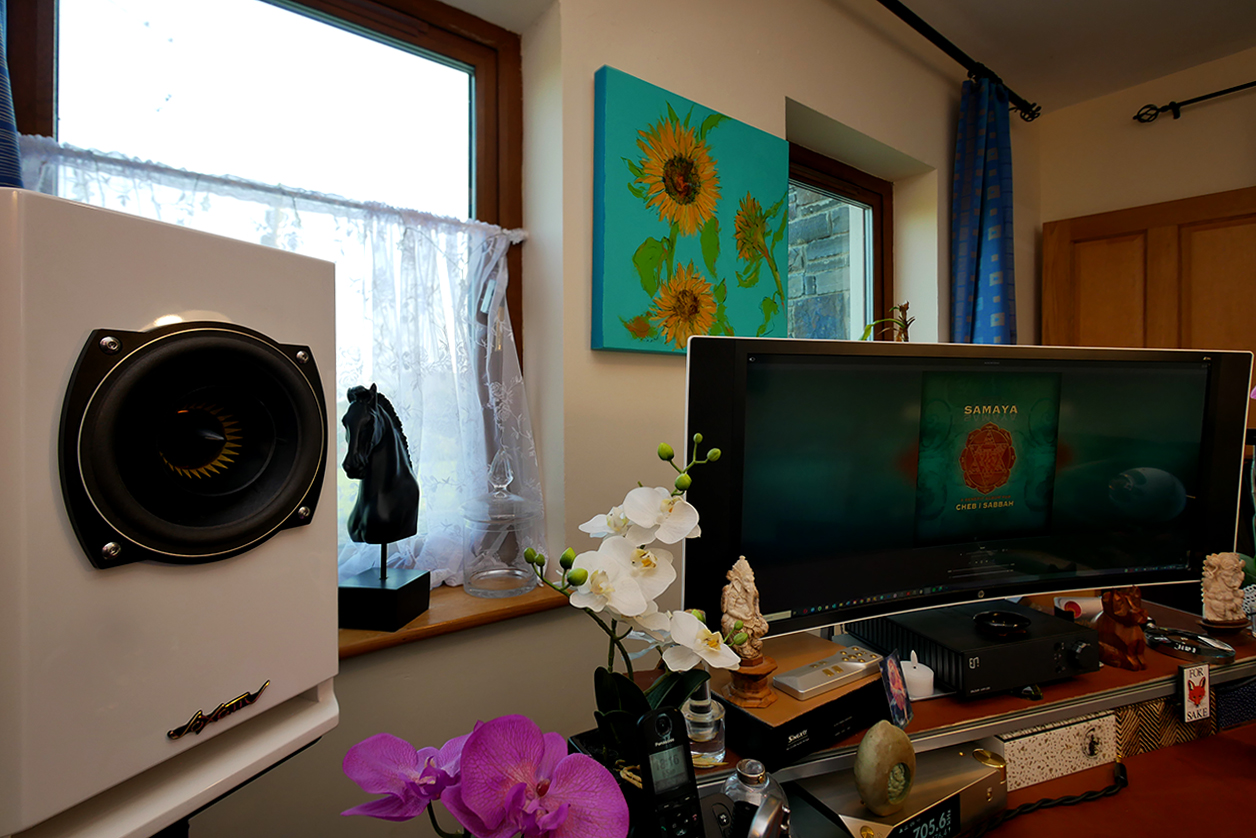
Black 'n' white. Inès had merely ruffled my blackened feathers. Her shipment included black and white pairs to show off both finishes. For my nearfield pix I naturally grabbed the white with the AF-2B henceforth referred to as simply White to avoid spilled alphabet soup. Widely spaced binding posts sit high so right behind the driver. Their deeply inset mounting plate with the company logo and model name is red. The chunky terminal barrels dress in gloss carbon fibre. The lacquer looks as though frozen dripping wet so flawlessly lustrous. The shiny gold of the frontal Voxativ badge with its black background adds another touch of cosmetic flair. So does the beige star around the pointy phase plug of the black diaphragm suspended with foam then set into a black mounting frame with silver edge. One needn't be a hifi insider to see Hagen's luxury ambition.
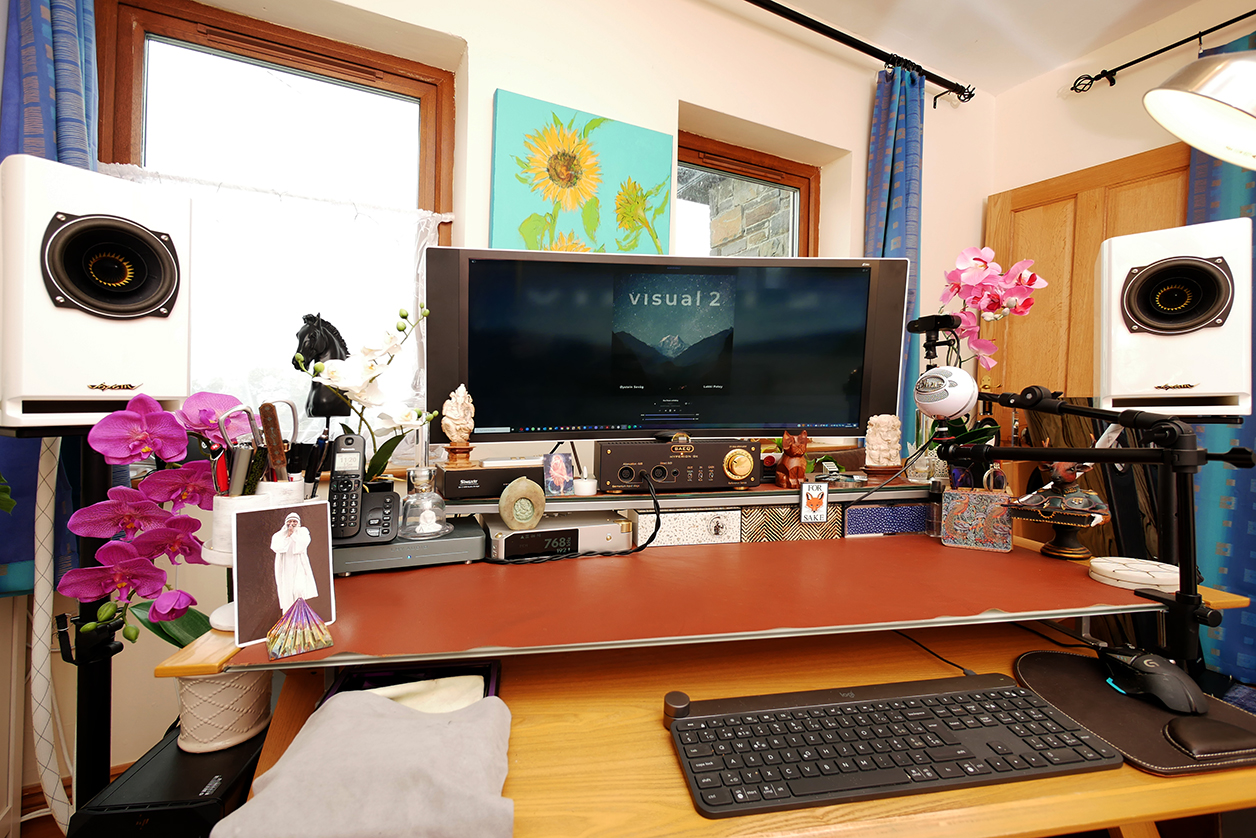
Whilst clearly more sensitive by quite a number of clicks on this 24-step attenuator, White just as clearly lacked all low-down weight to do Ryuichi Sakamoto's solo piano of Opus any justice, never mind even intuit the foundation of Halaken Soundsystem with Mercan Dede and Dexter Crowe. On bass completion Black clearly came up short against my usual Dutchies too, just a bit less so. In solo nearfield mode on my modern music, it would be just about borderline if I curated my playlist mindfully. I had just enough midbass reach to work whilst being ever conscious of what remained under the table. White would have to sit bored and disqualified on the carpet to await subwoofer assist in my two other systems. This was the sad reality on the SAEQ amp's sub 5mΩ Z-out. To insure that its value wasn't the culprit of premature bass expiration, the 25wpc Enleum AMP-23 with its 0.5Ω stepped in. Much better. In the bigger systems, the SIT4's still higher 4Ω promised yet more bass boisterousness. For the desktop, Black on the Enleum now had virtually ideal tonal balance. The tipped-up whitishness on the Hyperion Ge—over-edged transients lacking in bodily follow-up—had found its antidote of blackness. The tonal bloom portion gained mass. Equilibrium restored. Message to self: why snub lessons already learnt? I knew from prior rodeos how this type driver abhors too many impedance zeros behind the decimal point. Shun explicit overdamping. For this job, three/four-figure damping factors are the devil's work. In fact, on this type transducer a damping factor of 1 can be best. Hence the routine preference for SET. With the FirstWatt amp too large and far too toasty on the desktop, that chapter remained to be written. First I had to milk office joy and learn whether White would step up to Enleum's plate.










It did. Though upper midbass was at least 3dB down versus the presence region, there was enough of it to counteract most of the earlier crass upshift and serve Kalya Scintilla's Remix Archives Vol.1. without feeling completely emasculated, just rather less hung than usual still. Then came plenty more than usual on the asset ledger. Before we grab that, Inès responded to my question that I'd framed like so: "Sensitivity as I understand it is a function of moving mass (diaphragm, whizzer, voice coil, surround, spider) and flux in the gap. So either the AF-2B's motor is stronger, its moving mass less or both. Right? Is there anything significant about the fact that this paper is now black? I don't exactly remember the geometry of your earlier whizzer but this might be a bit narrower of diameter but longer?" "You are right. Everything you wrote is true. Both motors do have more power. Also, the magnet gaps are much longer now to keep the voice coil farther immersed in the magnetic gap and obtain more possible stroke. With this and a smoother suspension, we get more bass. The measurements show that both drivers go one octave lower than their predecessors. The black paper is mostly a design decision. I think it looks much better and the paper makers who do the Japanese calligraphy paper for us were able to colour the paper to give us the same quality but a better look. Geometry is optimized too."
By then I'd already taken White upstairs for the subwoofer tango. Here seamless integration doesn't rely solely on correct frequency and dovetailed amplitude handover. We also chase textural continuity to avoid a softer zone above and below which tonal grip intensifies. To narrow that zone required raising my usual 70Hz transition to my analog filter's highest 120Hz value though the upper bass was still softer than what happened beyond in either direction. That was the first deviation. Related was dynamic nonlinearity focused particularly on the third octave above middle C so 1kHz+. Whenever a performer leaned into this octave with emphasis, that jumped upward and forward of the dynamic fluctuations below it. Like a beauty deviation from AI-generated facial symmetry—an eyebrow slightly higher, a mouth not perfectly centred, a nose not completely straight—this amplitude/dynamic flaw gave White its hyper-resolved personality of electrostatic headphone sound taken out of the skull prison and let loose wall to wall behind the speaker. Simultaneously Anja Lechner's cello and Renaud Garcia-Fons' 5-string upright lacked their usual gravitas. The lower mid/upper bass was still a bit lightweight to do them full justice. Increasing low-pass level to compensate overdid the lowest 1½ octaves. A 200Hz handover might have been ideal but my hardware couldn't accommodate it. As Inès had put it, "my personal opinion is that the AF-1.9 is superior. Its resolution is lower but the overall tuning more even and the bass much better. What do you think?" Spot on. Resolution brought about by nonlinearities in various performance aspects isn't true resolution. It's just a magnifying glass held over a specific bandwidth. Whatever falls within the scope of the loupe increases in intensity or 'pixel count', the rest remains normal. After all, concentration works by exclusion. Not that Black's take on resolution was normal, either. Whilst far more even and anchored than White, its lucidity and contrast demonstrably eclipsed that of my desktop residents. Though subjectively less resolved than White, its resolution was far more honest, its balance truer. It was superior to my classic Acelec 2-way but on the Enleum not its equal in bass reach and weight. Those aspects simply weren't a subjective demerit on the desktop where I prefer a somewhat lighter tonal balance. Given this assessment between siblings, I decided to bench White for the duration and focus solely on Black. The path to ever higher speaker sensitivities seems far from clear-cut; and Black costs €2K less.