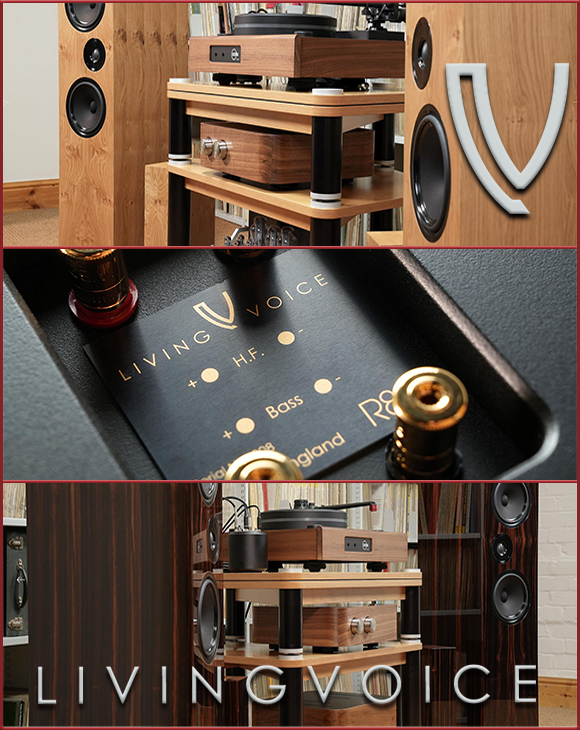
RiPol's quasi cardioid dispersion unclutches the usual dependency between smaller room and problematic low bass riding room modes. It's how without acoustic room treatments I enjoyed linear non-lumpy low frequencies. Those deepened the colour palette's black values which saturated all other colours. Call it perfect compensation for a small widebander's exceptional speed and its shadows of potentially lean, crisp and whitish aspects. It's the same line which divides most all 2-way monitors and 3-way floorstanders with bigger cubic volumes and woofers. The standmounts usually have the edge on subjective resolution, transparency and imaging magic. The towers beat them on substance, colour temperatures, image density and shove. On which side of that line we prefer to live—or how close to the centre—determines so many of our hifi choices. Alberich²'s success lies in infusing the tower speaker with a small monitor's strengths from the top all the way down to the soft-nosed conical footers; then infusing the monitor from that very bottom all the way up into the whizzer cone with the tower's virtues. That's how we meet in the middle. It speaks to Marie Adler's insistence that this isn't a case of docking a standalone monitor atop a generic sub to bolt on extra reach. It's purpose-designed unity split across two cabs. This separation is just physical for obvious isolation benefits. Acoustically there is no separation but oneness. That's no pretty philosophy. It's a very tangible experience that's predicated only upon successful prior knob play to lock in the adjustments. In my case it included a precision active high-pass on Hagen². It's a trick Grzegorz Rulka of Virtual Hifi has borrowed for his new Viper monitor. It includes a selectable 80Hz high-pass executed with a premium 200µF Mundorf silver/gold/oil capacitor for users who wish to add a sub.

Herb Reichert called Hagen an engineering achievement he spent almost 50 years searching for. My number halves his. At 18 I wasn't searching for my perfect speaker. At 18 I went to India in search of a guru and commune. But since I joined hifi then launched 6moons by 2002, I circled the widebander wagon again and again like a moth does a white-hot lightbulb. I reviewed numerous Voxativ, Zu, Rethm with/out Lowthers, Cube, sound|kaos, Bastanis, Lindemann, Camerton, MonAcoustics, Qualio and more. I heard small and large single-driver executions move the monitor/tower line with 4"-10" diameters. I sampled rear horns, tapered quarter-wave tubes, ports. I heard integrated and external bass systems. I watched purist all-on-one-cone notions concede defeat to embrace complete bandwidth with clever multi-way hybrids. I've always owned at least one example of the widebander breed throughout my audiophile career's fluctuating speaker collections. Ever since discovering Raal's original TrueRibbon SR1a headphones which today upgraded to their triple-ribbon Immanis and twin-ribbon Magna, I've applied their rigorous 'no policy'—refuse filters, diaphragm mass, energy storage and room issues—to speaker expectations. It's nearly predictive that serious attempts at cloning ribbon headphones with speakers would involve widebanders and cardioid bass. Against that backdrop, Voxativ's Alberich² is first to in-house engineer a 5" twin-cone widebander then combine it with the best-damped hence quickest bass loading via active 12" RiPol woofer. Even the built-in plate electronics aren't off the shelf. Whilst I didn't search for it, it nonetheless found me. Now that we met, it's everything I thought such a combo would or should be. Does that make Alberich² a Srajan speaker? That phrasing reeks of (cough) classic cloning so I won't spell it out. You do that math. Whilst weighing and counting it, loupe-wielding buyers will notice how the glossy lacquer skins don't extent to the internal surfaces exposed by the front and rear slots. On my samples that transition of lacquer to white paint wasn't perfect. Cosmetic extremists could prefer a thin inset grill at least in the front if not back like the sound|kaos Vox5 executes in bronze mesh. It didn't bother me so the mention just keeps it honest.







More honesty must go to the treble. As an admirer of Mundorf's small dipole AMT—it flies atop my Qualio IQ and ModalAkustik MusikBoxx on short open baffles—and Raidho's planarmagnetic tweeter often falsely called a ribbon plus of course the actual ribbon earspeakers, I'm a bit of a slut for exotic HF. I love air, decay trails, fully illuminated upper harmonics shifting with tone modulations, firefly swarms around cymbal and triangle strikes, steep transients on blitzing flamenco-guitar runs. These qualities the compression throat tweeter in my Zu Soul's big widebander doesn't highlight. That design majors elsewhere. Whilst Hagen² doesn't equal my open-backed AMT on ultimate refinement, energetically it meets them head on. Voxativ's whizzer whose vibrating surface far overshadows a 1" dome is no wallflower. If you find the Zu aesthetic a bit warm and opaque on top, this isn't that. So rewrite populist 'it is what it is' preconceptions about wheezy whizzers. Just as it does down low, Alberich² pushes the envelope on high. That really takes to close-mic'd unplugged productions whose overtone capture is more explicit. One presumes that here Voxativ's extensive experience with paper—the whizzer's precise cellulose mix, thickness, shape and diameter—factors big. Predicting sound from specs on paper never works. In this case, matters on paper very much matter. All this by way of suggesting that even exotic tweeter freaks shouldn't feel short-changed by today's candidate.

Of course music's lion's share lives between the two extremes just as the mass of North America lives between its narrow Eastern and Western coasts. Having that big bandwidth come off one compact bi-cone without filter stitches or cone flex creates a kind of wholeness which speakers with 1-3kHz crossover often can't match. We call them seamless but by direct comparison, a widebander registers different on the nervous system. It's how across my hifi years, I've drifted into this niche then made my home there. I can enjoy multi-way speakers like my prior Audio Physic Codex just fine and find no real fault. But if a good widebander is at hand, my listening reactions inevitably trend toward it. That's not belief manipulating perception. It's an observation of a more instinctive selection process. I recently gave away six pairs of speakers which collected dust and took up space. I could listen to them at any time yet found myself gravitating toward the widebander hybrids. My pet theory on why is timing. Many people prioritize frequency response linearity. Fewer are dominated by the time domain. I suspect that I'm a citizen of that latter smaller nation. I'm in fact convinced because of my love of headphones. They're quintessential filter-less widebanders in extreme proximity. Transposing their gestalt into a room opens up a whole can of worms if we can't accept too much loss in translation. We should probably agree that running another widebander across the majority bandwidth to eliminate a crossover anywhere near the presence region is a good start. At least that's become my way of thinking. Here Alberich² demonstrates beautifully how to actually implement that in the real world. That it must include friendly dimensions which regular homes are happy to accommodate goes without saying. No more capacious rear horns in favour of narrow active bass systems turned 90° which enables a 5" widebander to set overall width. What else should we be saying? For that we move into my bigger system where getting properly Wagnerian was more appropriate.