 How about by contrast to its most famous stablemate? The 2024 relaunch of the original Ampeggio at right which I reviewed in 2010 and Stereophile's Art Dudley a year later has fully passive 18kHz bandwidth whose LF roll-off begins at ~60Hz. It presents our eyes with a 40x120cm baffle so is twice as wide as the stack and taller, then adds an unsightly large horn mouth my cat Chai Baba would walk right into. Its driver concept is older than Hagen's, price depending on driver refinement €14-27K. Here too Alberich seems to be a cat amongst pigeons. And knowing of my disdain for black hifi particularly in fingerprint gloss, Marie even promised a review stack in white. Talk about anticipation.
Before we bid adieu to Wagner's colossal opera, Marie reminds us that the Nibelungen saga has many more protagonists. The modular concept begun with her short and tall stacks of Alberich is just the beginning. Given that the composer's home was Villa Wahnfried which best translates as respite from mania yet the full Ring orchestra employs close to 90 players including modified French horns called Wagner tuba and a bass trumpet; we should probably think big. Today of course we look in the opposite direction. We want to learn how to get the most augmented widebander bandwidth from a still compact form factor. A final wrinkle to cover are Voxativ's trademark faceted rear horns inspired by the odd angular shapes of radar-eluding stealth fighters. Their modelling tabulates angles vs wavelengths to minimize reflections within the horns. For a given bandwidth, this allows certain values and forbids others to create an acoustic invisibility cloak that leaves our ears none the wiser. This purportedly can't be done with the smooth curves that our intuition might think superior. It absolutely relies on very precise angles. Though short and invisible, such a faceted rear horn lives inside Hagen then opens through the narrow front slot. It's a bit of white—or if you prefer, gloss black—code magic. Alberich's decisive distinction is that it no longer involves the low and mid bass.
And as I wrote elsewhere, "Thor came to be in a burst of anger and immense dissatisfaction whilst listening to widebander bass". That quote is from the website of Aurai Audio's Alain Pratali. He adores the old Supravox widebanders and has designed numerous speakers around customized Supravox cones. Today all of his floorstanders have discontinued in favour of 6.5" and 8" two-way monitors plus that 4th-order bandpass isobaric sub with 350 watts of class D called Thor. Making taut low bass commensurate with the demands of modern music is a very tall order for light-coned widebanders even loaded into large rear horns or TQWT. It's not just about reach but damping and speed so bass textures. If properly matched, dedicated woofers fronted by high-power direct drive rather differ on that score. It's why so many widedbander purists who first did it all on one cone have already come around to the idea that moving the bottom 2-or-so octaves to dedicated bass weaponry is far more effective and compact. Lastly, Voxativ v1 outsourced cabinet production and gloss lacquers to the Schimmel Piano factory which added production costs. Voxativ v2 outsources its cabinets more cost-effectively and has gone standard MDF beneath the lacquers.







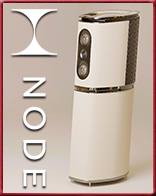
 Who does Alberich look at? Décor-conscious listeners with money but zero appetite for monster amps. This semi-active build eliminates the need for external muscle, the self-damped nature of efficient widebanders the rationale for low output Ω and the potentially very high negative feedback to achieve it. Say hello to zero NFB 300B SET, Voxativ's big-bottle 211 or FirstWatt transistors. Even my Enleum AMP-23R's high-ish Ω falls right in line with what this type driver thrives on to not overdamp. We can focus on smaller simpler better-sounding gain circuits. In trade we need two possibly long power cords for the active subs; and matching interconnects to get signal into them. With the sub's access panel high on one side not the back, most installs will probably prefer the resultant cable connections on the outside like below to achieve a cleaner look. The mirrored layout of the woofer bases supports this.
Alberich also eyes shoppers who previously thought the "single-driver" concept too outré and limited to lovers of Baroque spinet and singer/songwriter fare. Those high-power AlNiCo RiPol woofers should love to feast on some depth-mining electronica seasoned with glitch. Naming notwithstanding, Alberich strikes me as a serious attempt to normalize and demystify the breed despite still exotic design DNA and artisanal standing. Even perennial naysayers might finally have cause to reconsider? So much for phoning it in from stage to pit. Anything more now means laying on ears. I'll preface that by expecting to be impressed. After having reviewed standalone Hagen and with a dual 15" RiPol sub in my main rig, to me everything about Alberich made very good sense. But how would it all translate in the best—cough, only—seat of the house? [My brother on the French horn. Click link to learn about Bayreuth's orchestra pit and telephone.]