Our boxed review sample showed simple but adequate packaging. Assembly was a piece of cake. Remove all parts from the box, remove the rubber cork from the bearing's opening and insert the shaft of the sub platter. Run the belt from pulley to sub platter. There are two pulley sizes, the smaller for 33.3rpm, the larger for 45rpm. Switching between speeds is thus a manual job. Next put the lightweight acrylic platter on the sub platter, slide the dustcover into its hinges and presto, a complete turntable. The clear acrylic version is slightly exhibitionist in that some of the electronics are partly visible. With the black version, this is obviously not the case.

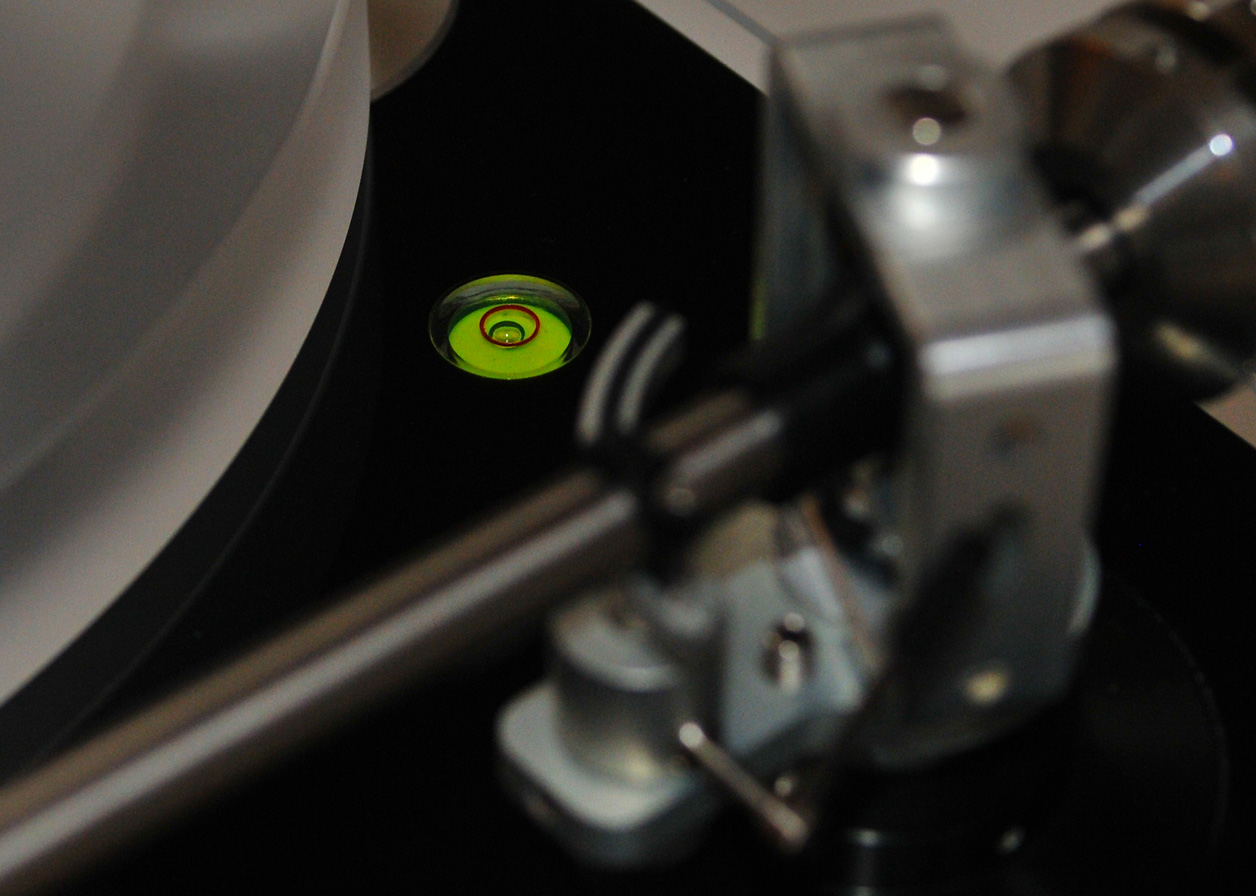
With the adjustable feet and spirit level built into the plinth's top, it was easy to set up both tables for perfectly horizontal. Talk about complete completeness. We checked the factory alignment of the arm/cartridge combinations with our Dr. Feickert Protractor which both were spot on. As for VTF or vertical tracking force, the MM table was exactly on the recommended 1.8gr, the MC table at 3.0gr slightly over the recommended 2.1-2.5gr. Power for the AC motor came from a simple but effective wall wart.

Both captive interconnects were equipped with no fewer than three ground wires ending in two spades. We connected the MM table to the MM input of our Trafomatic Reference One phono stage and the MC table to its MC input. As the Quintet Bronze is rated with an internal impedance of 5Ω, we chose the closest setting of that value on the Trafomatic amp, 50Ω for a start. The rest of the system was a Music First Passive Magnetic preamp and Trafomatic Kaivalya monos. Speakers were Avantgarde Acoustic Duo Omega assisted by a pair of Zu Submission MkII subwoofers.












Time to play music! We selected a variety of records covering different styles. The first Takumi to play was the one with the MM cart mounted. We played the Zita Zwoon Group Dancing with the Sound Hobbyist, Rob Wasserman's Duets, Eric Vaarzon Morel & Chanela's Flamenco de Hoy, Paul Simon's So Beautiful So What, Neil Young & the Blue Notes' This Note's for You, Joe Cocker's Sheffield Steel, Stanton's Stanton, the Standing Stones album and Salvatore Accardo's Paganini. The latter is a 45 thus needed the belt to be switched to the larger pulley.
After this selection of albums had run its course, we liked what we'd heard in a musical sense. There was a nice tonal balance across the overall frequency range. Bass was not ultra deep but very acceptable. The top end was pleasant with the exception of the Paganini album which leaked a little sharpness. We also liked the arm lift's action, being simple and well damped. The lowered needle never hit too hard. Our Standing Stones as a collection of so-called New Age music is a bit warped. Even though the vertical movement of the cartridge looked like it were riding a roller coaster, the arm's bearing made up for the unevenness and sonically there was no notable price to pay.

We played the same selection of records again but now on the clear Takumi fitted with the Ortofon Quintet Bronze MC. Right off the start the difference was obvious not so much for musical enjoyment but by ticking off more audiophile boxes. The perceived soundstage was larger in width and depth. Dynamic impact was stronger. We played with the load settings at the chosen 50Ω but also experimented with 20Ω and 100Ω options. Changing the load changed the tonality slightly where we preferred the original 50Ω setting because the dynamics and tonal balance in the midrange were most to our liking.

In conclusion we must admit that Rik Stoet did a really great job. He managed to design and get a turntable made that is complete on all fronts. For the price paid, the customer gets an excellent no-fuss product where the Takumi Level 2.1 exceeds its ask on musical quality, looks and completeness. And of course there's plenty of room for upgrades. Apart from the offered cartridge move from MM to MC (we would add that considering a Denon DL103 or one of its upgraded versions is an interesting alternative), the wall wart can be swapped for a high-quality power supply. Rik is already working on his own. When vinyl is your (new) passion, the Takumi TT Level 2.1 may very well be your solid centerpiece for years to come; a sound investment.