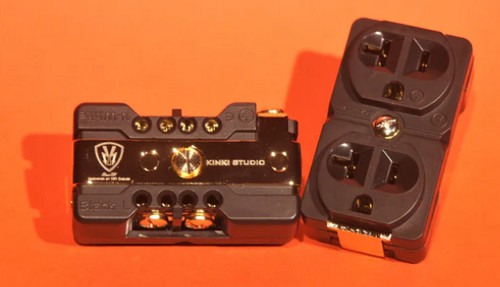
 Come February 6th 2025, limbo relaxed and this story took an unexpected turn. The new product is actually badged Kinki Studio + Vinshine Audio so presented as a collaborative project. The model name is Tai Hang for a power enhancer with 4x15A US/EU outlets so a total theoretical capacity of 60A max limited by our wall outlet's 15A. Inside sit two large inductors to increase current delivery and prevent dynamic compression on even powerful amplifiers. Two large banks of 30/ea. Nichicon Gold capacitors absorb DC components on the power line. As we already learnt, this in turn rebalances the AC relative to zero volts. Single-crystal copper wiring links up cryo-treated power sockets.
There's no on/off switch. The moment the 100-240V power inlet connects to utility juice, the device is live. "Surge protection is built in. When powered on, the front LED lights up." On the mechanical side, the solid build claims dual-layer vibration dissipation effects. The four footers can height adjust for perfect levelling. Tai Hang measures 31.6 x 31.2 x 11xm WxDxH and weighs a substantial 9.8kg. My dress code for this date would be casual. This component category I already understood and appreciated. As we read on the back panel, Kinki Studio call it VoltGuard DC Shield. Rather than appear on Kinki's global website, Tai Hang lives on Vinshine Audio's site as the global reseller. It's a clever way to skip rebranding with yet another name whilst still separating this power accessory from Kinki's main business of amplifiers, preamps and integrateds. Instead of me losing the plot, I suddenly felt rather on board. Not visible in these photos, the top cover sports the Vinshine logo. I couldn't think of a better made-in-China endorsement.
 The ground post could in particular look at turntables and phonostages?
 With a S$1'394 or ~€1'000 launch prior to stabilizing at S$1'694 or ~€1'200, Tai Hang falls right in line with Kinki Studio's established positioning.
At left we see the cover's Vinshine Audio logo. Dealing with Alvin's ace Singapore team means excellent support pre and post purchase. That's an intrinsic part of the Tai Hang package not easily duplicated by competing brands from this wider region. Translation: if we shop for rock-bottom coin on Ayoshida, AliExpress and equivalent online platforms, we're not buying the extra value which team Vinshine add to guarantee original not fake or previously repaired product; plus prompt resolution of potential issues arising from shipping or other mishaps.
'Best price' is a real thing. But what does it buy us, exactly? And, is 'best' just about raw hardware or does it include the type customer service which won't have us hung out to dry in a tight noose when Murphy strikes again?
As to the name Tai Hang or Taihang, like CHoco Sound's Emei it's a mountain, in fact a 400km long range of mountains between 1.5-2km tall which cut across the Chinese provinces of Shanxi, Henan and Hebei. It's how Kinki Studio celebrate rather than hide their Shaolin Hifi origins. Good on them!










Likely because the Hong Kong warehouse had itemized the contents as "plastic amplifier to improve home audio", Irish customs in Shannon couldn't correlate the weight so embargoed the shipment. After a few days of being on hold, I asked Alvin to intercede. My best efforts at dealing with the DHL customs liaison had come to naught. A day later, his carton cleared apparently thanks to Annie in his office. All hail Annie the red-tape cutter. Customs had even opened the carton but likely no idea what they were looking at other than, plastic was nowhere in sight. Like all prior Kinki kit, Tai Hang is a chunky customer with a high weight/size ratio. With its deeply rippled fascia and miniature power LED, it's also understatedly handsome. Time to take my date to dinner and learn where it might lead. "Wanna come over to my place?" That's where. Whilst still on dinner, if you've not eaten for days, pretty much anything will do and you be glad of it. But a snob gourmet dining out at Michelin star joints knows when their plate didn't come straight from chef's hands but parked under a heat lamp for a few minutes. What's the difference? Freshness. A halved apple begins to oxidize and brown very quickly. Tai Hang in lieu of my usual purely passive Furutech bypassed or at the very least shortened that exposure to food 'rust'. How so? Tone colours. If those were a just-made fruit salad, they communicated more vitamins and enzymes, more lively zing and pungency, more acids and sugars building tension and contrast between them. It's kitchen language to map the difference. Would a McDonald's diner notice? I couldn't say. That's not me. I know my system intimately. I notice changes. To me it sounded fabulous before. Yet with Tai Hang fronting my four monaural amps, that tone-colour freshness stepped up.
How to explain its cause and focus? Even more subtle than recorded ambience are high harmonics. To my thinking, lowering a noise floor already down enough to illuminate recorded space benefits primarily upper harmonics otherwise too homeopathic to matter. It's in the upper harmonics beyond the 6th where the 'fruit acids' live which aren't just low even-order sugar i.e. the typical no-feedback single-ended triode aroma. That's my best guess at the Tai Hang's effect in my big system. I didn't hear it impact soundstage depth or any of the other usual suspects when system noise drops. I heard it in the liveliness of tone which, incidentally and to my ears, is already a big focus of the wide-bandwidth DC-coupled Kinki Studio sound and that of Mr. Shoon's Exact Express cables. That man's hand even appears in Tai Hang's custom power outlets. I'm personally not attracted to the common prettifying strategy which artificially sweetens the sound. I prefer the 'bandwidth' of timbres—the difference delta between honey and hot chili, smooth and hoarse, caress and bite—to be maximized. To my surprise, Tai Hang worked in exactly that direction. It broadened the window on tone modulations and timbre liveliness. That brings me back at freshness. If allowed just one word on how I heard Tai Hang shift my sound, that's the one. It's also fair to say that when exploring advances in overtone lucidity, premium tweeters are a must. I'm very partial to the dipole Mundorf AMT of my Qualio IQ and Raidho's planar.