Unholy crap? Whatever your preferred—mature or thoroughly adolescent—exclamation of shock and awe, get ready for hackneyed. Personal foresight hadn't really read anything significant into the brand's Voltair propaganda other than a promise of low-distortion transparency. Hindsight meanwhile knew better; much better. Strap on the big 'd' of dynamics. Having cued up "Wind" from the Øystein Sevåg album Caravan, I wasn't prepared for the sheer violence of the 'thunder 'n' lightning' drums that crisscross the back of the scenery like the horizontal dry lightning discharges did off Coral Beach in Cyprus. This presentation packed bigger vertical motion, more scaled jaggedness, fiercer crack. I had long tried to have this track render over my speakers how Raal's best true ribbon headphones portray its dynamic explosiveness. Now I had it – across metres of expanse, not the six inches of headstage.

I flashed on one of the generic reasons why certain very vocal listeners prefer active preamps: higher dynamic range. If present—not at all a given in my own experience—I always found it accompanied by reduced articulation, more textural fat, diluted energy and lower resolution. It's how I became a passive or no-pre practitioner. What the Crossover Mk2 did was bolt on turbo boost for amplitude expressiveness then save me from all the other "active stuff" I don't want. My preference for mountain-water freshness and a brisk Nordic summer day without humidity or sweat stayed in place but found itself accelerated or energized in the dynamic realm. Frankly, that was a most unexpected benefit of inserting an active frequency divider whose primary/sole task is as traffic cop: mid/high freqs right, low freqs left, each stay in their lane. End of. Except, not. Returning to SPL's claims for Voltair, I found this very action laid out unmistakably: measurably higher dynamic range. Professional cynicism had simply gotten the better of me to skip right over it as another empty promise of the hifi hawkers at large. Yet this was actual truth in advertising. Logic predicted that reversing direction into lower levels should enjoy a delayed flattening out of dynamic expressiveness to feel more compelling deeper into background volumes. That proved out. I wouldn't call it greater resolution per se, just greater dynamic differentiation. Whilst this obviously included the more challenging low registers where 500W/4Ω of Ncore per 15" woofer had required headroom, the arguably still greater beneficiaries given their far broader bandwidth were the speakers driven off 300wpc in class AB. Again, an unexpected side benefit – and poorly phrased when 'side' misrepresents its weightiness.
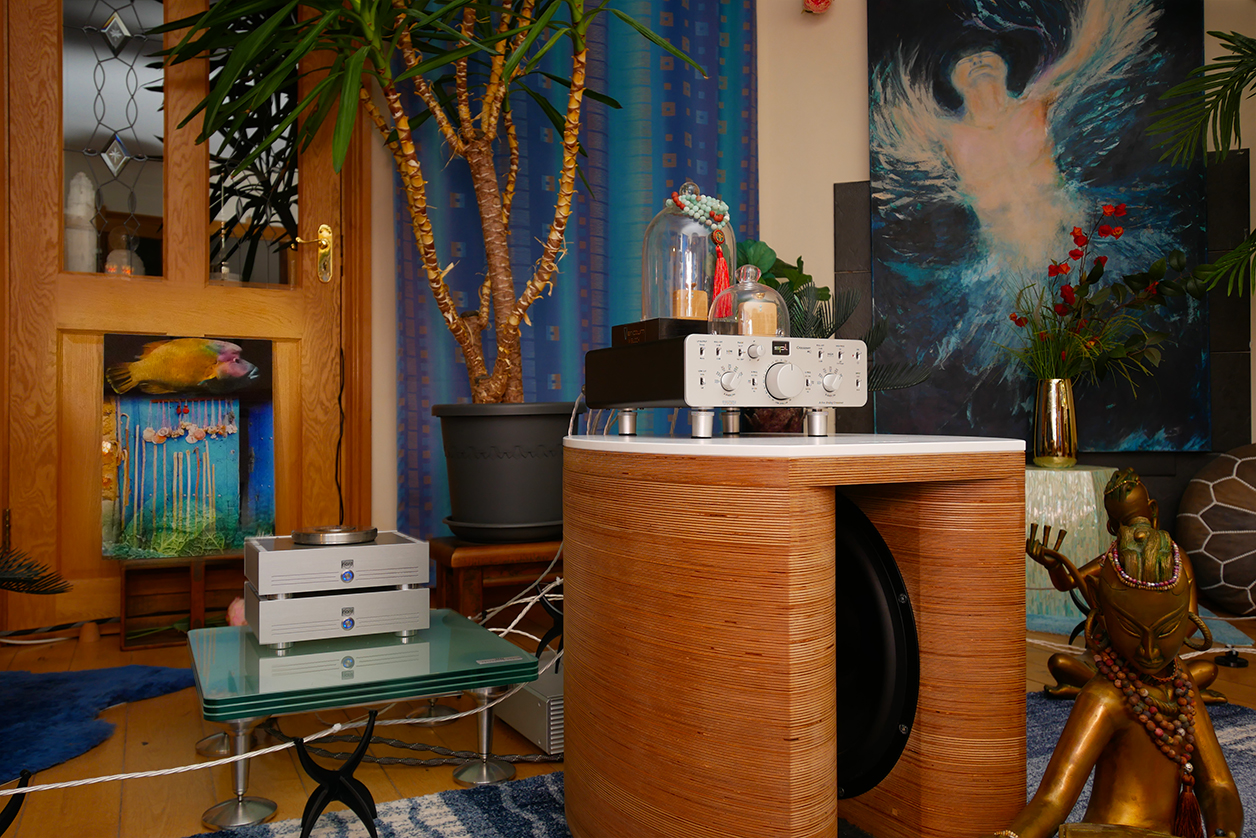 sound|kaos wire suspension isolators decouple the Crossover Mk2 from the sub in lieu of the stock footers.











What the SPL gave up in certain functionality versus my Lifesaver Audio Gradient Box II—no remote control over low-pass volume or complete filter bypass, no shelving filter option—it made up for functionally with front-mounted controls for easier reach; and sonically with its 'freebie' dynamic expander effect. I usually expect active things in audio to be subtractive in some way. It's why widebander aficionados celebrate no crossovers. The best filter is no filter. It's why fans of direct-coupled gain circuits fête the absence of signal-path capacitors. The best coupling cap is no cap. It's why open-baffle freaks love losing the box. In my estimation, SPL's Crossover Mk2 counters such valid observations. Its insertion loses no ground to a source-direct connection. Instead it downshifts dynamic range into lower gear to accelerate harder and higher. That's above and beyond its primary function as a lossless comprehensively adjustable active pure analogue frequency divider, a role in which it performs exactly as hoped for. In fact, a new-to-me option was its 12dB roll-off function. To cross lower but shallower; or higher and steeper? Initial assessments remained loyal to the 24dB/100Hz setting. For a bass shelf I'd now have to go inside Audirvana's software PEQ.

In the end and to even start, don't overlook today's component just because it arrives from outside our audiophile ghetto by way of the recording studio and musical content-creator scene. Like a chef's sharply honed knife, it's an expert's tool meant to do a skilful job at slicing and dicing frequency traffic whilst getting entirely out of the way being unfussy and confidently predictable. That it makes our chef work faster—audiophile translation: hearing more dynamic vigour and from it, livelier artistic expression—is the unexpected bonus. That active hence adjustable and directional bass outperforms passive fixed omnidirectional bass goes without saying. After all, anyone shopping for or even just contemplating a precision analog active crossover has already ticked off those basics. The same goes for the differences between active and passive filters particularly at low frequencies. Et voilà, a rare highly commendable entry into the niche sector of audiophile-quality outboard filtering to dovetail subs and speakers with precision. Interlocking fingers are a good visual for that. They also represent praying, another fitting image when the SPL Crossover Mk2 could be an answered prayer for those wanting a reliable solution to the specific problems it solves. Job. Correct tool. Success. Pleasure. The end.