
Country of Origin

 This review published on HifiKnights.com August 2026. By request of the manufacturer and permission of the author, it is herewith syndicated to reach a broader audience. – Ed.
Reviewer: Marek Dyba
Digital source: a custom passive server with WIN10, Roon, Fidelizer Pro 7.10, JCAT NET XE, and JCAT USB XE cards with FERRUM HYPSOS Signature power supply, KECES P8 (mono) linear power supply for the server, JCAT USB Isolator
D/A Converter: LampizatOr Poseidon + Ideon Audio 3R Master Time (USB signal regenerator)
Analog front end: J.Sikora Standard MAX turntable, J.Sikora KV12 & J.Sikora KV12 MAX tonearms, AirTight PC-3, Audio Technica PTG33 Prestige & LE SON LS10 MKII cartridges, Grandinote Celio MK IV & ESE Lab Nibiru V 5 phono stages
Power amplifiers: GrandiNote Shinai, Circle Labs M200, Art Audio Symphony II (modified)
Preamplifier: Circle Labs P300
Loudspeakers: GrandiNote MACH4, Ubiq Audio Model ONE Duelund Edition
Interconnects: Bastanis Imperial RCA x2, Soyaton Benchmark RCA, Hijiri Million Kiwami RCA, Hijiri HCI-20 RCA, TelluriumQ Ultra Black RCA, KBL Sound Himalaya 2 XLR, NxLT Ether XLR, David Laboga Custom Audio AKOYA USB, David Laboga Custom Audio Digital Sound Wave Sapphire Ethernet
Speaker cables: Soyaton Benchmark Mk2, WK Audio The Red
Power cables: DL Custom Audio 3D-S-AC Connect, LessLoss DFPC Signature, Gigawatt LC-3
Power: Gigawatt PF-2 MK2 and Gigawatt PC-3 SE Evo+; a custom power line with Gigawatt LC-Y in-wall cable; Gigawatt G-044 Schuko and Furutech FT-SWS-D (R)
Network: Silent Angel Bonn N8 + Silent Angel Forester F1 + optical LAN isolator
Racks: Base VI, Rogoz Audio 3RP3/BBS
Anti-vibration accessories: Rogoz Audio SMO40 and CPPB16 platforms, BW40MKII feet, Omex Symphony 3S, Franc Accessories Ceramic Disc Slim Feet and Wood Block Platform
Review component retail: €294K/pr
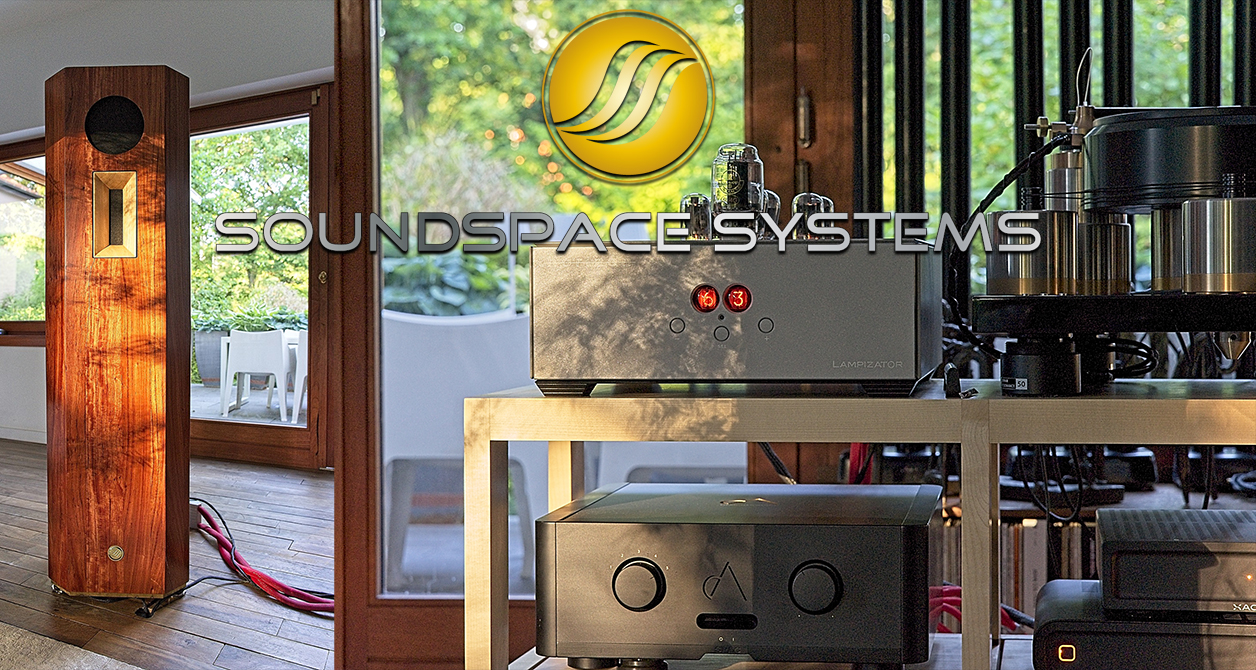
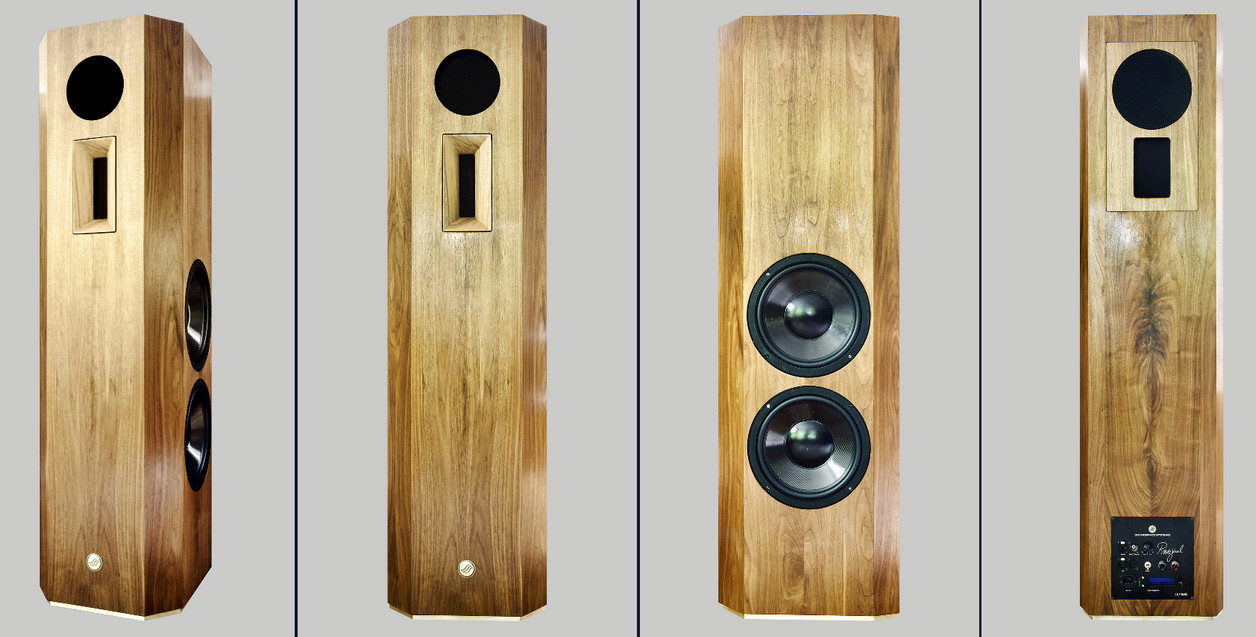
Berlin-based SoundSpace Systems have added yet another songbird to their aviary. I had opportunity to listen as it performed in a beautiful environment within a largely familiar setup. You may remember two prior reviews of theirs: a 2019 report on the Pirol and one on the smallest Robin. Despite size and weight, a brave German crew led by owner and chief designer Dr. Michael Plessmann delivered them to my 4th floor flat sans elevator. The third model available then and still this catalogue's flagship weighs ~250kg—each. Delivery to my place was most unlikely despite no lack of will. About a year ago, Michael added a fourth model below Aidoni and above Pirol although he feels that it sits much closer to his flagship. He named it Rossignol. It answers requests from customers and distributors for almost Aidoni performance derived from a single midrange to allow shorter listening distances and smaller rooms. To achieve his goal, Michael reached for field-coil drivers used rarely nowadays. [Voxativ do make their own as does Andrew Jones in a coaxial field coil for his new company – Ed.] Field coils are quite expensive and their implementation is very demanding to achieve excellent results. One of their key challenges is the power supply. Michael opted for a Supravox membrane and loved the results so much as to currently offer a field-coil upgrade for ambitious Aidoni owners. He can personally replace one of its midranges and upgrade the crossover accordingly. Based on my experience, most if not all current Aidoni owners would find the upgrade worthwhile. Back to Rossignol, it's a 3-way floorstanding semi-active design whose bass section of 4×12" woofers is fronted by two powerful built-in amplifiers. One might expect it to be an obviously smaller speaker than Aidoni but those differences are not big. In fact, the flagship measures 148x44x67cm HxWxD, the newcomer 158x43x48cm so is even taller if not quite as deep. But Rossignol does shed 40kg off Aidoni. At 100dB/W/m these are high-efficiency sorts of 6Ω nominal, 3.2Ω minimum impedance across 20Hz-30kHz bandwidth. With maximum SPL of 112dB listed, you can listen very loud.
Michael, how did this Rossignol model come about?
Rossignol was developed because some clients wanted Aidoni performance at a closer sitting distance. That's how the project started. The idea was to get the best qualities of Aidoni and transfer them to a speaker that doesn't feature the D'Appolito configuration of the midrange/tweeter section but still offers all the other benefits.
What benefits are you referring to?
These are the benefits of what some people call a hybrid speaker. I call it a best-technology case because in the treble, midrange and bass I use the best available technologies combined in a single speaker. It's a very different philosophy or approach from what you find in most other speakers. I'm not even aware if anybody else does this. Some designers integrate an active subwoofer but the rest is based on one technology. Some open-baffle manufacturers put a tweeter on top or widebanders add an auxiliary tweeter but does anyone go the full length of combining the best tweeter concept with the best midrange concept and the best woofer solution? I think not many do. While developing Rossignol and selecting components for it, I had a chance to do what I've always wanted to: push midrange performance even further. It was important because, to my ears, the midrange is the very core of the music. If you get the midrange right, you have started at a wonderful place so when designing the Rossignol, I decided to use a classic field-coil driver instead of a conventional midrange.
Please explain why you thought that best.
It is amazing and beautiful how resolving such drivers are when properly used. It is hard to implement them in the midrange because it requires a separate power supply and you can clearly hear its every imperfection in the sound. It took me a while to develop a power supply that delivered sufficiently clean power to make the midrange sound the way I wanted it to. As in my other speakers, the midrange is configured as a dipole so open baffle. There is no compressed air to load down the back of the thin diaphragm so the driver is completely free to move.
Let's mention other design aspects.
I decided on a completely minimalist crossover, the simplest possible. In Rossignol it just protects the midrange from the lowest frequencies and prevents those delicate paper membranes from breaking. That's the whole crossover for the midrange. Everything else plays openly. The field-coil is technically a midrange driver but because it plays down to 50Hz and up to 4'000Hz, one could almost call it a widebander. That's one of the reasons why I use a pre-chamber fronting this driver. It acts as an acoustic crossover which helps keep the electrical crossover small and manages the output of the midrange.
How about the tweeter?
It's the same as in Aidoni, an 18kg (!) magnetostat. Its membrane is extremely light. It works in a very dense gauss field so does what people believe is the best way to create perfect sound: strong magnets behind a very light membrane. The tweeter crossover is again just protection against lower frequencies. Additionally it benefits from acoustical transformation achieved with a horn which I use in all my speakers. The horn does two things: it extends the downward range and helps manage directivity to match that of the midrange. That is very important because the tweeter covers 900Hz all the way up to 35'000Hz. If you do the math—from 900Hz to ~4kHz—there are always two drivers playing. The very minimalist tweeter filter avoids a resistor because resistors destroy the expensive electrical signal we put through it. What do I mean by expensive? Typically the amplifiers that drive our speakers are very expensive so their signal itself is expensive, too.









The bass module is probably the most similar part to your other models?
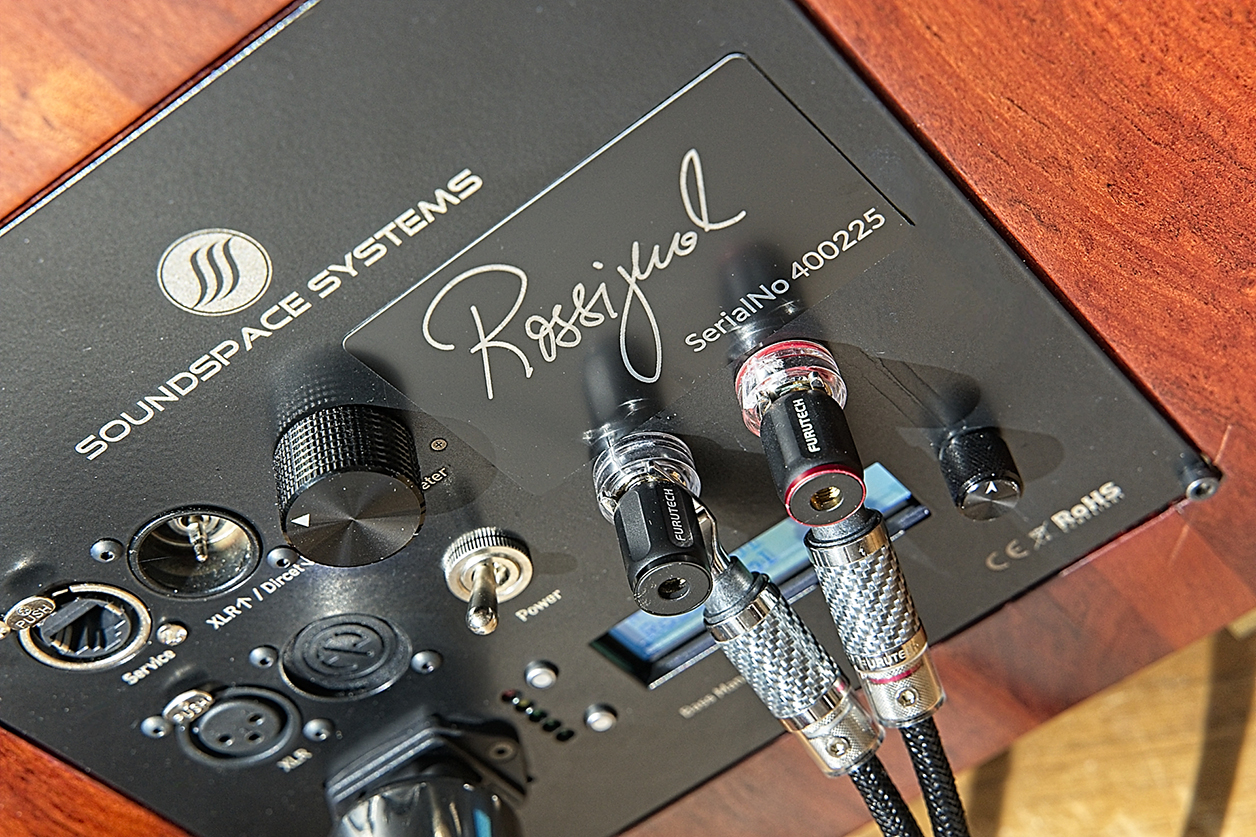
My philosophy about bass remains unchanged because if we talk real bass, we talk large volumes of moved air and for that there is no substitute. When people claim that a bookshelf speaker delivers nice bass, it is not truly so. Such a speaker can create a nice illusion of bass but it can't play actual low bass. It is our brain that recreates their bass. True bass requires big air motion and that's why all of my speakers feature large woofers. Rossignol runs four 12-inch drivers per speaker operating sealed. There are many white papers on why this is the only way to create proper bass when you don't want out-of-phase signal. Like with all my speakers, the bass drivers orient for force cancellation. They work in push-push to cancel mechanical forces in the cabinet, thus eliminating a huge problem. There are some enormous speakers in which the mechanical force of the woofer on the cabinet is asymmetrical. If you do it symmetrically, the force cancels and there is far less LF distortion. Like Aidoni, Rossignol features two 1kW amplifiers in the bass compartment. That's simply the cost of using sealed bass which requires a lot of energy/power. It's the amount of pressure needed which requires such powerful amps. That bass section connects to the rest via shallow 6dB filter. Considering how this particular approach is tricky in the passive domain, I use extremely fast DSP. The <40Hz filter point and shallow 6dB/octave gradient mean still significant amounts of output at higher frequencies. So that's the concept of Rossignol. Everything else is like in all my other speakers. I use a constrained-layer cabinet, in most cases with natural timber as the outer layer. I use a brass or bronze plinth to control the residual mechanical forces in the speaker. The bass sections connect to the internal amplifiers through single speaker terminals so users don't need bi-wire or jumpers.
What is the internal wiring?
It's copper/silver hand-wound for all connections and different for each driver because that sounds better than a one-size-fits-all approach. The exact geometry dates back to the early days of telecommunication in the 1920s. Back then they figured out the right geometry through experimentation.
It sounds like tinned copper?
They did use tin in those days, correct. But our wiring is not tinned. It's copper wiring with a very heavy silver plating. The geometry they used is very smart because they didn't use shielding and still didn't have many of the problems we have today. They also had a hard time managing crosstalk and were very smart about how they solved it. You can still find many of these old cable geometries if you know where to look.
Okay, 100 years ago no shields may have worked because there was far less electronic pollution.
Absolutely, there were no airports creating lots of radiation, we didn't have mobile networks and so on. Still, the technologies they used were very smart. It was very hard to manufacture and in modern times where we do everything with machines, we no longer apply their techniques. We could but we don't. Which brings to mind another key design element of Rossignol. We embed into them what I call Mozart, our power filtration tech. I need it for multiple reasons. Because of the speaker's high sensitivity, it is extremely keen about any form of distortion. Since the active subwoofer now jumpers internally, any noise from it could bleed into the higher range. That's why I needed to isolate my amps completely. It was in the early days that I found some of my speaker designs to sound a little nervous in the treble. Now that is completely gone. The nervousness came from my class D amplifiers but since I started using isolators, it's dead quiet and offers a more relaxed performance, making it even easier to listen to.
I suppose that the power supply on the field-coil driver needed its own isolation?
Absolutely, that was one more issue to solve. To do that, I decided to use a multitude of power conditioners and devices inside the cabinet not only to deliver clean power to the components but also to isolate the power supplies from the rest of the system internally.
So if I understand correctly, the power supply for the field-coil also builds in so all the required power enters through a single power cord. Then what happens?
The power feed splits and conditions differently for various sections. What's more, after the power supplies it gets cleaned again because the power supplies themselves create problems. All of that took a lot of R&D. The field-coil driver I'm using has been on the market for years. It's not a new driver but an existing Supravox. It is a great driver which not many people use because developing a power supply for it is a challenge. It's a solvable problem though if you put your mind to it.