
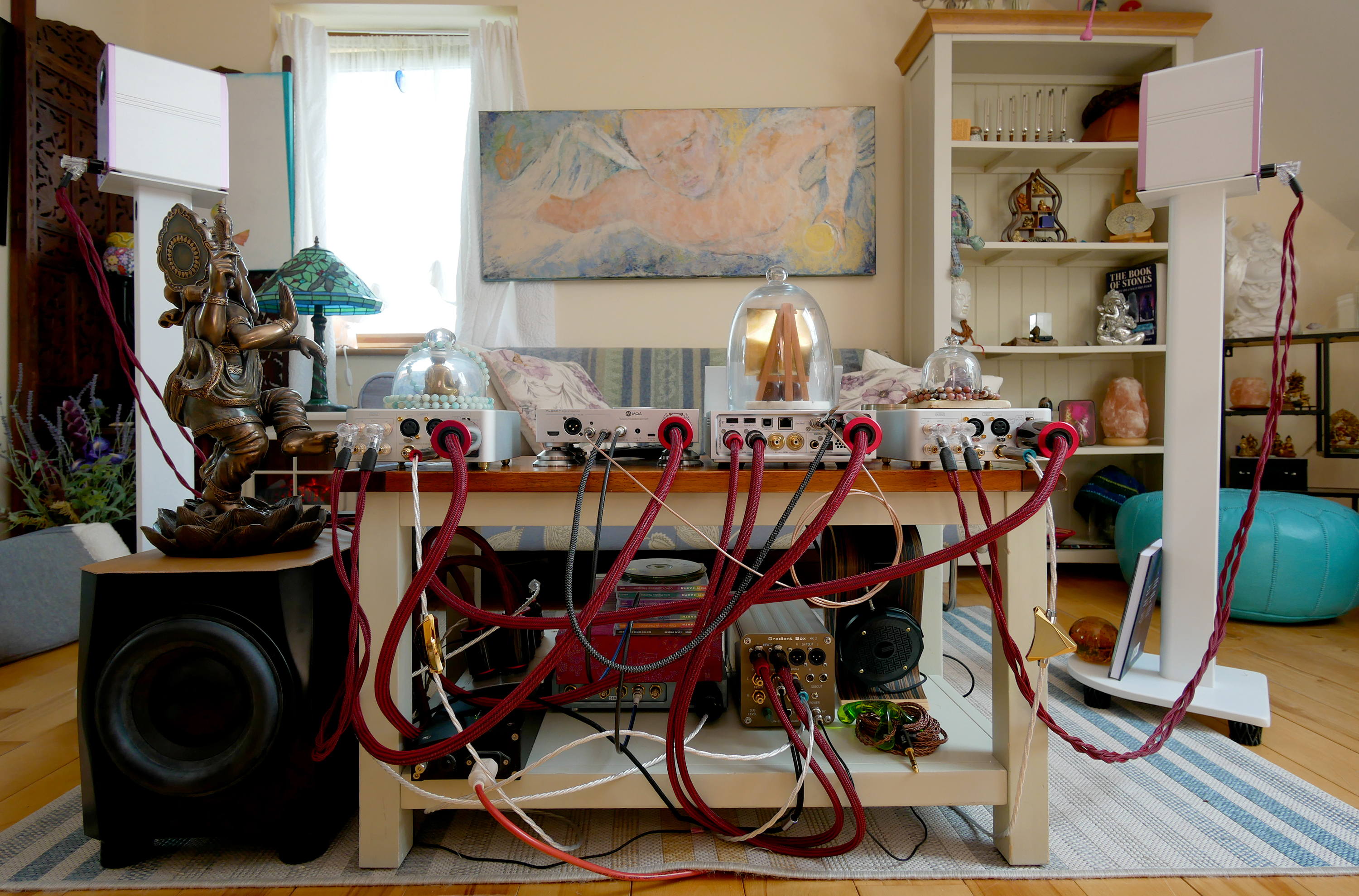
 But first, all the 'nasty bits' that spill forth when my short screen removes to reveal the snake pit at the busy end of any separates system. A classic orientation hides it because the rack parks against the front wall with speakers on either side. Those sit in relatively close wall proximity. Inverting that layout sits us against that wall so that our speakers move into free space for far reduced room interaction. Further room subtraction comes from wide head-on spacing and quasi nearfield distance; 1.3m in my case. Hiding our main AC cord to the wall outlet beneath a throw rug takes care of power. A low screen—even a stocky fireplace protector works—conceals the wiry back end from the rest of the space. That retains multi-purpose utility and only accords our hifi a virtual nook rather than take over the room. Whilst the visual and utility aspects are wins, this is firstly about superior sonics from minimized room reactivity sans classic passive diffusor/absorber panels and bass traps. On the smsl's back you see coax/Toslink cables connect to the Shanling; and a 50Ω clock cable to the lower LHY clock. Still open are AES and I²S ports which this install couldn't exploit. Time to put the screen back, all slithering snakes into their basket.

 I've tried to timex DACs, bridges and switches by external clock. Either my ear was insufficiently golden or said clock not atomic enough. I heard naught. So this clock hibernated in storage. Video/sound and multi-channel editing must slave multiple digital workstations to a shared clock. But when my single-box attempts failed, I began to hear digital engineers like Ed Meitner who call that concept bunk. They argue that the best clock is closest to the converter chip, FPGA or R2R ladder—in the same chassis off by a few centimetres of traces, not in another chassis. Attaching an outboard clock to just one digital box hopes to replace its own clock with a better specimen. It disavows all hi-speed cabled transmission challenges from Ω mismatches to resistive connector losses. Syncing at least two digital components to one clock to march to the same drummer differs. Voilà, my experience and headspace. I was surprised when contrasting now between int/ext clock—leave that menu layer open, toggle between either option by remote—heard small gains in focus and grip for my LHY. I have no explanation or takeaway, just reminder that I didn't reclock a DAC but CD transport. Anything more is for actual digital engineers to explain.









With my clock rescued from oblivion to sail on a second wind past the rack of forgotten kit, I had to reconfront my suspicion of the prior page. There was some kind of fork in this road. In terms of raw sonics, I really couldn't say that optical vs magnetic data retrieval—CD vs microSD card—sounded any different run through the same DAC and identical follow-on gear. Yet I felt different about the sound. Stubbornness be, I had a preference for the disc spinner. Had this been a solitary observation, I'd have invoked active imagination or phase of the 7th moon. It'd warrant no comment in the first place. Alas, it stuck around. It proved consistent. Something about the whirring polycarbonate readings saturated my satisfaction more. Recognizing it was one thing, explaining it another. On this sensed not sonic tact, the file streams put me in a quality of light: data revealed to sight; netting comprehension from clarity. The physical pits and lands invoked a quality of darkness: still, weighty, enveloping. As the observer/participant, I occupied a different place whilst looking at the same scenery. Just so, the SD card communicated more with the observer, the CDs with the partaker. If this resonates, nothing more needs saying. If it doesn't, saying more would get ever more abstract. In the end, the point of this is a faint suggestion. For reasons unknown and not important, could our listening experience be influenced by factors beyond critically trained hearing that parses constant streams of sounds and interpolates from them a 3D soundstage and connective tissue of musical meaning that's distinctly other than random noises? What if it's not just our ears which listen in? Could another faculty in our psycho-physical apparatus partake to subtly alter the tenor of our experience in repeatable fashion? Should this reaction differ from person to person? Likewise for what triggers it? Mark Levinson the man not brand too is hip to these questions and has come to his own answers by first championing DSD over PCM during his Red Rose Music days and claiming a fundamental flaw for PCM. He then progressed to his proprietary Daniel Hertz algorithm which injects into playback a strategic very small time delay across a specific bandwidth to make playback more – 'nutritious' if you will; more palatable to our nervous system.

Having bought this smsl purely for personal pleasure, I've now shared my response to it. It's no claim or promise that you'd react the same. I in fact haven't the vaguest why my response to it is as hinted at. Regardless and quite apart from that subjective aspect, as an affordable little machine doing an objective job, I have nothing but praise. The four chassis controls are sweet switch sex; the TOC reads in surprisingly swift to start playback in a jiffy; direct track access skips are prompt; fit 'n finish is tidy, featurization solid; there's no mechanical noise; and I've come across no single issue or behaviour I'd earmark for a MkII improvement. For €575 delivered from France to Ireland, this groomed half-width deck scores very high on my ROI and bonsai charts.