The most obvious aspect was how midrange and treble up to the overtone range of female vocals now conveyed an organic texture, smoothness and tacitness that I had experienced before only on top echelon analogue rigs. By direct comparison the Rossini sounded mechanical and dry, not something I would have ever dreamt of saying about this dearly loved DAC just one day prior. The night before I received the Horizon, I attended a concert featuring a string ensemble. I sat in row two. I could swear that the string tone presented by the Horizon was unreasonably close, illuminated by that warm carpet of overtones so that the seamless yet fretted flow of bows on strings had none of the jagged acid character which most digital sources inject to a degree. The other aspect that emerged immediately was an increase in bloom, saturation and richness especially in the low registers.
 That was the transfiguration of Immanis. At this point no EQ was necessary. That restored their pristine transparency. I had the best of both worlds: the speed, detail and resolution of ribbons plus glowing organic connective tissue. The length of my listening sessions doubled and I was very surprised to see myself listening to full albums already in the first hours of new-DAC ownership. My usual attitude in the first days with new toys is to tinker, skip and scan across my library to accelerate the reassessment of the updated system.
Moving from album to album, crossing genres, recording eras and styles over the next days, I could not find a single case where I was disappointed. On the contrary, I had repeated and consistent goose-bump moments and involuntary smiles pop up. This is atypical of me as a hyper-critical guy and grown-up audiophile who learnt the hard way that with a big change in sonic presentation always come trade-offs. But this just seemed like the exception to the rule.
 My simple assessment is that the arrival of the Horizon brought a twofold improvement because of a serendipitous synergy with Immanis. The triple ribbons became a much more capable and euphonic do-it-all without losing the sonic features that make them unique. With vocals tracks, the presence of singers projected into imaginary rooms with nuanced inflections. Lyrical hues became more moving and physical to speak more to my heart than mind. Small ensembles took life as palpable musical objects with an easily detectable shape of their own while the blend of respective overtones and harmonics structures produced a unified whole of the performance as opposed to etched images operating in vacuum. The dreaded applause check, a torture test which often resembles a firecracker party more than the cupped meetings of flesh and bone, passed with flying colors. The spatial deployment of big orchestral forces took on an organic connection to the venue by not only extending way outside the ears but layering in the depth domain as a continuum of interconnected sections. Far-field sounds like timpani, an ominous horn solo or choral sections took a spooky out-of-the-room locations.

 Rhythmic drive and its propulsive energies as one of the strongest suits of Immanis morphed from being slightly lean, percussive but stingy to more heft, bounce and inviting heel tapping. Negatives? I am challenged to find one. Perhaps the Rossini had more authoritative bass punch and an even blacker background? Actually, I thought the Horizon's bloom and perception of physical air that sustained the buoyancy of the music more engaging and realistic.
Bluntly put, combined with the Horizon, Immanis scaled up to the very best headfi system I have experienced. That includes the mythical Sennheiser HE-1 that I had at home for a two-week evaluation which became a sort of haunting sonic ideal for my tastes. This applies especially to timbre realism and overall naturalness than expands to fully spatialized visuals which surpass my previous references, the Abyss AB-1266 TC and SR1a. To dCS's credit, the Rossini adds several functional and practical advantages over the LampizatOr.











First, it integrates a very decent Roon-ready streaming module and refined app, allowing significant system simplifications and cost savings compared to a pure DAC like the Horizon. Then, its size and weight are more manageable. Lastly, it can be left on 24/7 with no downsides like heat and shorted tube-life expectancy to be ready for an aural quickie whenever the mood strikes. Speaking of tubes, my Horizon came equipped with the stock set of KR 5U4G rectifier and a pair of 6SN7GT blue-ball Psvane except for the driver tubes where Lukasz selected a quartet of Tung-Sol KT150 in lieu of KT88, after I described my musical preferences.
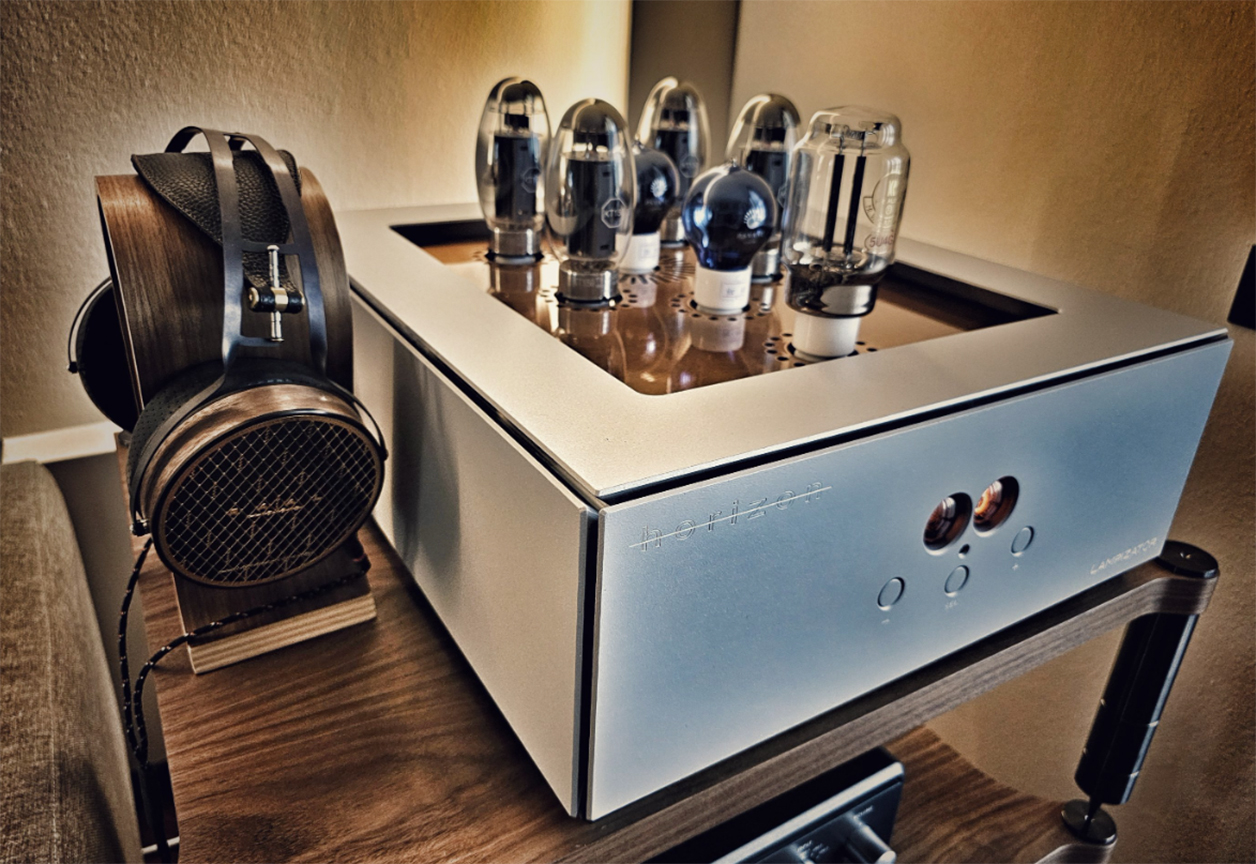
Tube rolling will likely be my next expensive exercise but I am in no hurry to do it although fellow Horizon owners already taunt me with dramatic improvements of this magnificent musical instrument. In any case, I will venture into this perilous rabbit hole only after assessing the synergy between the Horizon and my beloved Spirit Torino Valkyria. I feel a bit guilty towards my fellow Italians when since the arrival of the LampizatOr, I've almost exclusively used Immanis. I just could not put them off my head. Given the stark differences between Valkyria and Immanis, I fear in the back of my mind that a DAC so synergistic with one may disappoint with the other?