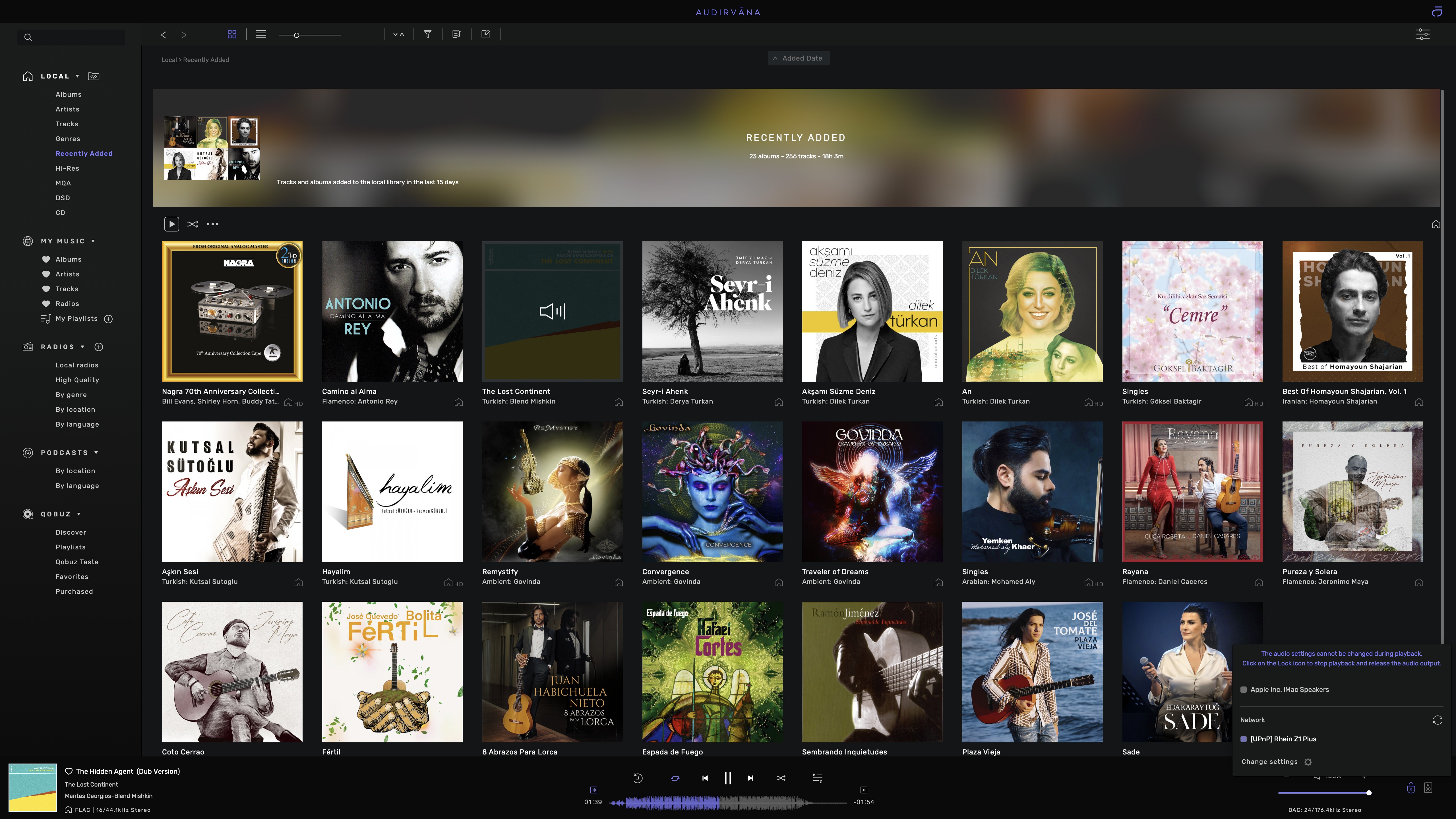
But before that I really wanted my big display back. Once ReadyMedia installed, the Silent Angel appeared as UPnP-selectable device in Audirvana. Time to retire the Oppo. This whole exercise played reminder that streamer/servers are at least 50:50 software/hardware if not heavier on the former. Software isn't just about convenience, response speed and features. It's about sonics too as anyone who compares player software, signal-routing code, processing algorithms, footprint reduction updates and more knows only too well. In Audirvana for example, the SoX and R8brain upsamplers lead to different sonic results.

My UPnP install wasn't 100% stable though. Upon power-up, sometimes the device wasn't discoverable. Reattaching the Oppo showed that the VitOS app had stopped and needed a restart by smartphone. Occasionally Audirvana cued up a song then refused to play it, eventually showing an error message that it didn't get a request from the device. Switching internal and external clocks also required power-cycling the Z1+ before the change set. That too could create subsequent issues. Otherwise operating the Silent Angel was no different than my usual routine. Audirvana Studio served as GUI for my local library and Qobuz Sublime subscription. It's finally time for sonics of what is just a digital transport. That makes any prospective performance delta far narrower than amp ⇔ speaker ⇔ room interactions, passive/active preamps even D/A converters. Since Silent Angel bill this as a complete solution with optimized signal routing, USB ports dedicated to specific tasks including one tweaked as DAC output, I bypassed my Singxer SU-6 bridge. The Z1+ packs—or should—equivalent functionality. I also bypassed the cascaded network switches to hardwire my 20m CAT8a spur direct to router. Those switches constitute LAN extras whose functionality too we hope are already built into upscale network servers. It's what separates an audiophile streamer from a generic computer after all. My contention remains that with proper pre/post isolation so network switches and a USB bridge then bypassing a PC/Mac's sound engine with a software player to stop unnecessary computing threads, an iMac equals audiophile server on sonics. Then it adds a superior far bigger display, integrates streaming clients via native browser apps and requires no WiFi; or even Internet access for local files. Finally, to remove Audirvana's sonic influence from the Silent Angel picture, for my comparative sessions I plugged my 4TB SSD into the Z1+ then accessed it via the Oppo.
Given the narrow nature of digital-domain nuance, splitting the action across various with/out—LAN switches, USB bridge, Audirvana, external master clock—and being precise about small subtractions and additions exceeded my abilities. The best I can do is this. Without any of my extras, the Z1+ clearly came in second to my  residential benchmark. I curated the latter against offline playback of local files to get cloud streaming on par when it wasn't to begin with. I learnt that routing cloud streams through Audirvana like I do for local files was ~50%, using router isolation for cloud files the other half. I estimate that the Z1+ pulled even when I added my LAN switches ahead of it. With Silent Angel having no need to bypass MacOS, Audirvana was redundant. Once I added the Singxer USB bridge, the Z+ pulled ahead a bit. It did so once more with the Genesis clock. Across two micro stages, my Taiwanese visitors scrubbed off a tiny playback edge.
Now the music felt subtly calmer. Language logic demands that before the music must have felt busier or more agitated? Something along those lines if we remember that they were very closely spaced. These were a few shades of grey one may tease out in a direct A/B of very critical attention. Otherwise they fade to nothing. At €3'299 for the Genesis clock, such funds make profoundly more difference elsewhere. It's only when elsewhere is maxed out that I'd even consider this clock. Before that I'd pursue optical isolation via $494/ea. FMC media converters plus the very cheap fibre-optic link between them. While I did use Silent Angel's control app via its integrated Qobuz panel on the Oppo smartphone, you'd expect no love from a guy with a 27" Retina display and full-size actual not tiny virtual keyboard. To properly learn about VitOS Orbiter, you'll have to read reviews which used it exclusively.









My takeaway from it all is simple. Despite upscale billing, the Z1+ still audibly benefits from isolation between itself and our router. It's why Silent Angel offer their own network switch called Bonn NX. It confirms my belief that the Internet/router node with various cloud streaming clients requires more help than local-file dispatch over USB. Yet the Z1+ didn't require the Singxer SU-6 USB bridge. It just wanted my two network switches to front it. I'd say then that the Z1+ builds in my external USB bridge's reclocking and dejittering but not the full Internet isolation of my slaved switches. Silent Angel's engineer agrees on WiFi's inherent noise so best performance should be a LAN connection. Of course we must still convert our signal to analogue. So far we've merely dabbled in the digital realm. To stay on brand, I waited on the Munich 2024 show to end to be shipped Silent Angel's Munich MU demonstrator with UPnP Renderer preinstalled.
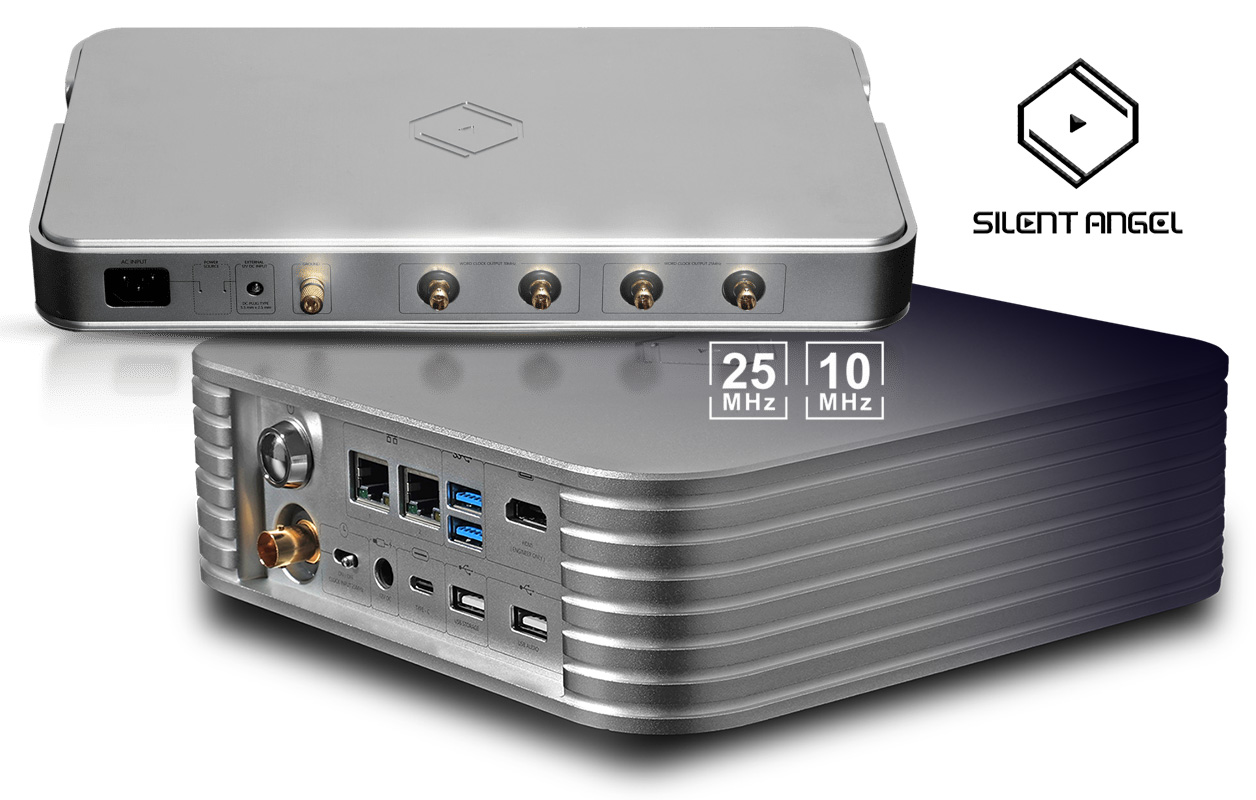
To wrap the all-digital part, returning to my usual Mac-centric setup showed how Silent Angel's signal path had a slightly darker, warmer and heavier tinge, our domestic version a more light-filled lit-up-all-over feel. In review commentary I often find the former described as more analogue. Not doing vinyl myself, that tells me nothing. Just so, it's a common writer reference so fair to mention. We also need a few more words on build quality and finish. These machines are elegant, minimalist and commensurate with high-end expectations. It reminds us that Taiwan not China has long been the region's destination for superior metal work. Now let's add Silent Angel's D/A conversion to the mix.