
Country of Origin

Reviewer: Srajan Ebaen
Financial interests: click here
 Main system: Sources: Retina 5K 27" iMac (i5, 256GB SSD, 40GB RAM, Tahoe 26), 4TB external SSD with Thunderbolt 3, Audirvana Studio, Qobuz Sublime, Gustard U26 USB bridge, LHY Audio SW-8 & SW-6 switch, Sonnet Pasithea; Preamp: Hattor Audio ARP-S; Active filter: spl Audio Crossover MkII; Power amplifiers: Vinshine/Kinki Dazzle & Audiophonics NCx500 on subwoofer; Loudspeakers: Qualio IQ [on loan]; Subwoofer: sound|kaos D15; Cables: Exact Express Flame, Furutech; Power delivery: 2 x Kinki/Vinshine Tai Hang on amps and source stack, Furutech DPS-4.1 between wall and conditioners; Equipment rack: Artesanía Audio Exoteryc double-wide 3-tier with optional glass shelves, Exoteryc amp stands; Sundry accessories: Acoustic System resonators, AudioQuest FogLifters; Room: 6 x 8m with open door behind listening seat; Room treatment: 2 x PSI Audio AVAA C214 active bass traps
1st upstairs speaker system: Source: Shanling EM7 into Soundaware D300Ref SD transport to Cen.Grand DSDAC 1.0 Deluxe with POW; Preamp/filter: Lifesaver Audio iCon 4SE & Gradient Box 2; Amplifier: Kinki Studio EX-B7 monos; Loudspeakers: sound|kaos Vox3awf; Subwoofer: sound|kaos D12 on twin Nord Acoustic NC500 monos; Cable loom: Exact Express Earth; Power delivery: Vibex Granada/Alhambra, Akiko Audio Corelli Corundum & Castello Solo; Equipment rack: Hifistay Mythology Transform X-Frame [on extended loan]; Sundry accessories: Furutech cable lifts, Furutech NFC Clear Lines; Room: ~3.5 x 8m
1st upstairs headfi system: DAC: Cen.Grand DSDAC 1.0 Deluxe with POW; Headamp: Cen.Grand Silver Fox; Headphones: Raal 1995 Magna, HifiMan Susvara
Desktop system: Source: HP Z2 workstation Win11/64; USB isolator: LHY UIP; LAN distributors: LHY AS6 Pro & SW6-SFP; Ethernet reclocker: Stack SmoothLAN; DACs: Gustard R26II & Audalytic DR70; Preamp: Topping A900; Speaker amps: Topping B200 monos; Headphone amp: Enleum AMP-23R; Loudspeakers: Virtual Hifi Viper; Headphones: Final D-8000, aune SR7000, FiiO FT7, HifiMan Susvara Unveiled
2nd upstairs headfi system: Shanling EM5; Headphones: Meze 109 Pro, Fiio FT3, HifiMan HE1000 Unveiled
2nd upstairs speaker system: Source: smsl PL200T CD transport; DAC: Shanling EM7 w. 1TB microSD; Crossover: Lifesaver Audio Gradient Box II; Amplifiers: LAIV Crescendo Chorus monos; Loudspeakers: MonAcoustic SuperMon Mini with Dynaudio S18 subwoofer
2-channel video system: Source: Oppo BDP-105; All-in-One: Gold Note IS-1000 Deluxe; Loudspeakers: ModalAkustik MusikBoxx; Subwoofer: 2 x Zu Method; Power delivery: Furutech eTP-8, Room: ~6x4m
Review component retail: €6'200 ex VAT
 |
 |
 |
 |
 |
 |
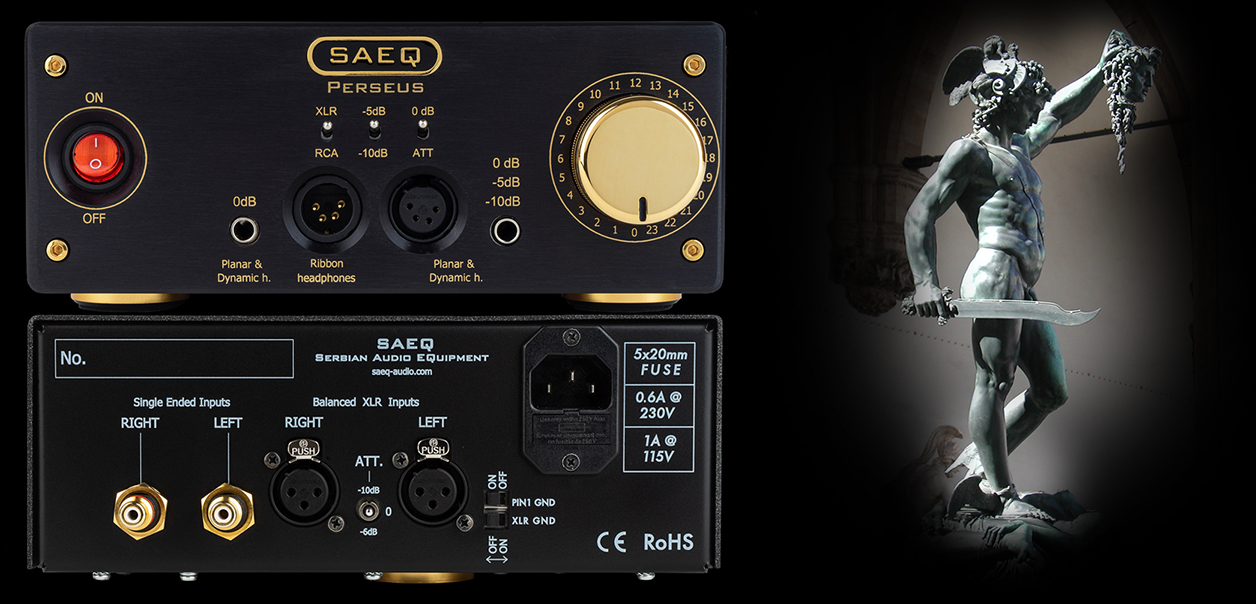
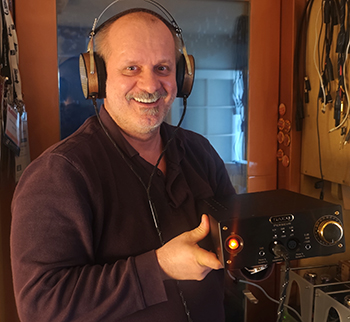 Considered a 16th-century master piece is the bronze sculpture of Greek hero and legendary dynasty founder Perseus holding the slain Medusa's head. Its maker was Italy's Renaissance sculptor, goldsmith and author Benvenuto Cellini who lived and died in the city of Florence. Being called Perseus, the latest headphone amp from Dragan Domanovic of Serbia promises to be a 21st-century slayer of monsters. He claims that it can drive Raal's Magna, HifiMan's Susvara and Abyss' 1266—simultaneously. For that we'd need the three heads and six ears of Cereberus, the hound guarding the Hades Underworld. But the point is made. This pure headfi deck without pre-outs packs hellacious load-agnostic potential. With their <1Ω impedance, true ribbons present as a virtual short to standard headphone amps. Valve decks from Dragan Solaja, Jack Woo and Kang-Su Park get around that with special output transformers. Raal's own Aleksandar Radisavljević [right] does with an external interface transformer. That presents to our amp as a 32Ω load—8Ω by request to suit speaker amps—then only asks ~3wpc to cover all SPL needs. SAEQ were first to subtract all coupling magnetics and author solid-state direct-drive amps for ribbon headphones. Later Schiit had the short-lived Jotunheim R for ribbon direct drive. But the originator of this sub breed is our Serbian dragon who with Perseus returns to the same well. To also suit loads of lesser appetites, a -6/-10dB rear toggle on the XLR input plus a frontal toggle for a -5/-10dB cut on 6.3mm can shelf the circuit's voltage gain to varying sensitivities. Dragan's familiar 23-click stepped attenuator controls the lot. Bandwidth is ±0.2dB from 20Hz-50kHz, input sensitivity 1V whereby all modern digital sources can hit full power. At 6.5kg, Perseus's metal is muscular whilst 32cm depth vs 22cm width and 9cm height make it half width but quite long. Those were the basics. For more, I needed Dragan. Having already worked with NOS Germanium, 6922 input tubes and for Astræus SE his very own input transformers rather than Lundahl, he's fluent across various gain devices and topologies. What's his recipe and sonic target for Perseus which saw its global premiere March 16th in Shanghai?








As it turned out, our man had other plans; potentially: "Thank you for your email and review suggestion. At the moment we have another three new amplifiers all with transformer-coupled inputs that should appear on the website by the end of next week: Hyperion LF, Armageddon Mk1 and Hypnos, a new hybrid flagship with ribbon-direct output. We will agree on priorities when I return from the Hong Kong fair after August 12th. In every regard, both the new Hyperion and Armageddon have risen a clear step above their precursors." SAEQ's pantheon of choice was rapidly expanding. Which demi god of antiquity would Dragan dispatch to the Emerald Isle to rid it of all nonbelievers as St. Patrick did on County Mayo's peak with the exorcism of the allegorical snakes? Eire never had any real snakes. Bait'n'switch? "We always try to make improvements in new models easy and effortless to detect. That difference implies a higher class or different presentation. Here both conditions are met. The new versions of the Hyperion and Armageddon models sound more seductive and complex." I'd loved and awarded Dragan's original Germanium-infused Hyperion. That had me particularly curious about €6'200 Hyperion LF. It wasn't lost on me either that Armageddon II and Hypnos would position higher; €13K for the more-than-twice hybrid range topper. With the external transformer barrels of my Immanis and Magna, I'd not need ribbon direct drive. I could run them off standard XLR4 outputs as long as there was sufficient voltage.
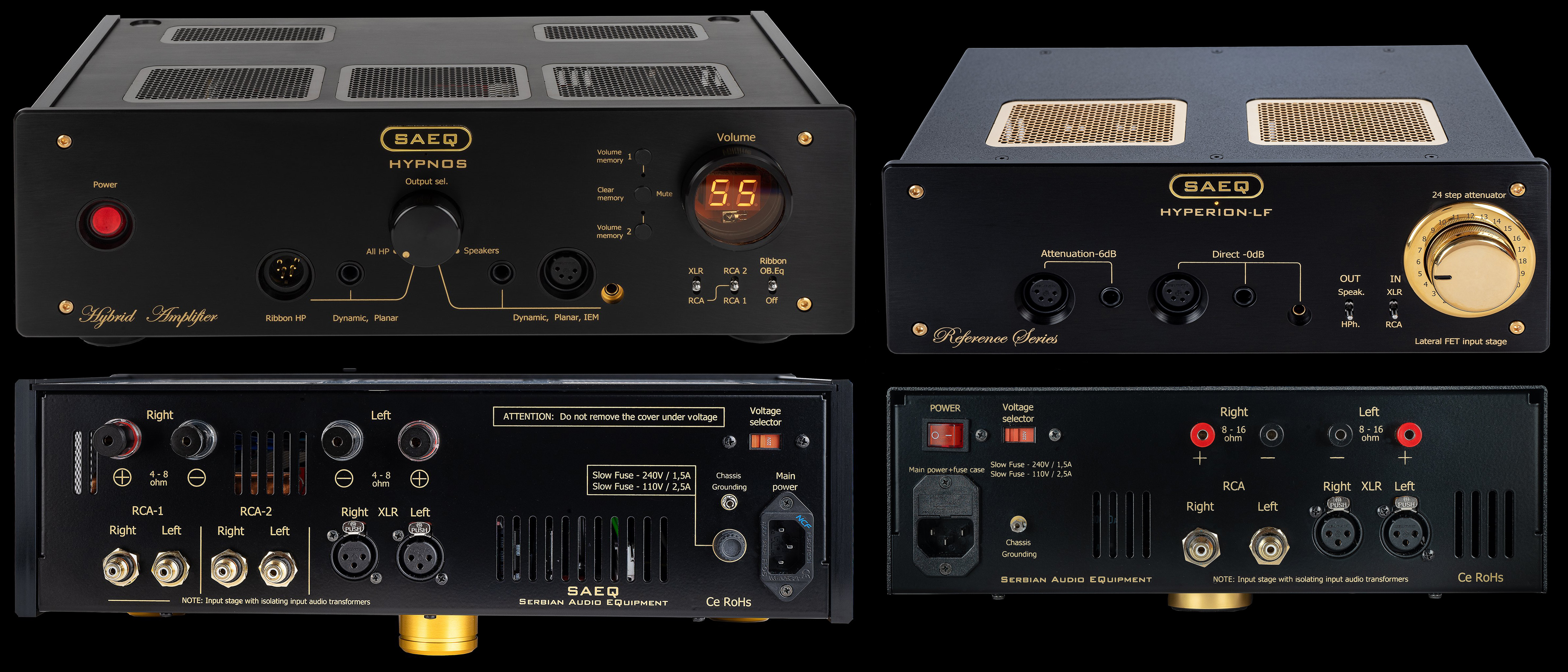 As shown, both of these double as speaker amplifiers contingent on amicable sensitivities, room size and top SPL.
 "We created the first Hyperion Ge amplifier in 2022 and produced it since early 2023. It used germanium input transistors. The sonic result was incredibly good. A quasi-complementary output stage provided excellent support for its first stage. It left no listener indifferent. It had warmth and fluidity but outlined everything clearly for no lack of detail. The 2024 Reference Series refined certain aspects. With the new LF model we focus on an input stage executed with three in-line 2SK170 BL. Those are classic Toshiba n-channel Jfets specifically designed for low-noise high-gain audio apps. The BL designation specifies their zero-gate-voltage drain-current range of 6-12mA. So the suffix LF is short for Line Fet. Instead of a Germanium input buffer we now use input transformers on permalloy cores. This gained the sound fluidity and density so both lightness and fullness. Without my description, 90% of listeners would think this was a tube amp." Then there's this: "Deep in a remote Californian forest rises Hyperion to 116m as the world's tallest tree so higher than the Statue of Liberty. To protect its delicate habitat, its location remains undisclosed." Aside from that connection, Dragan's names look to the Bible, ancient Greece and Rome. Monster slayer Perseus. Sun god Hyperion. End-time battle Armageddon. God of slumber Hypnos. God of dreams Morpheus. Star god Astræus. It's quite a pantheon of illustrious choices already which currently span €3'300 – €13'000 ex VAT.
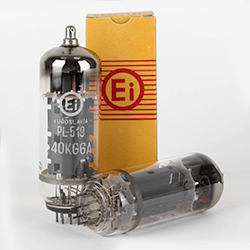 "The very fact that our input transformer primaries don't orient for an alternating signal produces some additional level of relaxation that doesn't exist without a transformer. The inputs of all our new amplifiers except Perseus and classic Astræus use audio transformers and single-ended input stages determined only by asymmetrical power supplies. Since the transformer primary has no ground, it generates that extra fluidity and ruggedness of character without losing micro detail. Alex and I spent much time experimenting with input transformers and realized that Lundahl transformers do not suit us due to certain parasitic phenomena above 4kHz. With some suggestions to a transformer supplier, we finally got what we wanted. Alex ended up removing the Lundahl transformers from a 2A3 tube amp he's developing and swapped in our new transformers. The thing is exactly like cooking. A new spice appears that proves perfectly compatible with the taste of boiled beef in pepper sauce—and voilà, a new special flavour." In this context it's interesting to recall that from his early ICEpower-based models to the present range, legendary designer Jeff Rowland too has advocated input transformers for solid-state amplifiers. If the mention of spice had you flash on the desert planet Arrakis thence Serbia as an arid hifi destination – things there are far greener than on Dune. Think Auris, Dayens, Karan Acoustics, Miraudio, NAT, Raal, Senna Sound, Solaja and Trafomatic for a few domestic brands. Then recall Elektronska Industrija Niš or Ei for short which in the former Yugoslav/Serbian¹ state had acquired original Telefunken smooth-plate tooling to produce highly sought-after audio tubes. Serbia's connection to vacuum tubes and vintage circuits runs deep. Dragan Solaja once mentioned how well-stocked his local library was on Soviet tube schematics. Meanwhile his country's EU exclusion created import difficulties for many popular electronics parts. This birthed a generation of highly resourceful DIYers who learnt to make their own. Some of them went commercial and today front successful international hifi brands.
_____________________
¹ From Wikipedia: During its 1918-1941 Kingdom period, Serbia began as the Kingdom of Serbs, Croats and Slovenes which in 1929 renamed as the Kingdom of Yugoslavia and incorporated the former Kingdom of Serbia. During the 1945-1992 Socialist period, Serbia was one of six republics under the Socialist Federal Republic of Yugoslavia. Following the latter's breakup, in April 1992 Serbia and Montenegro formed the Federal Republic of Yugoslavia which later became the State Union of Serbia and Montenegro until Montenegro voted for independence in June 2006. Since June 3rd of that year, the Republic of Serbia has been independent. In 2009 it applied for EU membership. Since 2014, negotiations are ongoing and hoped to conclude by 2030.

12
