"The purer space which the MusikBoxx left between the beat teeth of hand-drum salvos rendered such percussion with unusual focus and clarity. It removed some form of micro blur which tends to occupy the gaps between ultra-fast staccato sounds. This crystallization obviously didn't restrict itself to snappy whirlwind drumming. Soundstage holography as that sense of extra-keen focus too was very high. Both aspects point back at those snapping-into-focus comments which reviewers of Wilson speakers post when an expert makes time-alignment adjustments whilst they remain in the seat. It's an absence of blur not the presence of pixilated outlines or metallic leading edges. It's why this rhythmic exactitude of the Boxx doesn't feel unnaturally peppery. It retains the earlier-mentioned subtle relaxation or softness."
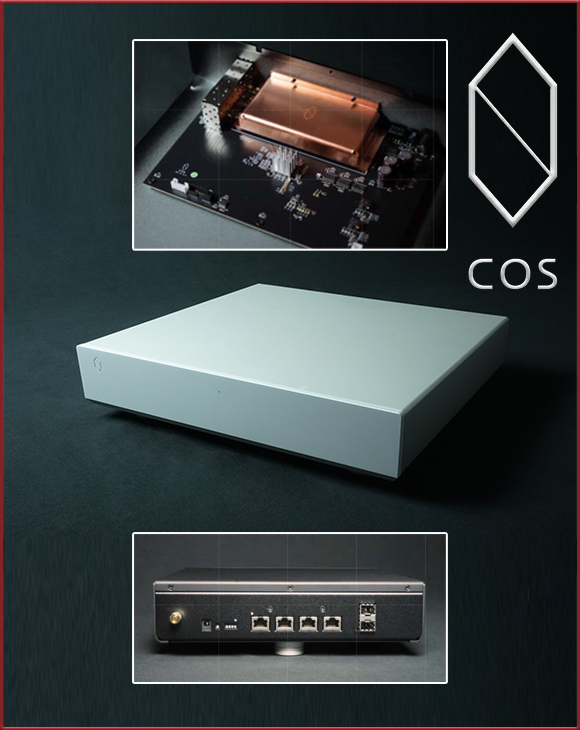
 Next to full-width gear, the Streamer is like a guppy amongst sharks. So are regular tablet remotes next to a 27" iMac.
"Given this, we now see the time domain not just as the beginnings of sounds but their stoppages. When recorded as close-proximity dry hard hits, sounds don't just start with suddenness. They also end very abruptly. When fundamentals and their harmonics rise in sync even though that sum total may spread over multiple drivers, we get clean transients particularly from low-mass drivers. Hello physical time alignment. When the same sum total clips off just as cleanly to make room for the next sound, we hear superior stoppage. That keener precision isn't about the virtual front foot of attacks. It rests on the back foot of how sounds end. It becomes particularly obvious on close-mic'd recordings where our ears mustn't separate the direct sound from its reverb trail. Talking about front and rear foot helps envision why the Boxx wasn't guilty of deep-fried attacks. It combined its superior staccato diction with a subliminally laid-back attitude, not a forward lean. In tech terms we'd probably call that excellent damping and pistonic behaviour for the Accuton mid/woofer. It made for brilliant intelligibility and separation of tightly spaced sounds in a rapid flurry all originating with one instrument. But with equally punctilious tonal beginnings, superior separation also factored for dense wet recordings with plenty of reverb. Our ear/brain locates sounds by their rising edges. It's how in a noisy restaurant we can follow a conversation a few tables over by extracting it from the surrounding din."










"Now spread out five or six musicians all jamming furiously in a reverberant venue. Close your eyes. Despite the inherent blur of the reflections having sounds overhang like wet water colours, cleanly rising transients still give our ear/brain all the necessary cues to precisely see where each performer is relative to the others. If we wish, we may lock onto their individual playing and peel out a counterpoint or tertiary line from the mix. Likewise for time-coherent speakers. Better separation doesn't mean that the musical whole falls apart. It just means higher clarity and less distractions from time distortion. Now we can reverse-engineer a mix in our mind; untwine complex compositional structures; isolate layers in polyrhythmic density. But higher resolution doesn't oppose listening for pleasure. The ability to inspect a tune exists simultaneously with a standing invitation to merge with it. We decide, moment to moment. A merger is always possible. That relies primarily on our emotional readiness. It's available from a clock radio or crackling car stereo. Musical inspection meanwhile is limited or liberated by the extent our hardware throws up obstructions; or not. That's back at eavesdropping despite overall clangour. We needn't do it and it's a rude thing to do in public. But playback is private. We may eavesdrop all we want on an upright bass or background singer working behind a band. Particularly listeners who use their ears to see are greatly helped whenever a virtual stage is well lit, properly sorted and cleanly focused; when sounds start and stop on time. They will find the MusikBoxx a tripod-steady wide-angle lens of astonishing depth of field. Meanwhile pleasure seekers looking to be swept away certainly won't be handicapped by more adroit enunciation and greater intelligibility. That's so despite the ongoing truth-vs-beauty argument that declares high resolution the enemy of musicality. If it could, to that the MusikBoxx would say, what a bunch of pickled croc! And in its own way, it did precisely that."
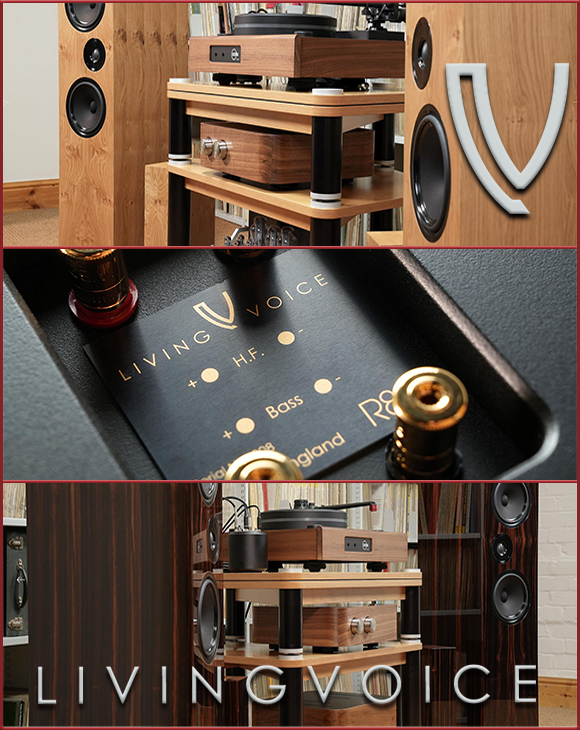
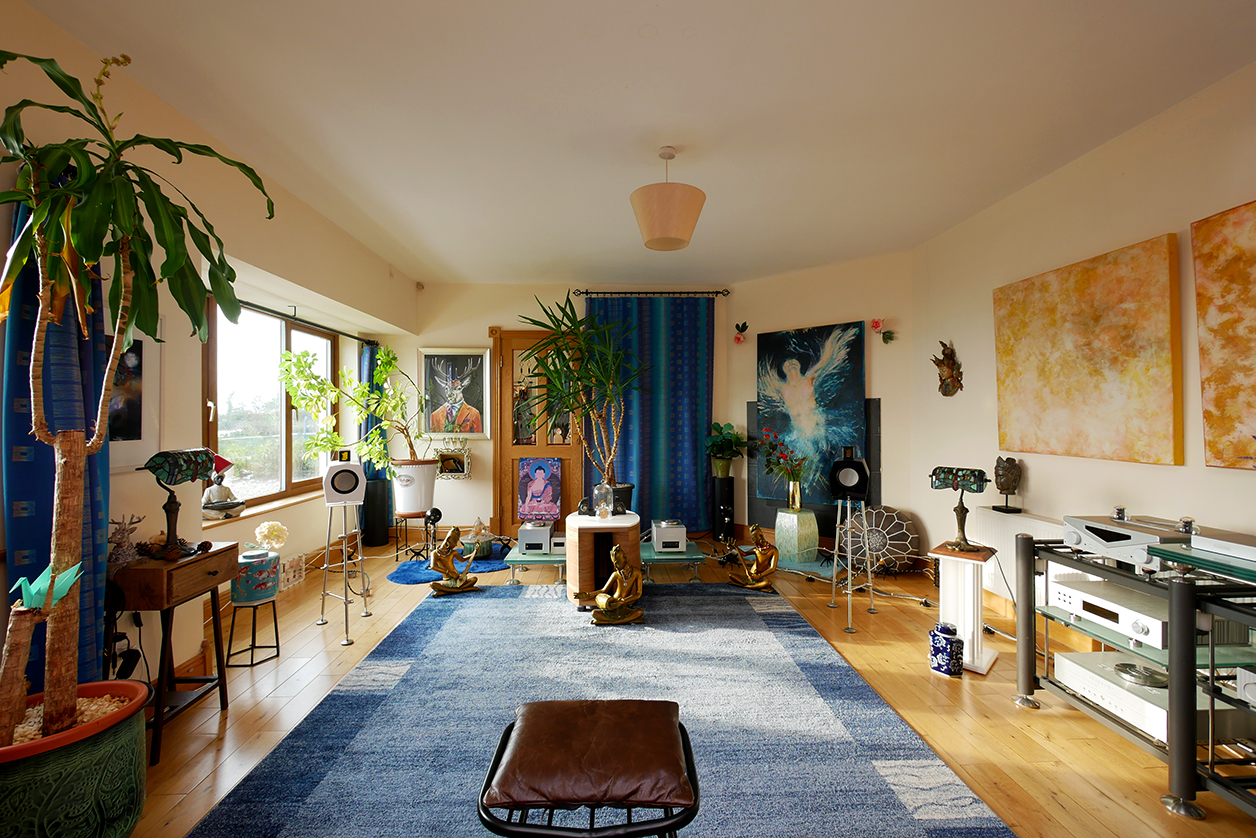 With MusikBoxx speakers in their two available finish options, outboard passive crossovers against the sidewalls.
"My ears didn't find the Boxx lean at all even driven DAC-direct and by DC-coupled amps of very high bandwidth. At the same time it felt clearly more unvarnished than paper cones. Should that mean lean to other ears, I'd understand even though I would flip the script to call their cellulose drivers more coloured and less informative. Given my other descriptions, this detour into tone was rather self-explanatory and predictive. Transparency, lucidity and other aspects of high resolution live on a different page than warmth and thickness. Warmth or thickness aren't something I heard. But I did hear that certain gentleness which was the antithesis of fuzzy. It mirrored a parallel review of Nagra's Streamer. Operating purely in the digital domain, you'd not expect big differences from what essentially is a reclocking signal router, certainly nothing in the amplitude domain. Yet Nagra's FPGA-controlled Andreas Koch-style custom clocking which omits USB has an effect. The sonic gestalt gets more laid-back! I haven't the faintest how or why this occurs. It's simply demonstrable and apparently a time-domain function. The MusikBoxx has it, too. My terminology calls it elegance. It's the difference between how a ballet dancer and bouncer walk when neither performs their job. The dancer doesn't dance, the bouncer doesn't brawl. They just walk. But there's a tangible difference in their build, how they move and carry themselves. One is lithe and loose, the other thick and tight. The MusikBoxx motion through time, what I think of as gait, reflected a dancer's elegance." That ends my lengthy quote of the speaker review.