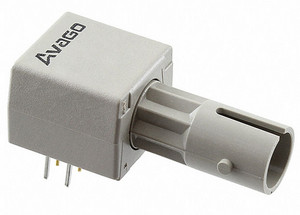
 Nagra's Streamer seemingly chides us for over-complicating hifi without sonically good cause. Don't rebels without cause die young? "Our standard Lemo cable with the Classic PSU as a power-supply upgrade is 1.5m but we can supply up to 5m. The fibre-optics can do up to 500 metres I was told though I didn't personally try it. Whether our N-Link works with SFP I don't know." [Nagra's optical transceiver at right.] To accommodate my setup, I would want a 4m umbilical to connect a Nagra DAC to the same external Classic PSU as their Streamer. That power supply can drive up to three Nagra components. To run the Streamer with my own DAC, I had a premium coaxial cable and spare CAT8 spur to hop on my LAN. Once the Nagra carton arrived, I unpeeled its chunky very compact contents. This smallest Nagra is one very substantial little brick whose footprint doesn't much exceed Apple's SuperDrive DVD though it's more than twice as thick and far heavier. Obtaining proof of life was child's play after Audirvana's UPnP¹ options selected the Nagra Streamer whose tiny yellow LED was steady. Et voilà, instant music. To compare versus my usual stream, I only had to switch the output device in Audirvana and an input on the DAC. Right as Irish rain.
¹ A number of streaming brands make much noise about having obtained Audirvana certification. I haven't a clue what it means. Any streamer with proper UPnP compatibility should be automatically discoverable by Audirvana, meaning its software and GUI handle signal routing and library navigation for local or cloud files, then output to the chosen UPnP device as shown below right. Where's the need for special certification? Yet a recent Audirvana press release announced Auralic, Lumin, Matrix Audio, Nagra and Trinnov as 'Plays with Audirvana' partners, Auralic exclusively via USB. So perhaps 'universal plug 'n' play' isn't as universal as its moniker lets on?
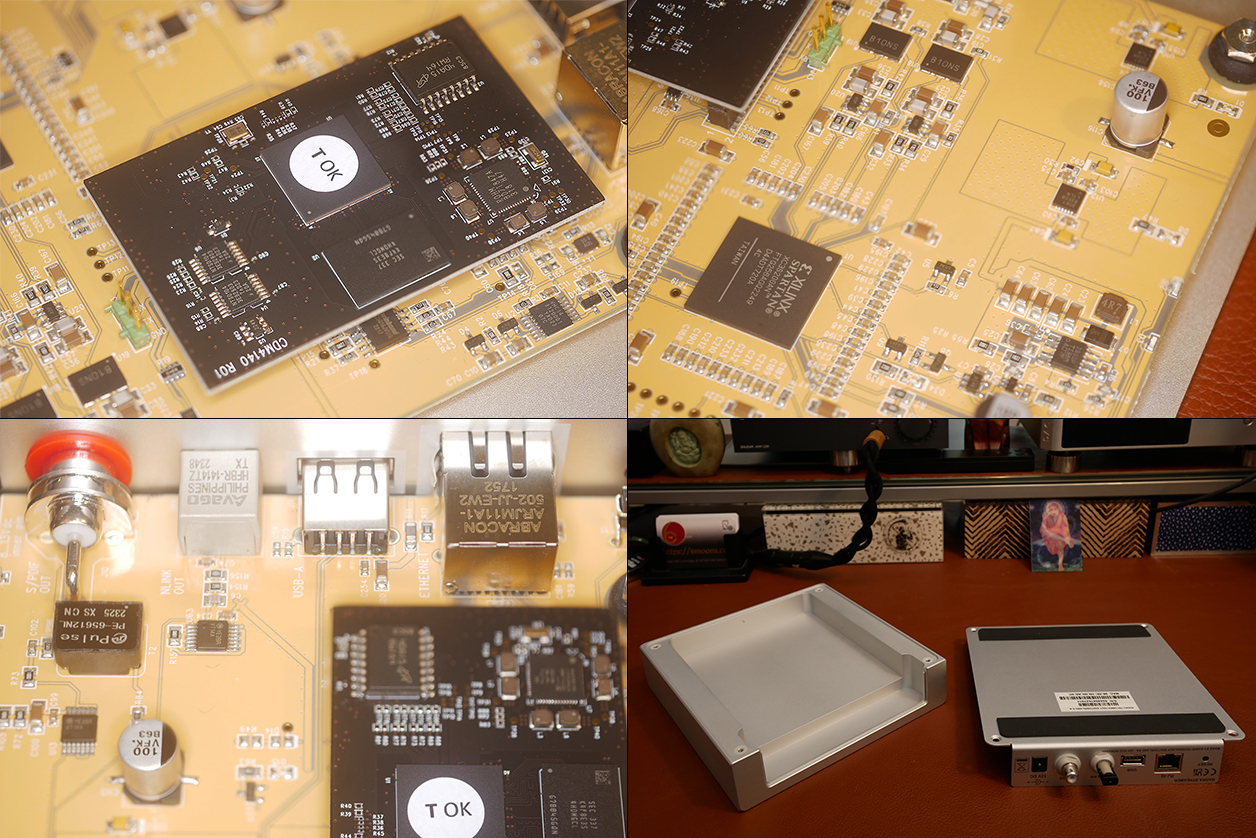 Isolation transformer ahead of the coaxial output | a massive piece of aluminium for a petite board.
 To hear how the Streamer's sonic impact tracked, I used a Cen.Grand DSD1'024 DAC; and Sonnet's pure PCM Pasithea discrete R2R DAC with split processing for the less significant bits. Speakers were my usual Qualio IQ and a visiting pair of ModalAkustik MusikBoxx monitors electronically crossed over to my usual 2×15" cardioid subwoofer. To describe the Streamer's effect, allow me a lengthy detour that will lay the ground for its very brief actual description. This detour lifts copy straight from the MusikBoxx speaker review. It'll make the intended point perfectly. Do keep the faith. Here goes:
"Time doesn't matter? From Vandersteen to Wilson, speaker designers object to this question. Vandersteen insist on physical time alignment (sloped or stepped baffles) and minimum-phase 1st-order filters. So did Thiel and the original Meadowlark. Wilson combine steeper filters with physical time alignment adjustments. Reviews describing how Wilson experts dial in their samples routinely comment on the absolute audibility of these very fine incremental changes of the relative distances between multiple drivers and the listening seat. Descriptors thereof tend to be variations on 'the sound snapped into focus' like a camera lens perfectly locked onto a target. Other brands combine 1st-order filters with vertical baffles; or use dual-concentric even tri-concentric drivers. Whilst the vast speaker majority denies the audibility of miniscule time delays from filter-induced phase rotation and voice coils not vertically aligned, exceptions certainly do exist. The MusikBoxx's set-back tweeter [below the break] is such a one."








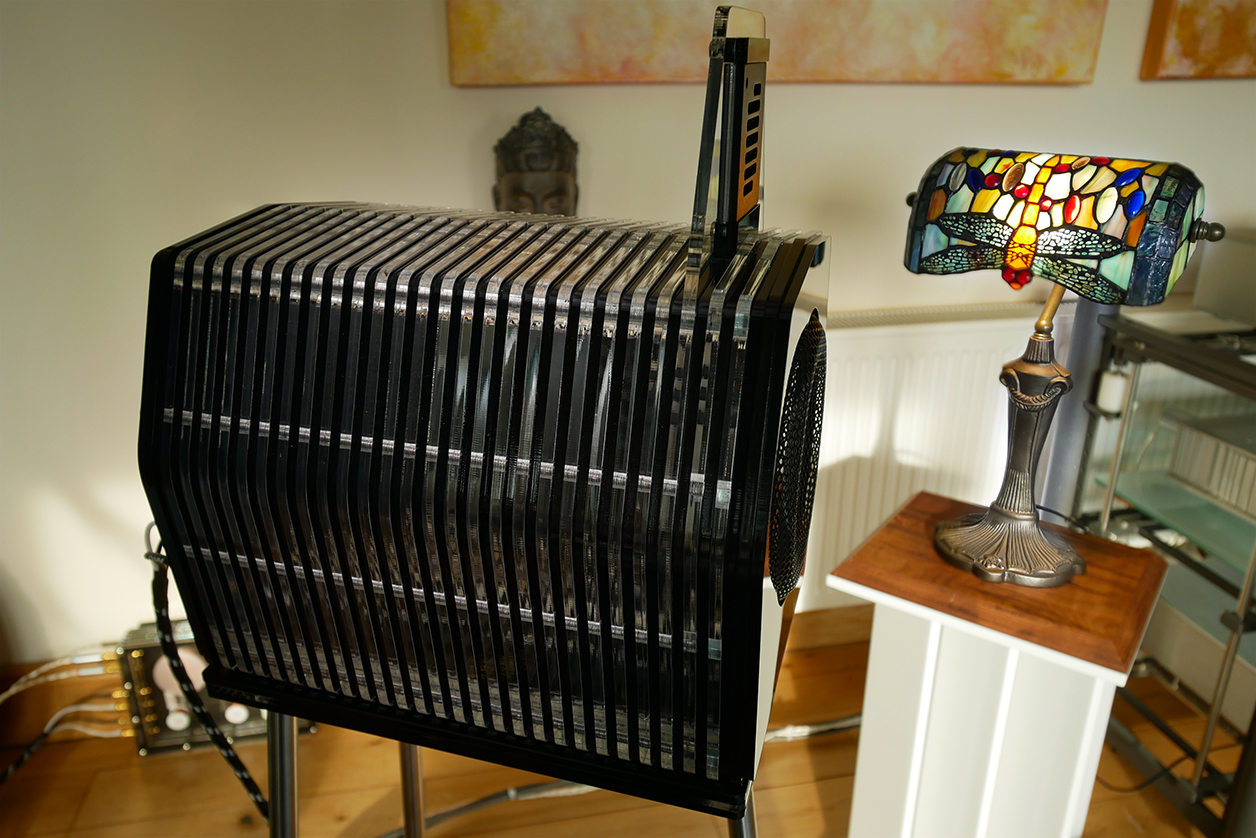 Time-aligned tweeter.
"Inert cabinetry addresses the time domain in its own way. It minimizes or eliminates so-called box talk whereby the micro flex of cabinet panels exposed to high internal pressure causes distortion. Single-driver speakers without filter parts avoid the time smear of capacitors and inductors. Likewise for sealed bass which avoids the resonant MO of ports. Whilst these connections to physical time alignment, sealed loading and multi-lam cabs under tension revive the reviewer's curse of wanting explanations, there's good reason to list them. Be it Zakir Hussain table trills or madly splattering darbuka drums in quartet formation, the Boxx absolutely excelled at separating very fast tightly spaced beats. Most speakers don't return to zero between rapid hits. Envision a classic comb from the side. Each inner tooth is surrounded by an air gap all the way down to the base. Compare that to a debris-matted comb whose individual teeth no longer separate cleanly. That's what many speakers do not with hairs but a kind of haze. Unlike a dirty comb, temporal haze may not be obvious per se but it certainly telegraphs against a speaker that doesn't do that at all; or to a far lesser extent."