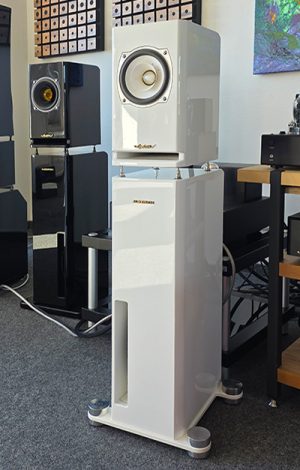
 Future proofing. Feature proving? With the companion MusikBass 2×12" RiPol subwoofer adopting the same acrylic zebra construction just across, the stack attack shows below. Smaller rooms, lower SPL and less adventurous eyes like mine will prefer the MusikBoxx on its low-mass stand augmented by one or two subs set up squat and separate.
Either way, the same catalogue offers a complete bandwidth package. The compact companion sub was another reason why I picked Michael's monitor over Raidho. Should the future urge me to splurge, I can surge on a natural upgrade path that will be coherent on sonic qualities and cosmetics.
I lack love for the looks of the stack. So I'd purge my current 2×9½" force-cancelling sealed Dynaudio sub with its typical omni radiation for one of these subs with its 'super-dipole' hence quasi cardioid dispersion.
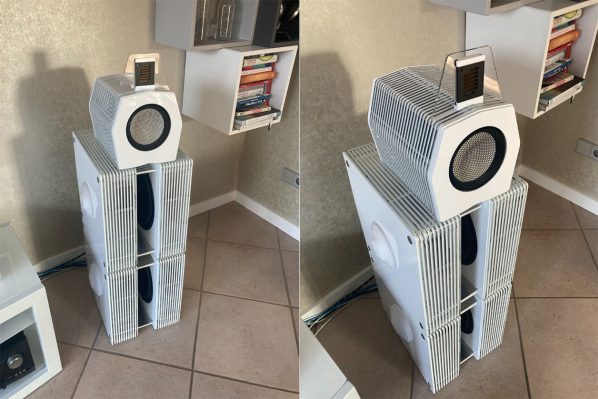
Inbound from Berlin just then was this white review stack at right. It's from Voxativ called Alberich2. It parks a filter-free 5-inch widebander backed by a short folded rear horn atop a single 12" RiPol sub with built-in electronics. Being matched on width, my eyes call this twosome cosmetically more coherent.
The price to pay for the cosmetic continuousness is one woofer. Running two face to face as the MusikBass does wouldn't fit. But with a custom plate amp and adjustable low-pass filter, with Voxativ one needn't worry about a separate bass amp with built-in crossover as one does with ModalAkustik whose maker can bundle two external options with it.
 Another speaker that belongs into this nano niche of transducer solutions is the forthcoming Vox5 from Switzerland's sound|kaos. It mechanically decouples a 6" widebander with upfiring Raal ribbon from a continuous bass bin whose two 12" dipole woofers stack to maintain a narrow baffle. But when today isn't a formal review just follow-up, these mentions are merely in passing. They sketch out a fuller picture for those who might shop this narrow gap well off the mainstream. Now is the appropriate moment to reiterate why my award for today's speaker specified a 2.1 monitor. As a sealed box of limited volume and having that sibling sub, the MusikBoxx rates ~60Hz. That wants augmentation in a standard-size room when we apply bandwidth expectations of an €8K/pr ask. This was one more reason for my choice. If one intends to exploit active bass via subwoofer and high-pass filtering the mains electronically, it's counterproductive to buy unnecessary bandwidth only to castrate it afterwards. All we need is bandwidth down to where we mean to cross over, at the very best quality we can afford. What we don't need is the excess bandwidth we'd want if we ran this monitor solo. So to be sure, in most apps this speaker wants to be partnered with a subwoofer. It's why my 2.1 purposes call it ideal. Your 2.0 situation might not.











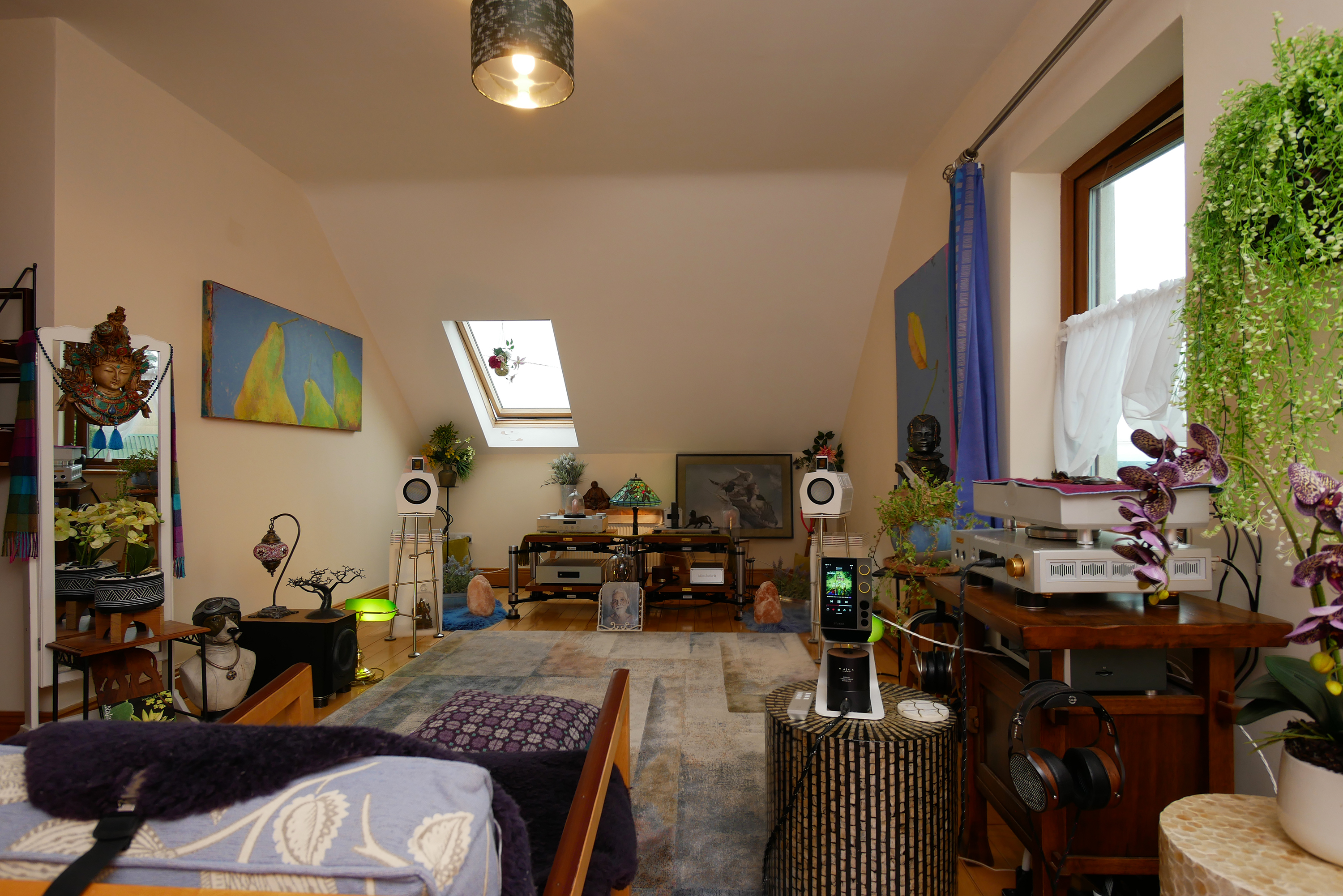
Here's the nearly final setup. In the absence of eight 80cm jumpers I still had to procure, I jerry-rigged some white foam liners from discarded packaging to act as crossover perches. Instead of squatting on the floor between the tripod legs, the filters had to temporarily sit far higher to make my shorter jumpers work. But you can already see that the size and profile of the MusikBoxx really suits my décor; and that these open airy minimalist stands are far more conducive to it than fat solid high-mass contraptions. When people say that looks don't matter, I tend to wonder. Tastes obviously differ but for my money and eyeballs, these really hit the mark. Once the white foam pedestals depart, I'll consider this wrapped. But it obviously already is, sonically. More on that anon.
First a look at a crossover while still sitting pretty near the speaker input terminals. It explains the rationale for an outboard filter box. There just wouldn't be enough room inside to maintain this spacing and positioning of elite filter parts. What's more, exposing them to the very high internal pressures of a sealed box just wouldn't be smart for a no-compromise effort.