 "In general I'm blown away by the performance of Matrix Audio in relation to cost. There is a super-smooth feeling about their sound that still has the right amount of articulation and definition with ultra-fine detailing. There is nice weight and bottom end all very refined and fast. All of this is already superb on its own but as you then consider the price points and build quality, it gets quite impressive. The MA-1 is no exception.
"Sure, I first fell for Matrix because of the streaming side of their portfolio but the MA-1 is a true high-end beast that will stand its own against many pricier competitors. It has great scale to the sound and elasticity in the bass but still that smoothness whilst being very detailed. The build is wonderful and so is the packaging. For me, Matrix Audio are offering a very complete package which includes the user experience. Do give the unit a few days to come alive and you will be very happy with the results."
That was Michael Huigen on his take of the product. Of course we'd expect him to like it. Unlike online shills behind a laptop however, he's financially and reputationally committed. He stocks hard inventory for the three Benelux countries and is responsible for warranties. Nobody warehouses goods which they don't believe in. Should they lose faith or experience too many failures, they divest themselves of a brand to pursue another. "Blown away" indicates anything but. Not blowing away was the actual delivery in its ~50kg weather-wrapped double cardboard box with 6cm thick precision-cut hard-foam liners for protection. The amp itself additionally protects in a sewn cloth bag with very stout loop handles across its belly to lift easier. There's the obligatory pair of gloves, a 3.5mm trigger cable, generic power cord, a far from generic Chinese/English manual in a plastic cover with hard spine and a 1-year warranty card with affixed serial number.
 The 2 x 15" cardioid subwoofer from Switzerland's sound|kaos was inactive to instead serve as a stout support tower. Parking the MA-1 on the amp stand behind it wouldn't show.
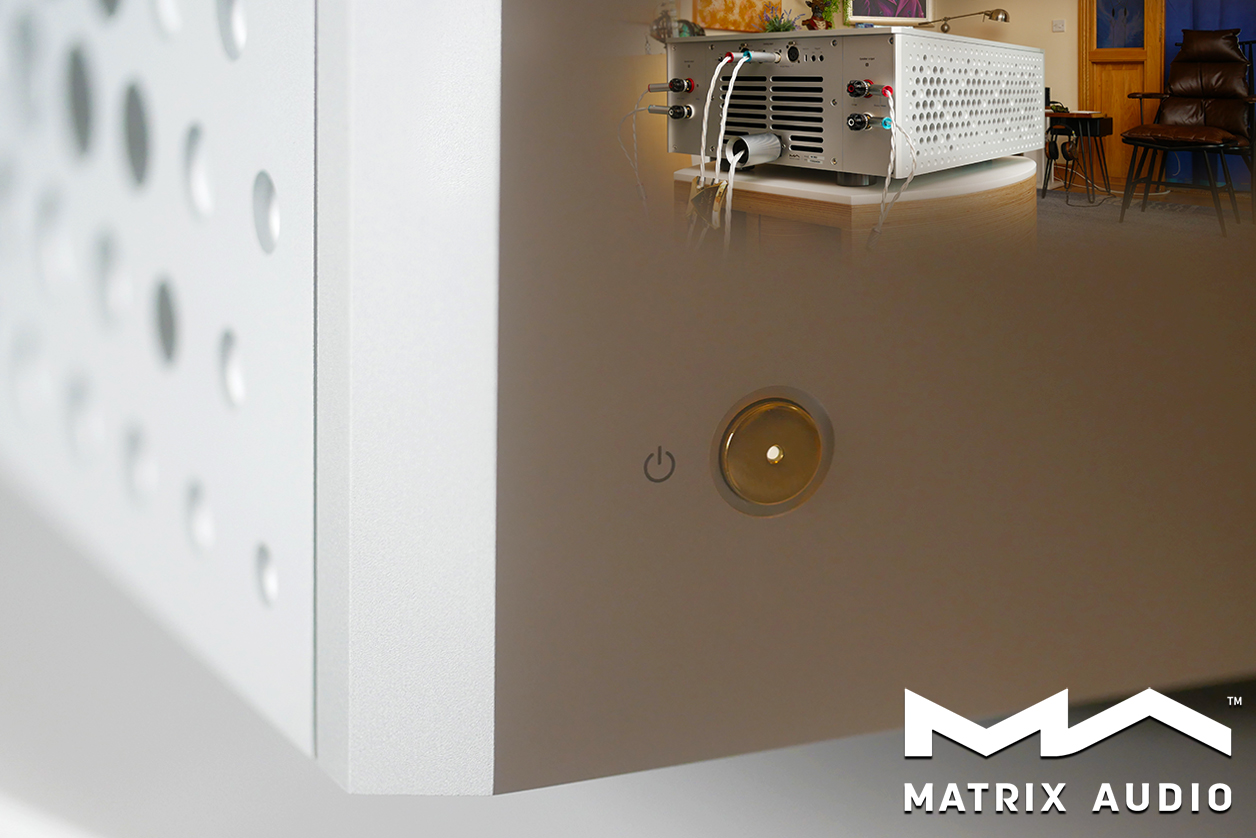
Though it's grotesquely geeky to call out cardboard chops, the box grade Matrix sourced is a few carton cuts above what typically drops at my door. This bodes well for safe arrival even with overworked underpaid delivery personnel; and being able to reuse the original shipping materials. Dweeb detour done. Now watch your back. This is hulky heaving hardware. Be careful lifting and carrying. Best use a sufficiently stout wheeled contrivance to bridge your distance. Then go soft in the knees. Your preferred perch will need to accommodate a footer spacing of 30 x 42cm. Et voilà. Once wired up, flicking the mains toggle in the rear then pushing the small round frontal standby switch caused its central white light to blink. A few seconds later one fat relay clicked, then another. The white light went steady. Zero turn-on transients. In low gain, zero noise with an ear on my drivers. In high gain, some power-supply hum appeared so back to low gain it was. I had just modest mechanical transformer hum doing a Van Gogh on the amp's cover. That was mild enough to fade to nothing a metre away. It was inaudible from the seat, period. I was in the stealth business with a muscle amp built like a bouncer then dressed in a Zegna suit. Your man in the moons was poshing it up for a change. For prior context, the only amps to best my Kinki monos in the above system were €23K/pr class A p/p Georg Friedrich Händel monos by LinnenberG; and Electrocompaniet's mighty still bridgeable AV800M at £20K. The MA-1 demands half or less than either. If it could create enough performance distance from my EX-B7 to shout next level, memory would park it adjacent to the German and Norwegian champs unless a particular quality dominated to become a more distinguishing feature even in hindsight. As to that metallic suit of armour in the flesh, its finish really is exemplary, its industrial design a superb example of chic understatement. Or as Denzel Washington's haughty cop tells his neighbourhood crowd in the movie Training Day, "King Kong ain't got nothing on me". Ditto for our MA-1 and the usual big boys.









"Today's speaker is 8Ω and 89dB so an easy load." Words to that effect litter hifi reviews. They blank out the fact that any speaker Ω is a nominal so averaged value. A ported speaker exhibits what's called a saddle response in its impedance curve. That saddle shows as two spikes which correspond to the port tuning and woofer inductance. At 28Hz and 55Hz for example, such a speaker might peak at 30Ω and 70Ω into which an amplifier delivers far less power that it does into 8 or 4Ω. A typical first muscle amp advantage is superior control over such behaviour. It means better damping of ringy peaks to filter out or minimize resonant lumps in the amplitude response separate from room modes which may occur at very similar frequencies. And so it was with today's King Kong atop my high-rise subwoofer. He exerted crisper control over my sub 100Hz band than my own monos. Cue the proverbial steel fist in the kid's glove. Steel is for grip, velvet for suavity to avoid the unnatural jackhammer effect of cyborg bass. If you don't understand that lingo, think of the rotund warm textures of an upright bass vs the hard-edged clipped brutality of synthesized drum machines. Cyborg bass has the former sounds like the latter. The tech term is overdamped. The side effect is extreme dryness and from it, a mechanical feel or absence of flow in the low end.
The MA-1 was clearly on a still higher level of control over my 9½" rear-ported Satori woofers. That registered as though it suppressed room modes which really were impedance effects. Yet bass textures and gait remained admirably elastic so non-robotic. Segueing back at our hard-body bouncer in his stylish Ermenegildo Zegna suit, he even had a higher university degree. That's for IQ and sophistication. Raw steroid-grown muscle isn't in the spotlight. The outcome of intelligent application thereof is. That's more refined. Here it wasn't about 'more' bass as in, going deeper or louder than the resident amps. Those already do it all. It was about higher linearity from more adept absorption of resonant peaks; and from that, a more continuous segue from the mid/high frequencies past the belt line down into the bassment. Whilst I could drive my Qualio IQ all day long from the 50wpc Simon Lee integrated on Ivette's desktop and clip my ears as though these were really easy loads, moving to a true muscle amp with high on-demand current says otherwise. There are levels, layers and leagues to control and successful dealing with back-electromotive forces and high LF impedance swings. In my domestic hierarchy, the MA-1 really was king of my various alternate kongs which span from 250wpc to the Enleum AMP-23R's 25wpc." Of course that's what we'd expect from a refined muscle amp," you demur. "But what about resolution, reflexes and speed? Isn't it so often true that on those counts simpler circuits with fewer output devices offer more?" At least in my experience you'd not be wrong to think so. It often can work out that way as long as our speakers play softer ball. How about here?