 Tech quickie. A passive radiator is a cone without voice coil or magnet. It's a tuned mass/spring system. The cone is the moving mass, the air trapped in the enclosure its spring. When the active driver moves out, internal air pressure drops. The higher atmospheric outside pressure pushes the radiator in. When the active driver moves in, internal air pressure rises. That pushes the passive radiator out. It seems that the passive moves out of phase. Yet at the system's resonant frequency, this relationship changes. Around this frequency pressure fluctuations from the active driver combined with the inertia of the radiator's mass cause the passive to move in phase. At or below its resonant frequency, the active driver still moves but drops off in output. Now the passive moves with much larger excursion. It takes over a significant portion of the sound. It acts like a tuned port but instead of letting air escape, its mass and size resonate with the enclosure's air volume.
The radiator converts internal pressure changes into bass output. It's about synchronized motion at specific frequencies to reinforce LF. Across their range, passives act like quasi active woofers. They are simply limited in that the active woofer sets their max excursion. However, for scale, pressurization and sheer impact around the tuning frequency, a passive can be viewed like a normal woofer. It almost behaves like a passive subwoofer driven by the main cone's energy. It's not just about cone area but moved air volume. Internal cabinet volume only has little influence on a passive's tuning frequency which just as much depends on the radiator's own mass. Adding more mass to it can shave off enclosure volume for a smaller box.
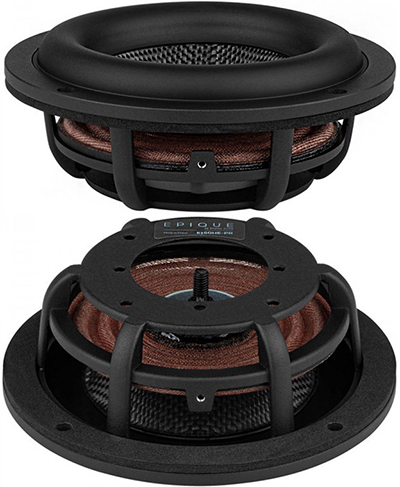
At right a passive radiator example from Dayton's Epique range. The exposed bolt on its rear accommodates add-on discs to increase the cone's moving mass and manipulate its effective tuning frequency within a given enclosed air volume. Again, this is merely an example of an auxiliary bass radiator, not Macarena's actual choice. It simply shows the concept; and in this instance, one with unusually high excursion potential compliments of that massive rubber-roll surround. Given the internal air pressures developed by an active 8" cone plus mass-loaded radiator inside a compact cab, we appreciate why Macarena exploits a double-walled curved particle-loaded resin construction with damping layer, even a decoupling material between it and the translucent baffle. Its namesake might be a flirtatious get-down party girl. But Macarena the speaker is a serious concept whose precise execution clearly underwent much thought before arriving at ~$10K/pr. It's no impulse purchase. It's a price bracket where many pursue 3-way floorstanders because they pack more stuff. That more stuff equals more goodness is obvious to all newbs. Their limits on budget and experience dreams of greener pastures where stuff bigs up so betters up. It's how most of us end up on the complexity lane of energy-absorptive multi-way crossovers; of the time confusion of box talk and steep filters; of needing big power and high damping to tame our transducers. It's routinely only after we've worked that lane for years yet failed to arrive that some of us exit the highway of convention. Now it often leads us down unmarked backroads into the wilderness of small boutiques. It could mean more unconventional approaches, greater simplicity, how to achieve more with less. Work smarter not harder. Today that's Canada's Maco Sound and their new Macarena three-driver 2-way monitor. Loved also by Germany's accredited engineer Norbert Lindemann, we bag a proven widebander from Ted Jordan's lineage, here with a simple high-pass cap for the immediacy of point-source dispersion; minimal phase rotation; no energy loss from a conventional resistive spider; no thru-cone time delay from internal box reflections; and LF completion with a horizontally opposed active/passive woofer combo. By this point I had practically sold myself. But would reality rain on my parade?









… to be continued…