The digital heart. Lindemann have been using a two-stage D/A conversion concept for several years already. Almost all currently common on-chip converters are based on the delta-sigma concept whilst some ladder DACs remain outliers. With Delta Sigma, past filtering the digital signal converts to PDM aka pulse density modulation which is technically comparable to 1-bit DSD. This is where Lindemann use a chip which converts PCM to DSD to feed DSD data to their DAC chip. This unspecified AKM silicon handles DSD natively so converts to analog with no conversion to PCM nor digital filtering. Norbert Lindemann rejects such filters on sonic grounds. This allows his converter chip to run at its optimal operating point and filtering is purely analog in the subsequent gain stage. The volume control works without first converting to PCM as is the case with ESS Sabre chips. According to Lindemann, his DSD volume control does not suffer the well-known pitfalls of typical PCM volume which bit-strips the least significant bits with higher attenuation to throw away resolution and in the worst case, increase quantization noise. Lindemann claims to elegantly avoid these issues with his DSD approach.
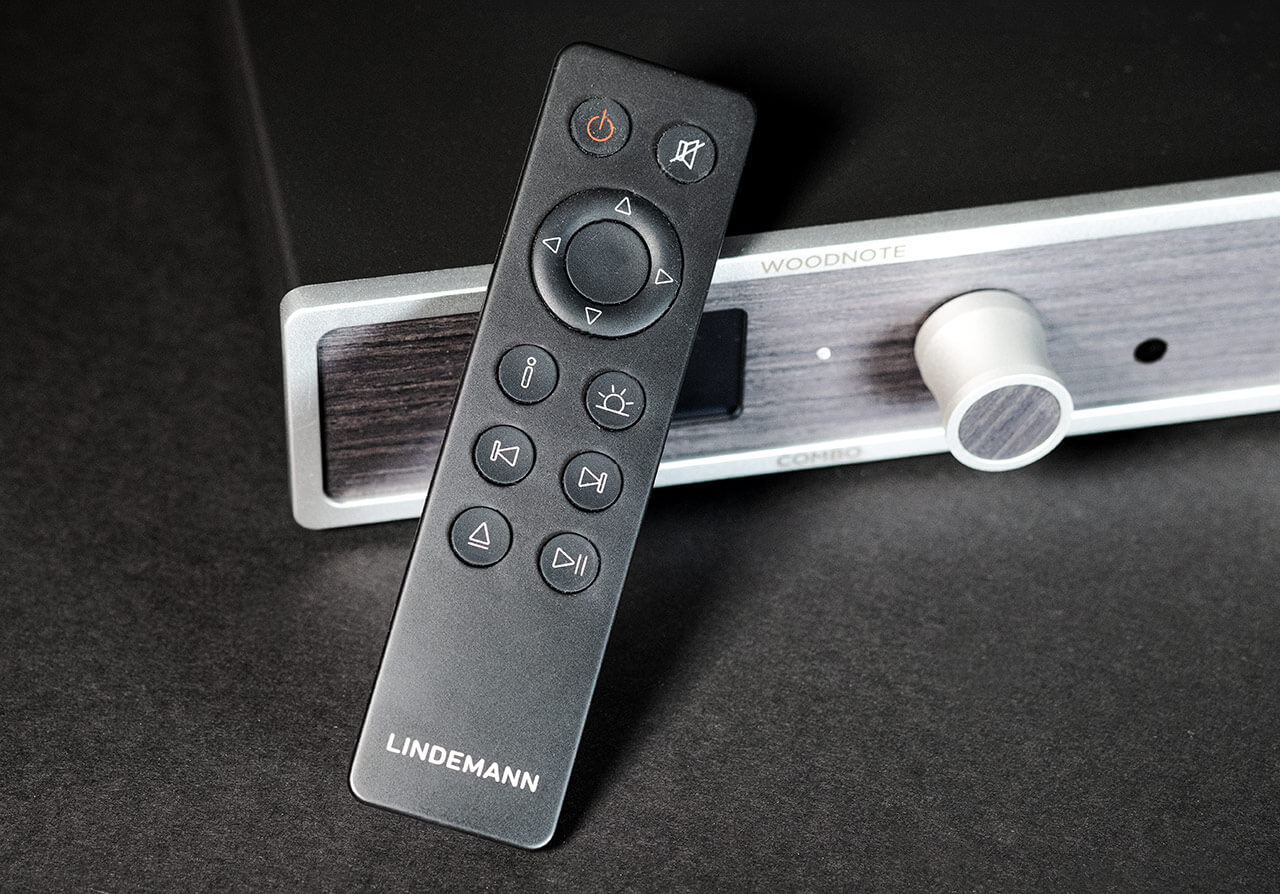
Before this gets too technical, back to the device! The Woodnote Combo is centrally controlled by the Lindemann Music app which offers intuitive navigation with excellent stability. The initial setup thus only took minutes. "Find" the device on the network, enter a few basic settings like my Qobuz log-in credentials et voilà, high-resolution streaming. Done! It's nice that Lindemann still include this classic remote for the most important functions like volume and source selection. This means that we don't have to reach for our smartphone or tablet more than absolutely necessary. I wired the Bavarian streaming amplifier directly into my router and initially paired it with demanding speakers. The €5'500/pr Harbeth 30.2 XD speakers aren't exactly sensitivity pushovers at 85dB/W/m and quite reactive to electronics. With some amps they sound absolutely sensational, with others they can sometimes get a bit dreary and ho-hum. I can already hint at other speakers too when Lindemann added a pair of their brand-new Move Mini in my freight "just because". Tiny light speakers supposed to fit perfectly with the Lindemann amplifier? Could it be true? Find out. Let's go!












 I admit to being quite curious whether the little Lindemann would light my candle because I'm not generally a fan of switching amps. Many of them don't really do it for me emotionally. But exceptions prove the rule. I listened via two digital inputs and couldn't tell any significant difference between them. The topic of tonality was dealt with relatively quick. Even if raw paper power is nothing to write home about, the amp handled even the deepest sub-bass of Billie Eilish's "Bury a friend" from When We All Fall Asleep, Where Do We Go? right down to the first octave without any overemphasis but with grip and contour. And so it continued across the remainder of the audible range. From the fundamental range through the mids to the highs, I heard no deviations or colorations. And the Lindemann also played freely at the very top, not a given with class D due to its output filter. The Combo simply played it linear without any harshness. My regular working amps are €6'200/pr Valvet A4 Mk2 monos which offer roughly the same power but run entirely in class A and therefore slurp much more lustily from my wall socket than the efficient Lindemann which consumes a mere 12 watts at idle. Compared to the Combo, the Valvet twins had a slightly more sonorous, juicy sound by adding a tiny bit weight to the lower midrange while being a little less bright in the treble. These were mere nuances but you'd certainly hear them clearly in a blind test. All in, I'd describe the Woodnote Combo as extremely neutral but not colorless. It was actually very good at reproducing timbres so accurately that one can enjoy the machine and above all, the music.