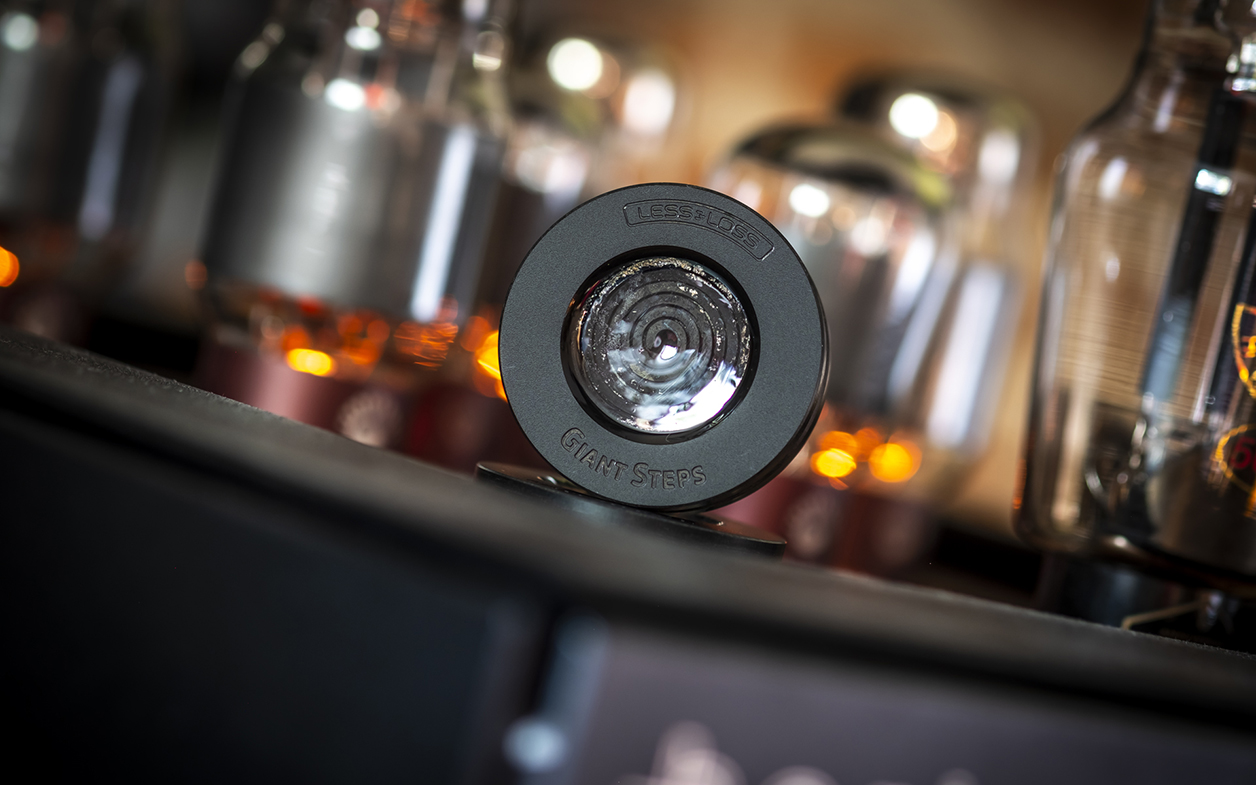
Should we now wonder how this has any impact on audio electronics, LessLoss remind us that stray airborne radiation is a fluctuating electromagnetic field. If transformers inside electronics and motors in speaker drivers are prime sources of these variations, Giant Steps' diamagnetic component acts like a highly sensitive magnetic shock absorber for them. As such it lowers EM noise beyond the scope of conventional anti-vibration accessories. The latter receive then respond to undesirable physical oscillations in a reactive process that includes some time lag. Giant Steps act quicker because they interact with magnetic fluctuations in real time involving no mechanics. The theory behind them is quite fascinating and the product itself a breeze to use. The lack of moving parts and low height ensures that anything positioned atop remains extremely stable though there is no height adjustment. The recessed translucent core shouldn't be loaded but the footer remains as effective upside down where a small dimple can receive classic spikes with no weight limit. This invention consumed four years of R&D and over 40 prototypes before maturing into the final design which LessLoss view as their most advanced to date. One puck will set you back $417 and three per component is the obvious minimum¹.
_________________________
¹ This would seem true only if this device is considered as and used like a conventional load-bearing footer. Given its magnetic MO, it should also work placed atop transformers, behind speaker drivers attached with BluTac or strategically placed beneath strong sources of electromagnetic radiation like SMPS without any direct physical contact. If so, single units could serve multiple locations without bearing any weight. – Ed.
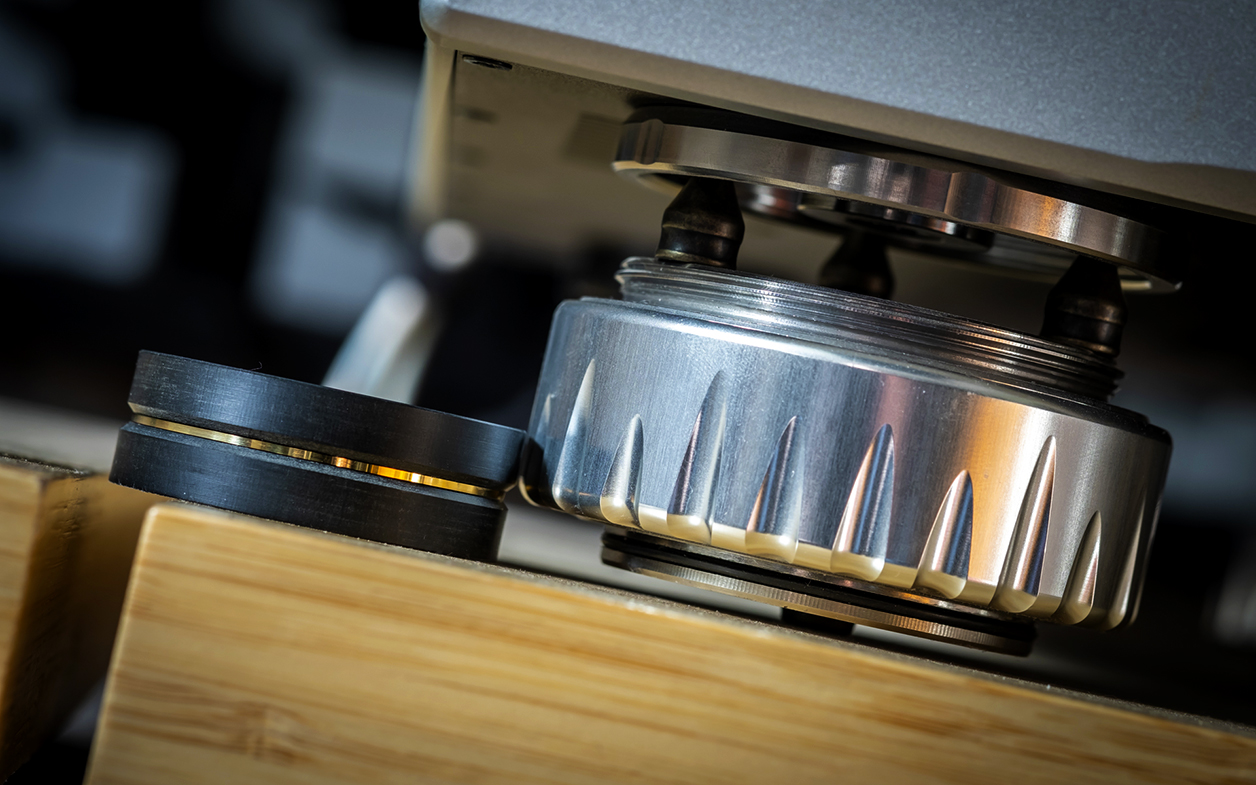
I anticipated a package with four or eight at most. Instead I got 20. Yet if I'm sent four footers, using three per component makes hardware swaps quicker by eliminating levelling. Odds are that slightly better performance follows. Sometimes less is more but not today. The efficacy of Giant Steps compounds. So a scenario that has a fancy DAC like my LampizatOr Horizon 360 atop 3 x 2 stacked doesn't seem unrealistic. Money aside, low height and robustness of these puck with no moving parts supports stacking. One may occasionally want risers if a component's taller stock footers can't be removed. Armed with twenty units opened quite a few possibilities. While some experiments were more practical than others, all were useful. sound|kaos Vibra 68 and Carbide Base Micro with TwinDamp bullets and diamond-tier Nano inserts were the two sparring partners.











Let me now briefly explain what to expect from a properly engineered decoupler. Early on their breed often manifests its presence as if volume was a bit lower because resonant bass gain diminishes. This is followed by easily traced improvements in bass textures freed of mud, boom and blur to feel quicker, more articulate, controlled and dynamically nuanced. Room talk of hollowness and bloom diminishes. The entire soundscape gets cleaner and more specific, vocals and instruments liberated from excess grain and edginess develop extra timbre differentiation and articulation. The backdrop becomes inkier, cleaner, wetter hence busier with recorded ambiance nuances. The scenery in front of us grows in size and layered complexity, images gain focus and contrast. Many top-shelf isolators provide these foundational qualities without major downsides or sacrifices. Essential offsets are degrees of effectiveness. The higher the latter, the easier our ears register and appreciate all the changes.
The on-site Giant Steps Q&A section mentions a burn-in period. For quick A/B comparisons, these footers ought to be moved several meters away from the audio system to nullify their impact on the radiated EM field. To start somewhere, I used three pucks under my DAC and listened. Then it went back on its stock footers, the same track played. Rinse and repeat. Two rounds sufficed to determine the gist. What the Lithuanian trio did under the pure-tube Horizon360 was instant and hardly subtle. I faced the very clear sound quality hike of all the traits explained above. Although it doesn't take much to outperform the stock footers, how Giant Steps scored their first win marked a great start. Comparisons against real competitors were next. Here's what I've earlier said about those: "The skirmish between Carbide Micro and Vibra 68 under my Pacific DAC and Trilogy preamp was spicy. In the context of Trilogy's own footers, the mid-sized Carbide clearly leaned the reading towards greater precision, articulation, quickness, definition, image specificity, illumination, freshness and envelopment. I can't say that I was surprised. In my experience, these definition/articulation traits grow more pronounced with increasing isolator hardness and extra isolation layers. Carbide Micro with diamond Nano insert and TwinDamp packs five such levels. Vibra 68's wire suspension only needs one that's also hard but under tension not compression. That elegant simplicity manifested in a more artistic perspective of higher perceived imaging depth, boosted saturation, softer outlines, a somewhat darker more organic vibe, wetter textures, higher relaxation and a tad less treble sheen. In automotive lingo, the Yanks packed higher horsepower and stiffer suspension, the Swiss traded torque for plusher comfort."