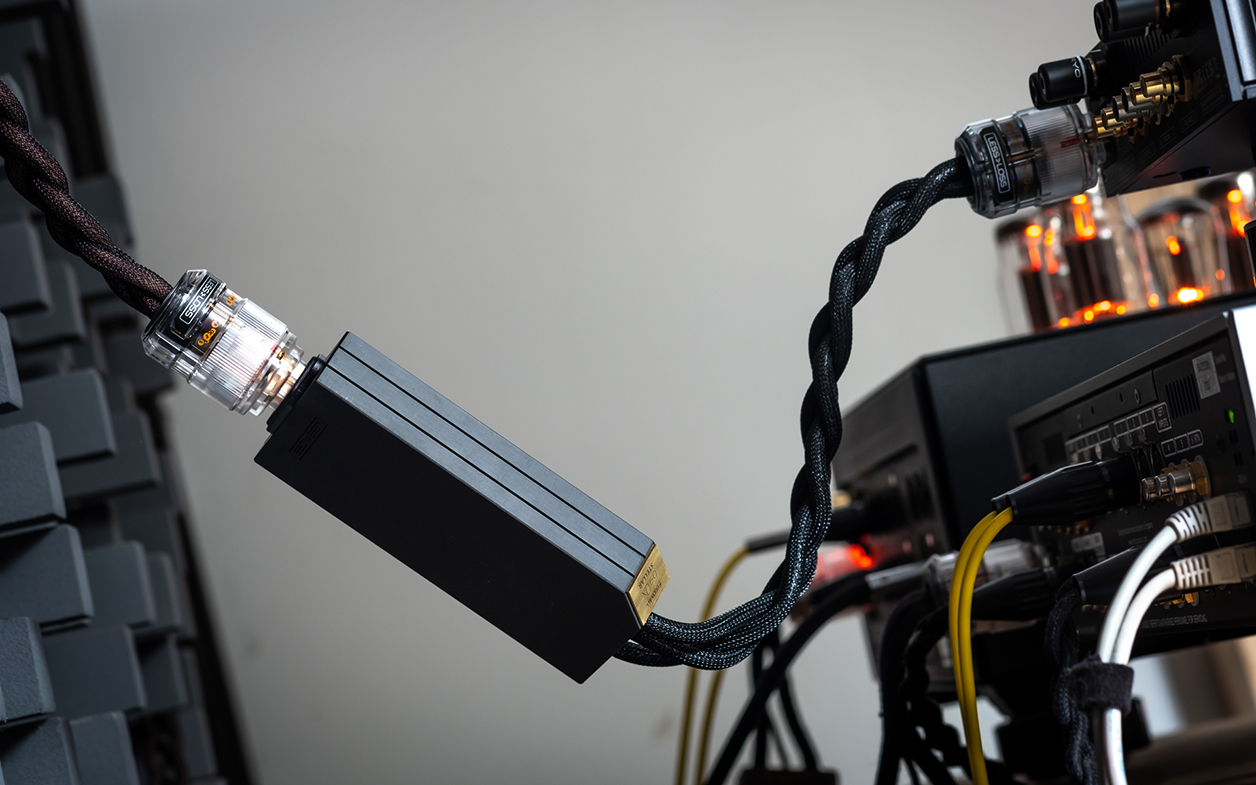
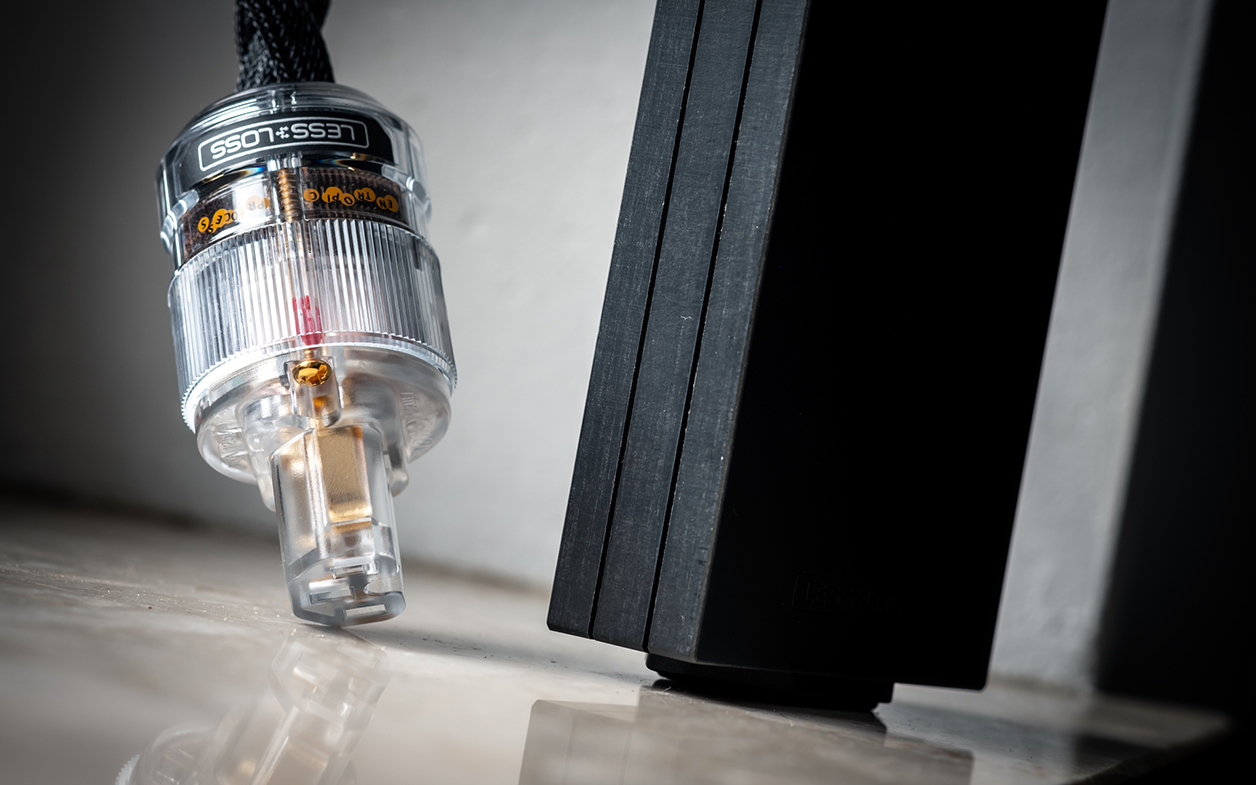
Each copper rod pair additionally surrounds by finned elements that incorporate DMLS Direct Metal Laser Sintering processing alongside high-powered ytterbium fiber lasers. These allow alloy powders to be welded into complex three-dimensional forms from particles as small as ten µm. The finned cylinders don't physically connect to the copper conductors they surround. Their interaction instead relies on magnetic fields beyond which details remain proprietary. Clear is that all elements must align with great precision to maximize the intended noise-reduction effect. Miss that mark and the entire premise falls apart. While the internals and enclosure of the Firewall 640x Stellar form its core, the attached flexible 20cm pigtail built around the company's own C-MARC wiring in its Stellar version is no less important. It employs a distinctive geometry based on two counter-polarized coils of identical diameter and pitch later fractally replicated—one wound clockwise, the other twisted in the opposite direction. Superimposed they form a bucking-coil connection originally developed in the 1930s. Noise induced across hundreds of these balanced strands is electrically cancelled due to their opposing polarity and geometry, resulting in a high S/N ratio. I have found C-MARC conductors to be exceptionally effective for their asking price. Hence all RCA, XLR power and speaker cables in my own system are built around them. Since its debut in 2017, the C-MARC concept has progressed noticeably. Around five years ago its designers found a way to apply their Entropic aging process alongside cryogenic treatment to this wiring. Most recently the Stellar version appeared, featuring twice the Entropic processing time plus an increased number of conductive Litz wires within the C-MARC configuration for still higher noise suppression. The resulting hike in conductive area lowers impedance by reducing resistance to signal flow. In that sense the Firewall 640x Stellar's name already reveals what kind of pigtail it carries. It's also worth noting that LessLoss have long been particular about mechanical connections. Their IeGO IEC plugs use 24-karat gold-plated hand-polished copper contacts that clamp firmly to reduce contact resistance and prevent micro arcing. The translucent plug enclosures are intentional as LessLoss maintain that colouring agents or solidifying additives such as glass-fibre fillers negatively affect performance. The IEC plug also incorporates a large internal anti-vibration ring based on laser-cut fins. Taken together the Firewall 640x Stellar reflects the most advanced execution LessLoss currently offer in this category. Priced at $1'972, it stands as the company's power-conditioning flagship.
The plan for how to review two LessLoss Firewall 640x Stellar units was set long before arrival. As usual, storage and transport duties were handled by an Innuos Statement Next-Gen feeding a LampizatOr Horizon360 DAC then onto the Trilogy 915R preamplifier and 995R monoblocks driving sound|kaos Vox 3afw monitors. It's worth noting that my entire system is already heavily infused with LessLoss technology. The speakers employ both internal and external Firewall modules, all signal cabling is based on LessLoss skin-filtering C-MARC wiring and power delivery is by LessLoss Power Distributor loaded with multiple Firewall modules connecting to a Boenicke Audio Power Gate built around the same internal components and fitted with captive M2 power cords using custom C-MARC wiring. The remaining power cables are a mix of LessLoss C-MARC Classic and their higher-tier Stellar counterparts. As configured, the power feed is very much dialled in and makes me very happy. At first glance it might seem that the power delivery of my system requires naught beyond what was already in play but the two latest Firewall 640x units were about to prove otherwise. Their ideal placement was fairly self-explanatory. I began by inserting a single unit just in front of the DAC as the part of my system most susceptible to noise-rejecting tweaks. The second Firewall then inserted right between wall outlet and first distributor, allowing its effect to influence all the setup's downstream components. After that the first Firewall moved between the preamplifier, server/streamer and monoblocks to explore how its placement affected the performance of each individual element. More on the results of these triangulations shortly.











In my recent Stack Audio Auva 70 review, I explained how a potent decoupling footer can influence speaker performance: "Early on its presence often manifests as a subtle drop in apparent volume, almost as if the system had taken a small step back. Then more tangible changes appear: bass extends deeper, gains speed, substance and authority, becomes more anchored, defined, composed, powerful, elastic and dynamically eager. Any residual hollowness or boominess that reinforces room chatter reduces noticeably. Vocals shed excess edginess and grain, gain color, density, smoothness and articulation, with outlines rendered more precisely. The backdrop grows darker, cleaner, more engaging and richer in nuanced detail that's easier followed. The soundstage expands, develops additional layers and increases in complexity while all images remain in focus, expressive and contrasting. Many anti-vibration devices I've sampled deliver these foundational improvements without major compromises but don't sound the same. The crucial difference lies in their efficacy. The higher it is, the easier it becomes for our ears to register and appreciate the listed changes." While this quote may seem counterintuitive for today's story, bear with me—it is highly relevant. Noise rejection is the primary function of anti-vibration accessories just as it is for network switches, digital sorters and power designs such as the Firewall 640x Stellar. This foundational action is their common language expressed at different points throughout our systems. These products do not compete; they rather support one another and compound their efficacy. Simply put, the description above ideally applies to the Firewall 640x Stellar. Even without prior exposure, its intended behaviour was clear to me. But there were still two unknowns that make listening to such designs mandatory; and every now and then get saucy. One is the sheer magnitude of changes produced in practice; the other any special traits that go beyond the foundational noise-trimming function. This is where accessories diverge. Some deliver touch-ups that never rise above subtle reworks while others introduce sonic transformations that trained ears recognize as significant. Some emphasize speed and articulation over colour and body, others follow a reverse protocol. Against this backdrop it's fair to ask how impactful the Firewall 640x Stellar proved in my system—and whether it had any aces up its sleeve.