While I fancied the previous top LampizatOr DACs for their unusual looks, exteriors of bent sheet metal, visible bolts and minor imperfections here and there gave away DIY vibes. I didn't mind. Great sound quality can justify many hiccups. On the other hand, in the financial ballpark of these machines, perfectly machined minimalist aluminium enclosures have become the standard. I'm happy to say that team LampizatOr finally got the memo. The Horizon platform has ushered in a new chassis whose build quality is up there with the industry's best. I won't fault anyone for finding dCS or MSB casework still prettier. Personally however I find today's dress code very appealing, gorgeous, even sexier. Its styling has that particularly strong personality I just don't see anywhere else. Utilitarian, industrial, robust, substantial and armed with exposed tubes, it packs all that I enjoy having around. The Horizon360 and its 1st-gen predecessor feature the same housing disguising an internal skeletal frame encased in thick solid panels bolted to it from the inside. Uniformly deep gaps at the edges between them make it quite intriguing. Without knowing how it was put together, one may wonder how all the walls connect without falling apart. Rest assured that they won't. Today's effort is built like a tank. Tight tolerances and lack of visible screws make it visually very clean and finely assembled. It can be ordered either in matte black (Matt Black Hole) or cold aluminium grey with specks of shiny dust (Sahara Silver). The concave top with tube openings and vents is the second customizable piece that can either match these colors or become a semi-translucent red, stainless-steel chrome or copper plate. Buyers can combine these listed finishes to their liking at no extra cost. Speaking of, where I live the Horizon360 retails for €67'650 with VAT to be the most expensive LampizatOr to date. Optional upgrades take the form of Graphite Audio footers at €490/3, KBL Sound Taiko XDMI leash (€2'900) and its fancier Taiko XDMI Extrema version (€5'000). Since this lot was beyond my scope, I have no idea whether it's worth the extra coin or not.
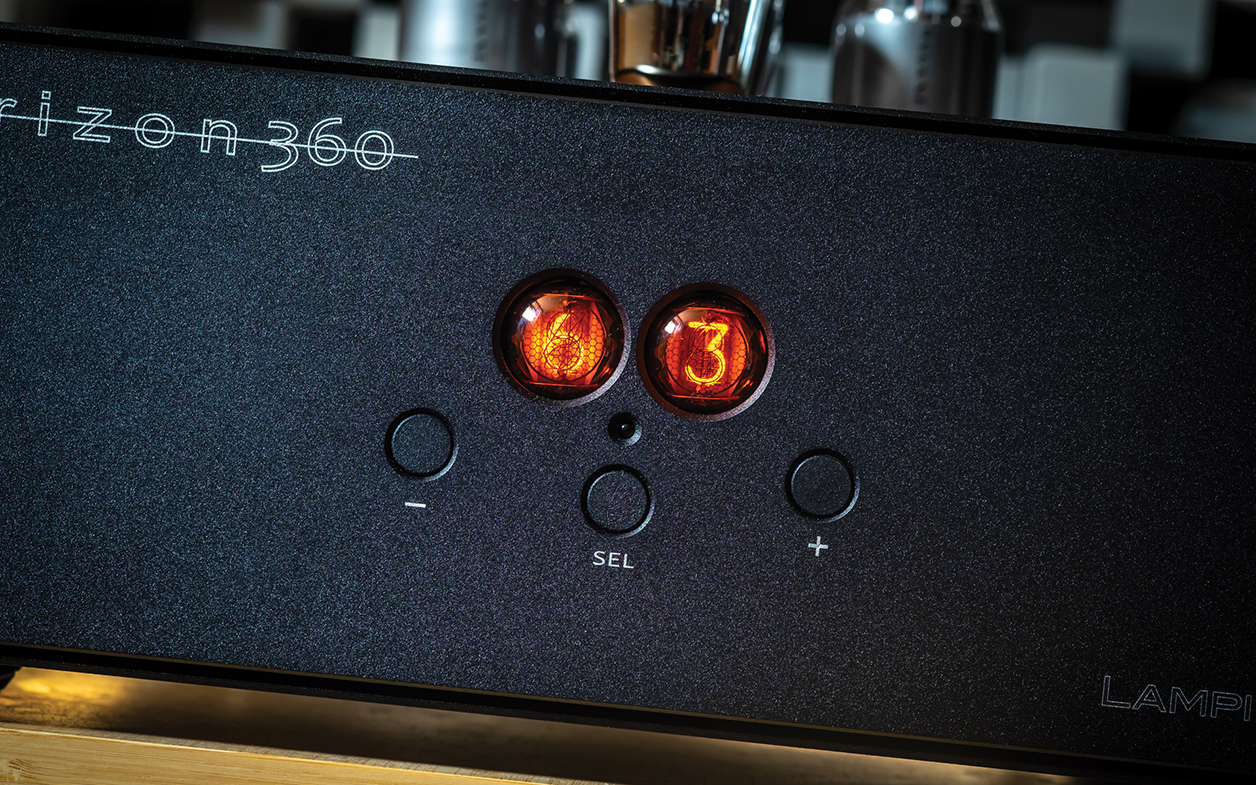
The front panel doesn't feature anything beyond basics. The push button in the middle is the secondary on/off switch and input selector while those to the sides cycle through inputs (1-8) and regulate volume in 63 x 1dB steps. The highest setting 63 conveniently bypasses the volume module. While the buttons positioned flush with the fascia look great, they're a bitch to use. Keeping them pressed takes serious physical strength but is necessary in most scenarios. This is why the remote wand included is no less than a godsend. Moving on, twin GN-4 Nixie tubes display volume and currently selected digital (1-6) or analog (7-8) input. That tells us that the Horizon360 can be used as a full-fledged standalone tube preamplifier. I don't think many owners will limit their use as such but the option to do so exists. When powered on, the device engages a soft-start protocol of 60 seconds. Then for three seconds we see our selected input after which the volume level shows up. The top can accommodate too many tubes to list here. In general the rectifier (5U4G, 274B, GZ34 etc.) takes the spot closest to the front. Then follows a quad of output buffers (KT66, KT88, KT120, EL34, 6550 etc.) and two voltage converters in the middle (6SN7, VT-231, CV181 etc.). There are also tubes without fitting pinout and/or bases which can still work with adapters. The business end from left to right sports a fused IEC inlet with the main on/off rocker, ground connector, twin XLR outputs (7Vrms), one each RCA output (3.5Vrms) and input plus one XLR inlet followed by six digital inputs: I²S on HDMI (PS Audio standard), coax, Toslink, Taiko XDMI, AES/EBU and USB. Four short reversed pyramidal footers match the enclosure aesthetics yet are easily outclassed on sonics. While this is a phenomenal DAC as is, a quality power cord and specifically hard decouplers will make it far happier.











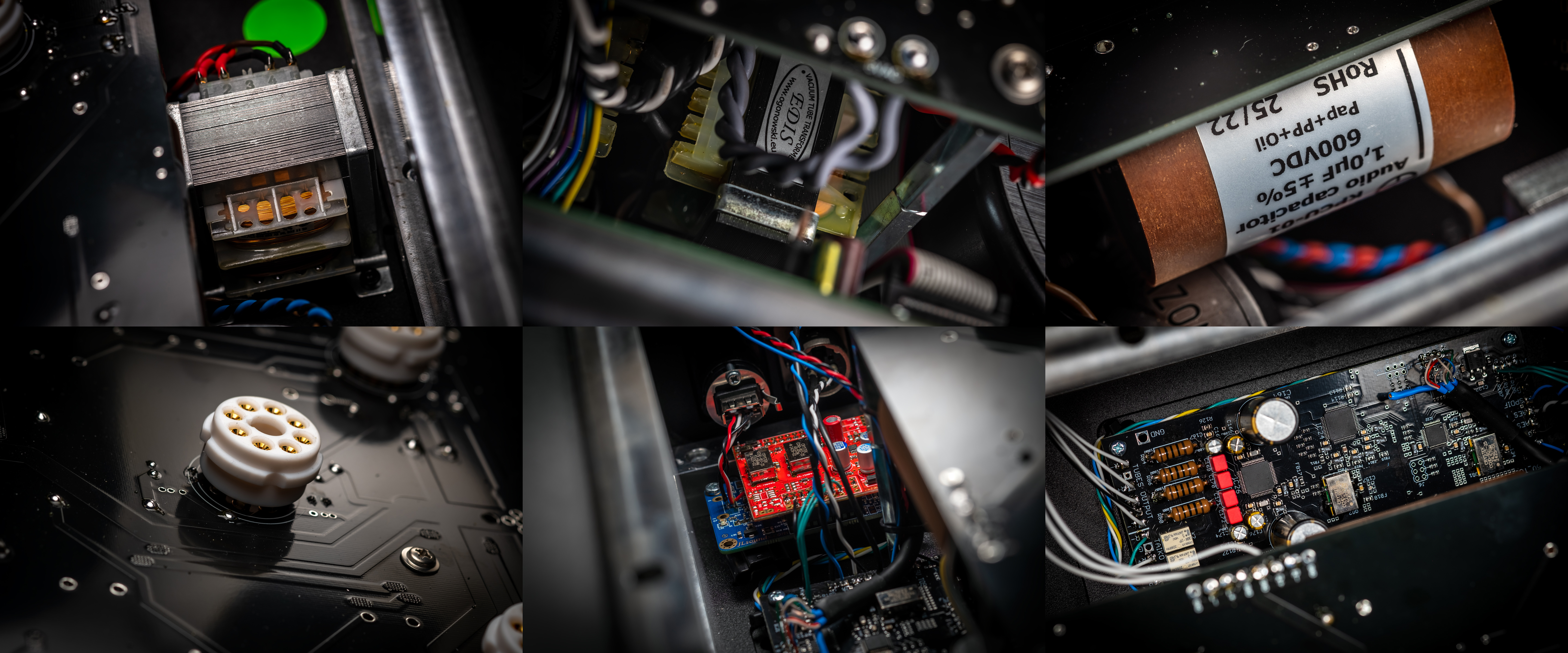
The Horizon360 is a fully balanced quad-mono affair front to back designed to work without operational amplifiers or any form of feedback local or global. More interestingly, about 80% is power supply spread across 17 separate lines to power all individual circuits. The digital section enjoys its own toroidal transformer with ten secondary windings sourced from local company Toroidy. The neighboring similarly sized toroid with the same logo provides anode voltage and heating for the non-pentode tubes while a dedicated EI transformer from Polish guru Leszek Ogonowski handles heating for the other tubes. Two smaller EI of the same origin are actually input chokes. Miflex paper-in-oil types are the main filter caps and tube sockets are excellent Teflon specimens with gold pins. For many years LampizatOr DACs ran Amanero USB receivers but the Horizon360 features a JL Sounds asynchronous USB-to-I²S converter with opto-isolated input and piggybacked clock board with two top Crystek for the 44.1/48kHz sample-rate families. This entire circuit is powered from two PSU on floating grounds fed from transformer windings dedicated to them. The D/A board features its own twin Crystek clocks and modern high-spec ΔΣ chips for PCM and DSD. Here it's worth knowing that LampizatOr put a lot of effort into writing their own code to control the behavior of the entire digital stage. This is in large part why the Horizon360 sounds as it does. Should they change that control software, the machine's voicing will alter, too. The pentodes are used as triode loads, buffers and voltage stabilizers simultaneously. As such they don't exceed 25% of full nominal power and effectively coast in cruise mode no matter what. Dual triodes serve as output voltage converters and more so aren't drivers. Volume attenuation occurs inside a stack of two boards peopled by resistors and relays in good ol' analog fashion. Now let's find out how it all translates to sonics.
 Use mouse-over loupe or open in new tab to view at full size.
First I should explain what motivated me to finance the 1st-gen Pacific DAC. Ever since I've been vocal about its quickness, openness, directness, accuracy, precise outlines, immediacy and large images always served up close and personal to make for a spatially enveloping at times spookily intimate perspective when a recording allows. This highly engaging presentation effectively put me on a stage very much alive, three-dimensional and breathing. The imaging fiends of my sound|kaos Vox3a monitors reinforced the effect. The Pacific proved so competent in this regard that I saw no true alternative. This was a key reason why for so long it was second to none by my estimation. To put that into perspective, prior to the Pacific's 2018 arrival I considered the Golden Gate very snappy, agile, open, articulate and groomed for high-RPM direct sound… until suddenly it wasn't. I just had to encounter a far superior machine to see that. Their confrontation day stigmatized the Golden Gate as lazier in the bass, withdrawn and nowhere near as clear, controlled, spatially sorted and impactful. Against the Pacific, the Golden Gate felt polite and hooded in a way that no longer sat right. The decision to trade it in, fork over the difference and treat myself to the successor was a large quality leap that felt fully justified. On a side note, the Pacific loaded with KR Audio 5U4G rectifier and LV300B outputs proved substantially more resolved than I initially thought. That made my reviewer life noticeably easier.