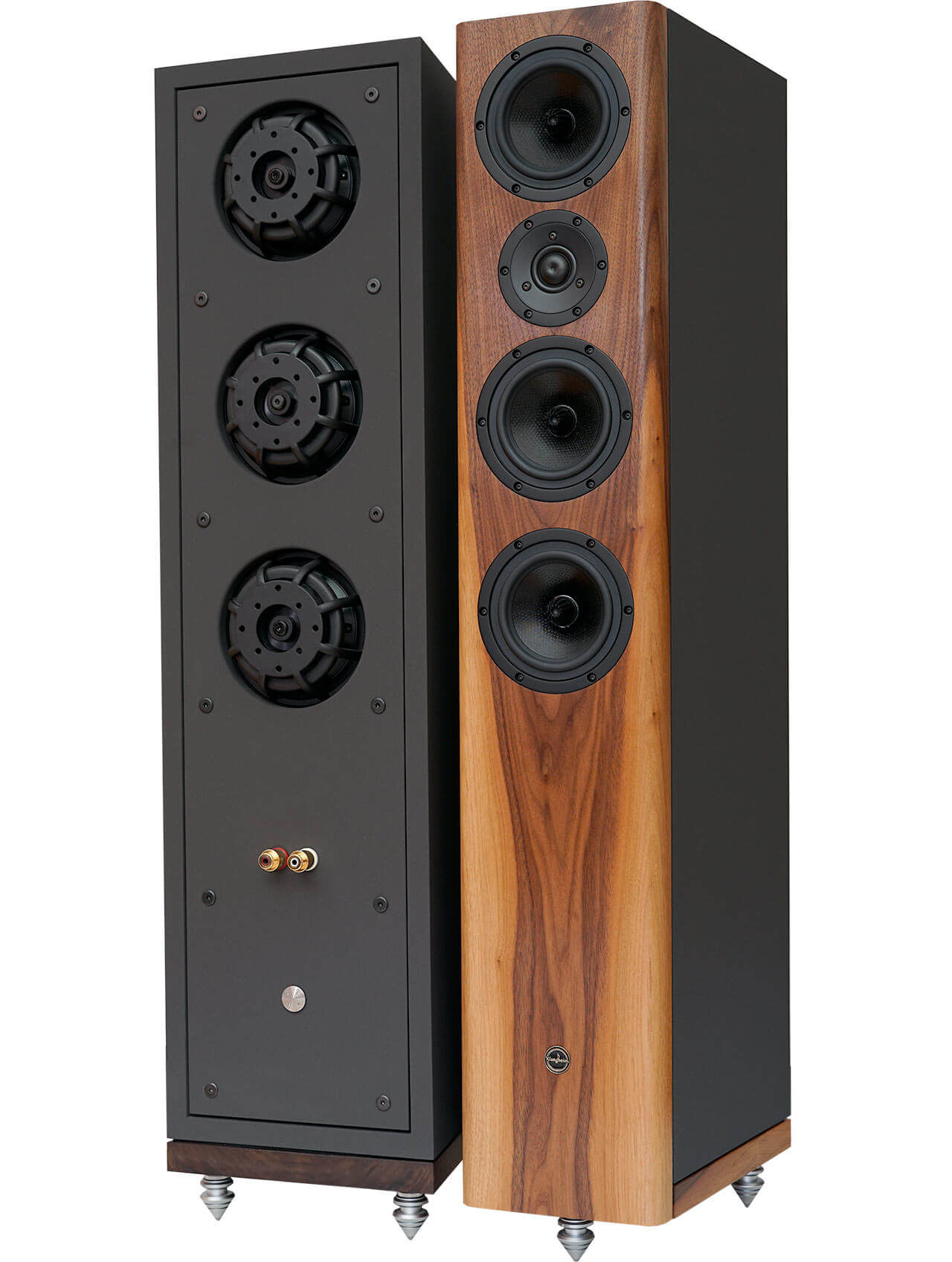
The hifi gods decreed that speaker setup precede listening pleasure which is no different for Fräulein Gloria. There are two parameters we usually want to manipulate: bass level and soundstaging. Sometimes this becomes a trade-off if we look for more bass closer to the wall but reduce stage depth. My standard advice is to move things back and forth until we achieve a good compromise then adjust toe-in. With Gloria however, it is advisable to pay a little more attention to the spatial presentation first because bass can be controlled later with the external weights. If we increase the gravity of a mass-spring system, we naturally lower its self resonance. Now Gloria plays lower with heavier weights on her back. The difference between lightest and heaviest is about 10Hz in terms of cut-off, says Weber. But since this simultaneously expands total bass energy across a larger area, there is correspondingly less upper bass. So heavier doesn't just mean deeper but also leaner. That's the first thing to catch our ear. Since everything connects to all else, it has a run-on effect on the midrange. Voices for example come across a little clearer, more present and stand out more with the heavier weights which is simply due to a changed overall tonal balance. All of this is pretty instructive. With the two lighter weights, songs with chunky bass lines like "Bad Guy" by Billie Eilish were a bit too fat for my taste while with the heaviest one, not only was the level balanced, I had more detail and in combination with the increased bass, more tonal differentiation. A clear win.

 However, acoustic guitars and cellos also sounded a little lighter and wirier which you may prefer but don't have to. The whole thing has less of an effect on women's voices but Micah P. Hinson's pipes on "When we Embrace" from Micah P. Hinson and the Red Empire Orchestra seemed a little too thin with the heaviest passive membrane weight. At the end of the day I ended up with the medium weight but that means nothing. After all, it depends a lot on the room and your listening taste so could/should be completely different for you. If all of this seems complicated, don't worry. It's one reason why Jörg Weber comes to see German customers in person. But I do recommend that you experiment for yourself. It's fun and very educational. To let the cat out of the bag, the Klangheim Gloria is a true all'rounder. I can cite other speakers for individual sonic parameters that might do a little more here or there. But when it comes to overall coherence and the somewhat clichéd but nonetheless true "I just listened to the music and forgot all about the tech", Gloria is way ahead of her class. After a long time surfing playlists and Qobuz, I had to remind myself that I still had to parse this Klangheim analytically and couldn't simply go on listening for fun. That was annoying but it's my job so I won't grouse.
Let's start with overall tonality as the basis for the generalist virtues mentioned above. I describe it as friendly and balanced because it came across as fairly neutral on a whole but not, to put it pointedly, "hardcore studio-like" as Magico's A5 which is three times pricier and recently was my guest. While the sealed Californian goes deeper, the German presents bass a little warmer, softer and more sonorous. It also remains a bit more polite and mild in the upper midrange but extends smoothly farther up. If we define the Magico as a linearity benchmark, individual deviations from it were only slight but did result in a certain easy-to-like appeal true also of many Dynaudio speakers: not really warm but certainly not cold, very honest yet without a brutal take-it-or-leave-it attitude. The tonal balance of Gloria seemed to me very mature and deliberately tuned for the greatest usefulness.










 Bass performance was astonishing not so much in view of price where there are more substantial depth-mining options if you need them; but in view of the manageable size. I was surprised that Gloria could actually fill my room with bass where larger speakers sometimes have difficulty. Of course she can be driven into a corner if you play dub, techno or other nasty stuff at very high SPL. But the fact that she could handle such fare in my room at SPL well beyond normal certainly deserved my respect. Still it was clear that she wasn't primarily developed for such genres but 'normal' music. And that worked great. Andrea Schröder's Bowie cover "Helden" started off beautifully powerful, big and full as it should. So did
  "Soothing" by Laura Marling from her album Semper Femina. Grand pianos, double basses and even timpani were given believable body to feel authentic. The fact that bass textures were generally more half than bone dry was a benefit to acoustic instruments in many ways although it is true that more definition in the sub bass wouldn't have been bad at times as noticed in the very expansive bass line on "Love at first sight" on Spain's Sargent Place. If that's what you're after, you need a larger and/or active speaker. There are physical limits. Gloria certainly plays much louder than you'd expect and in this Berlin portfolio is also the smallest of their floorstanding lot.
At the other end so in the high frequencies, I was impressed by the good resolution of the ring radiator. In order to test the Klangheim's detail in the upper registers, I specifically picked out my Totally Wired II LP because it has some interesting cymbal work and the track "Tilldess" features a sizzle cymbal. I'm not saying that you could count the rivets in the sheet metal by ear but with Gloria it was far far more than post-attack homogeneous noise as can still happen in this higher price range. Gloria instead conveyed a lot of textures and fine dynamic nuance. Since these super-high frequencies weren't toned down, the overtone range seemed very open and natural which paid off not least in terms of timbre bandwidth aka tonal differentiation. This brings us to the mids which perhaps were the highlight of this all'rounder where several virtues combined into one very tasty dish. I'm actually a fan of separating individual sound criteria for review purposes but their mix is really what matters here. Klangheim's recipe includes first of all balanced tonality as a backdrop which feels a bit milder in the presence region for long-term suitability and to render sparse recordings more enjoyable. Yet this was done subtly, never emphatic. The second ingredient was excellent vocal-range resolution in conjunction with a fully elucidated overtone range already mentioned. This ensures a rich palette of tones to adore acoustic instruments and voices. Then there was three-dimensional imaging which brought out vocals particularly beautiful. All this could be heard with Laura Marling's new album Child of Mine which musically falls more into the "yawn!" category but was captured intimately, at times extremely close. Gloria practically beamed Laura into my room most detailed, three-dimensional and persuasive. That was pretty impressive. And what also became clear is that the Klangheim lets the stage start before the speaker baffles.
It wasn't as far forward as a €15K/pr Orbid Sound Maridur's more aggressive nature but closer to a sub €16K Betonart Arrivato v2 which often starts off half a step in front of the baffles. That's excellent for bonding with voices in particular. In general there were similarities when it came to staging. Like the Betonart, Gloria offers befitting depth layering with a decently wide panorama which, when required, doesn't end with the outer speaker cheeks. Above all, with the Klangheim we experience this special imaging freedom which frankly surprised me more than from a speaker made of dead concrete. Herr Weber's efforts to minimize resonances obviously bore fruit with today's Berliner. Anyone who pursues a speaker in Gloria's price range can obviously choose from a wide range of concepts and sonic styles. It's really interesting to compare them. The Orbid Maridur for example is a good counterpoint to the Klangheim. The main attraction of the Maridur are dynamics where it offers a bit more, be it micro or macro. However, that does cost a bit in bass substance where Gloria comes out ahead. The Orbid Sound is most suitable for real dynamic fans prepared to pay the price with a tonality closer to the edge especially with mediocre bright recordings. That definitely makes for more of a specialist. The Klangheim on the other hand is a generalist. Compared to the Orbid, it has a more balanced overall tonality, finer resolution and more classic audiophile virtues which combine with an impulsive, lively gait even if über-dynamic freaks still might want more. Be that as it may, I'm pretty sure that the majority of listeners will prefer Gloria and her harmonious, natural, just-right sound rather than the more aspirated Maridur.