There was a definite sonic change when I fed my Esoteric N-05XD either over the JPlay app or Esoteric's own Sound Stream version. It's quite difficult to describe exactly what changed but overall I had the impression of a little more air, a more nimble fluid sound, slightly warmer timbres and somewhat more holographic imaging. I suspect as the enabler better attenuation of background noise. Of course all this was quite subtle and no doubt overall system resolution determines the difference delta. Nevertheless it should be heard quite clearly on most high-end installations and therefore the €50/yr fee to obtain this subtle yet easily perceptible improvement seems amply justified. The music also sounded slightly calmer using Marcin's app. The first movement of Beethoven's Trio opus 11 acquired better breath and superior articulation than the Sound Stream interface. The Esoteric app almost seemed to dumb down playback. The artistic tension of the trio was less palpable, Nicolas Angelich's piano less nuanced. With JPlay, dynamic contrasts and scaling crescendos were more marked, pianissimos more subtle. I find much of this also with Roon whose timbre palette is a little richer than Sound Stream's. Rhythmic tracking too is more precise with Roon by further highlighting the trio's microdynamics. Yet when I returned to JPlay, I found a more intense emotional dimension as though Roon filtered out some poetry of this superb recording. I gained still more tone-colour quality and the piano's phrasing felt more delicate and specific. Over MConnect the music stuck far more between the speakers and the trio's advanced musicianship dulled down. It's complicated and tedious to list all the small degradations MConnect caused over JPlay or Roon but as far as I'm concerned, the most prohibitive element was a loss of involvement in my own hifi system as though the musicians were on autopilot.
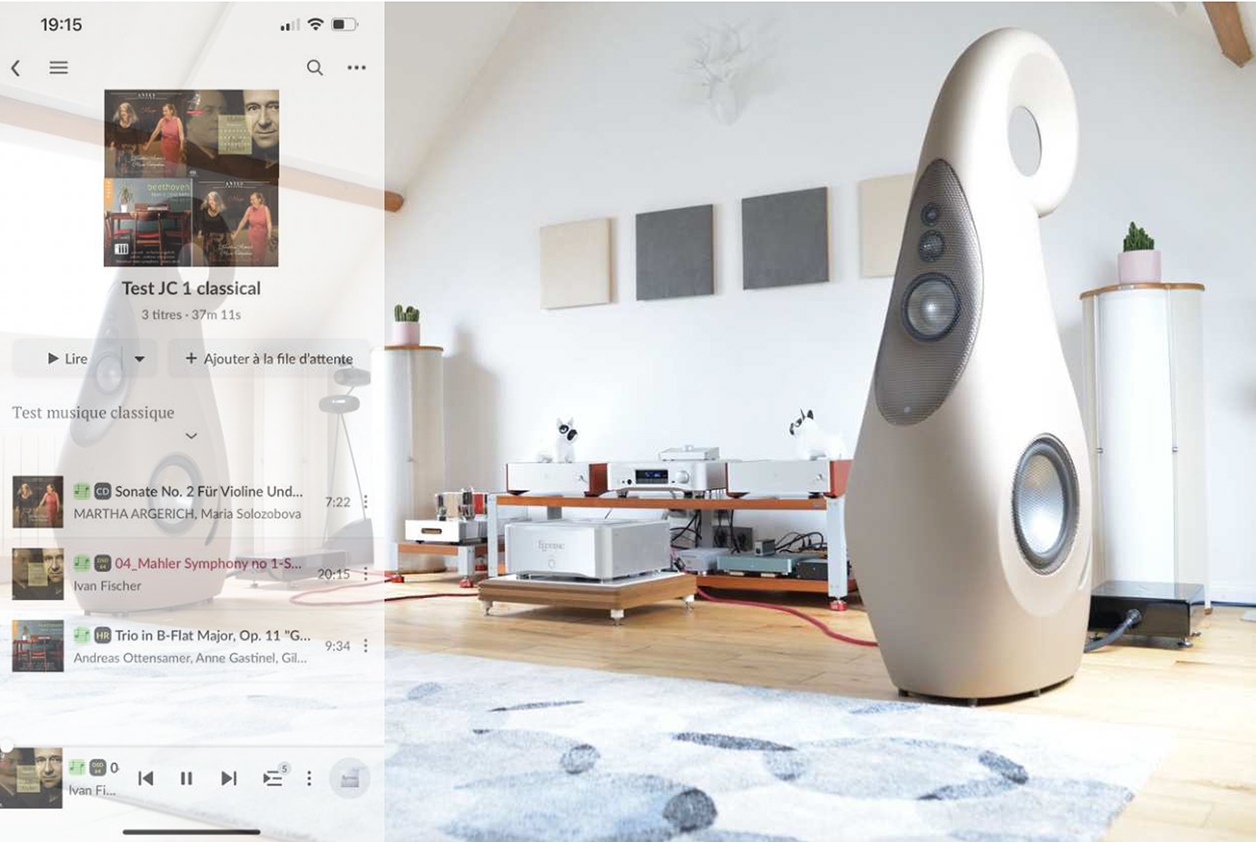
Prokofiev's Sonata for Violin and Piano Opus 94a demonstrated pretty incredible presence over JPlay. Mconnect tended to homogenize piano and violin tonally and imaging wise. JPlay rendered the Russian violinist’s bow work much more complex and detailed, his vibrato much tighter and more modulated. MConnect captured far less of the piano's resonant soundboard. Dynamic gradients were far more marked with JPlay. Unlike MConnect, Sound Stream cast a broader more structured stage and added tonal hues but less so than JPlay. Transients improved over MConnect. On that score Roon seemed very close to JPlay by regaining the complexity of the violinist's bow work and vibrato as well as the richness of the Steinway. But when switching back to JPlay, I still noticed a reduction in background noise to result in a better presence and more obvious artistic expressionism like certain accents and ornamentations feeling more deliberately executed. The last movement of Mahler's Titan in particular highlighted the tonal qualities of the different control points. MConnect had little to say on the magnificent timbres of the Budapest Philharmonic Orchestra. JPlay distilled a far more nuanced palette. The overall result was infinitely silkier, the tutti passed with much more ease and less effort. Mahler also mapped more differences between Roon and JPlay. Perhaps the DSD format tracks the impact of background noise even more than PCM? In any case, JPlay felt more natural and consistent with my experience each time that I heard the Budapest Festival Orchestra live in concert. Cymbals with JPlay were softer and the fluidity of the restitution significantly better. After hearing the Budapest Philharmonic over JPlay, I couldn't revert to Roon. I shan't dwell on the differences between local NAS and remote Qobuz files which were very close.










I was really impressed with the level of transparency JPlay revealed with the Hifi Rose player. It was amazing to hear this on a system as minimalist as Illumine Hefa speakers, Red Dragon S500 amplifier and RS201E player. I did not manage the same level of performance using Roon on the HiFi Rose. JPlay was superior with small details, leading-edge definition, highlighting resonances and ambient cues. This became quite astonishing in depth and relief when the JPlay rendered Beethoven's Trio in B flat major Opus 11. I almost had the impression of listening to a high-res version compared to a CD when I compared MConnect and JPlay. On the Hifi Rose Roon fell further behind. Even though Roon wasn't fundamentally bad, the aeration and holography the little Korean server manifested with Marcin's app seemed far superior. Switching to the Titan's last movement using Qobuz, Ivan Fischer's recording broadcast as 24/192 PCM no longer DSD. On the Hifi Rose app, the sound was more tense and pixelated. When switching to JPlay, the same Qobuz source acquired incomparably more fluidity. The sound became much more natural. Where the native Rose app has me hesitate to push the volume too for fear of distortion, JPlay did the opposite. It invited the big waves. The Prokofiev Sonata too was much less acidic using JPlay. Maria Solozobova's violin expressed more nuance across a broader tonal range. Lumin's P1 player packs an important advantage thanks to its dedicated app which allows us to manage playlists and access certain upsampling or phase inversion. Yet from the first notes of Prokofiev, I could hear the added value of the JPlay app. The sound immediately became more fluid, small details more evident and the timbres of the violin more soft and natural. I therefore noticed a significant difference between JPlay and Lumin. The Beethoven arrived me at the same conclusions. Finally Mahler's First Symphony showed off the greatest differences between the two iOS apps.

The proprietary Lumin app created a very dark atmosphere while the Budapest Festival Orchestra took on a lot of colour with the JPlay. I nearly thought that I had changed a server or DAC, the difference seemed so significant. The orchestra acquired more presence and depth. The tones of instruments were more diversified and each musical stand gained in clarity, from violins to double basses, from oboes to trumpets and horns. As for Roon, it was less dark than Lumin and ultimately much closer to JPlay in terms of audio quality. Yet returning to JPlay had the music feel still more natural. In the Titan finale, the violins stood out with such clarity that I almost had the impression of listening to another version of this symphony. I asked Marcin Ostapowicz how it was possible to generate such deviations inside a standard protocol like UPnP. He immediately explained that the UPnP protocol might be one of the least standardized and that everyone cooks their own code to create a dialogue between server, control point and renderer. Furthermore, programming in iOS differs radically from one app to the next. On the other hand, the complexity and tangle of the different programming layers in Roon makes that far less responsive than JPlay which my use would confirm. JPlay focuses on reducing the processing footprint and network traffic.