"The MatchMaker with my own highly customizable autoformers in copper or silver, with nickel or nanocrsytalline core and optimized inductance for different sources, is my other Liebling. For the price of a high-end interconnect, it can bring much higher improvements to a lot of audiophiles."

"About the Pure's skip-to-mute function, a 4Pro-style fade would tax the reed relays more. It's another advantage of my favorite analog switches which can switch a billion times without breaking a sweat. These reed relays are very reliable compared to rotary switches. Just so, across the past seven years and ~5'000 pieces, two developed a fault after a few years of use. Meanwhile I've not had a single fault with my chips. About the noise-less switching of reed relays, despite years of investigation and firmware tricks, there are very faint switching noises depending on the signal. Most the time the music itself obscures them but certain times they will be detectable. Since the buffered 5 is a type hybrid so not completely passive, I wanted a solution for my purist friends. But my inner engineer fancies the 5 rather more. I'm simply giving my clients a choice."

And with those words, my second Manchester shipment was on the way to really get us mixed up mixing it up.







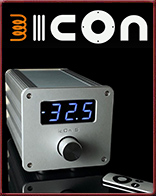



"Against nearly everybody's expectation the 5's buffer is not on the output but input. The sensitive part of autoformers is their input. The only potential problem with their output would be a severe load of let's say less than a few kΩ but this practically never happens. Their output impedance is very low already so without issue these parts can drive even 10m interconnects to have absolutely no need of an extra buffer. This is Dave Slagle's suggestion too. However, the input can be much more problematic. The ideal case would drive the autoformers with zero impedance without an output capacitor or with an unusually high-value capacitor. Why? Because higher source impedance requires higher autoformer inductance or else we cut bass. An output capacitor forms a resonance circuit with the autoformer's inductance. That can generate severe bass lift. A tubed phono with max 1-2µF capacitance or sometimes just 220-470nF creates a good chance of 6-10dB lift below 10-20Hz. That guarantees rumble and muddled bass.

"Higher source impedance creates higher distortion and uneven amplitude response. Yet source impedances range from near zero for solid-state to 1kΩ for tubes while transformer outputs remain unknown quantities. Faced with this lack of standardized terminations, a passive preamp designer's only safety net is using excess inductance like Slagle's standard 150H or even 300-500H. In the first years of my icOn 1 & 2 with Thailand's Silk TVC, I had extremely high inductance. Complaints came from reviewers who called it less transparent than class leaders while swing and timing accuracy fell short as well. High inductance prevents mismatch disasters on the input but unfortunately also slows down treble and transients, produces less air and compromises linearity. That's a poor trade. If we think outside the box which insists that a fully passive signal path is king and any active part evil, an input buffer nullifies all interface issues. Voilà, we can now use autoformers of much lower inductance with phenomenal speed and transparency. John Chapman of Bent Audio already suggested this for some sources with his Tap X. For his famous DHT preamps, Thomas Mayer ordered from Dave Slagle autoformers of the lowest feasible inductance¹. Coincidence? Not. These men know their onions. After a few years I made the hard decision. If I wanted to step beyond the icOn 4Pro, I had to give up pleasing extreme purists. I had to add some active electronics to the world's best volume control solution of a precisely specified/made autoformer. And even that's not completely true. I try to be a kind helpful guy so made the active part selectable and additionally created the Pure. That's even more passive than the 4Pro. But the really best solution is the new autoformer of just 1/3rd the prior inductance, with an input buffer plus the surprisingly pleasant and for me now essential tilt control³ with smooth 0.5dB corrections across eight positions for ±2dB max around a 900Hz pivot. As to pricing, we never adjusted our 4Pro retail despite absorbing ~50% cost increases across these last two years. So the MatchMaker prices at $1'200 with 80% nickel core² yet compares to this, the Pure at $4'000 with ultra-cap PSU which pits it against this, the 5 at $5'500 which battles this."
_________________________
¹ Another upscale linestage with magnetic volume control is the Dionysos from Bulgaria's Thrax.
² With silver coils and silver WBT, $2'500.
³ Frequency response fanatics have perpetuated the myth that a ruler-flat response is desirable. As it turns out, most people prefer an in-room response that's slightly down in the treble and slightly up in the bass. It's ideally still a straight line without significant bumps or wobbles, just on a slight incline toward the low end. The icOn5's tilt control allows one to predictably generate such a response; or compensate the other way if a room is overdamped to kill sparkle and air in the top end. This differs from standard EQ which notches certain frequencies up or down across a certain width to generate deliberate bumps or troughs. It also differs from instinctively chasing such a response with pucks, cones, cables and other tweaks by giving us an easily repeatable very precise means settable with very fine granularity.