
 My sweat shop. It's the below desktop in my office where a Win 11/64 workstation connects to the router via a Stack Audio regenerator, processes cloud/local data inside Audirvana Studio with an embedded Qobuz Sublime subscription then outputs them via USB to a LHY UIP isolator. Between its now reclocked but still digital USB data and a pair of Topping B200 monos sits an HP70/DR70 combo of DAC and head/preamp from Gustard's Audalytic brand for something in Warmer's price range. My review had its outlines. Warmer would replace the DR70. The linked track is from a Dutch medical doctor cum clarinetist whose Swing Band was founded to give people something old-timey to dance to. The sound itself instantly recalls an era back when tubes ruled to make for a good retro intro.
Back on subversive subtext, tubes done right can do things which are much harder for transistors: tone, textures and palpable billowy staging. As with most matters, once we throw money at them, possibilities expand. In our case which doesn't stress its glass, the particular flavour and strengths of tubes can factor far sooner on the money metric than transistors. Those retaliate with their own virtues. As cost becomes ever less of an object, tubes and transistors intersect or at least run in close parallel. At the entry level, they're still very different animals. As I deciphered Warmer's hidden manifesto, it's about introducing a new audience to genuine if generic tube values whilst making ownership a cinch so no bias settings, hum pots or adjustable NFB all whilst hiding the actual glow bugs from view. It's about offering an obvious alternative to FiiO's transistor kit. Operative is 'obvious'. If Warmer doesn't sound demonstrably different to ears shopping these strata, why would the brains between those ears give up on their beloved touch screens, app control, menus, EQ & other mod cons of the Connected Age? At least that's how I read these tea leaves to shape how I would approach this assignment.
After publishing the above, my contact forwarded me this from FiiO's CEO James Chung: "Why do we revive vintage audio tech? With the Warmer launch, I've been getting much feedback from folks sharing their excitement and experiences. Their support inspired me to chat about some aspects behind Warmer. The project stems from our retro series initiative. For those who know me, I'm a kid of the '70s now basically semi-retired. At my age some guys golf every day (Yongping Duan), others scale mountains (think Wang Shi) or get roasted online for Antarctic adventures (looking at you, Yu Minhong). Besides biking and hiking, my biggest passion is tinkering with hifi gear. Thirty-odd years ago I skipped out on rockets and planes because I was such an audio enthusiast. Little did I know that it'd turn into a lifelong career. These days the young guns run FiiO so I don't meddle in the day-to-day operations. About two years ago I started investigating vintage gear. Does getting older make one nostalgic? That's how it all kicked off. From the CP13 Walkman cassette we went full steam ahead with the TT13 turntable, RR13 radio and DM13 CD player. Shoutout to the team for humouring this old-timer. These are true sunset products with zero real commercial upside whilst sourcing key parts is a nightmare. But as we rolled out the retro line, we discovered a real community of fans; and not just folks my age but plenty of younger enthusiasts. Sure, on paper all of this tech is outdated. Still, it retains that irreplaceable charm. Cassettes, vinyl, tube amps are all pure analogue. Their specs lag way behind but that unique flavour digital can never fully replicate. After all, at its core the real world is still analog. No matter how fancy digital gets, it can't fully replace the authenticity of the physical. So starting with the CP13, we mapped out a comprehensive plan to leverage our resources and bring back these decades-old favourites for today's audiophiles: cassettes, vinyl, CDs, tubes, horn speakers and more. Tubes in particular were the heart of analogue hifi back in the day, the essence of that acoustical-to-electrical-to-acoustical cycle. Before transistors it was all tubes. Warmer is just the first in our retro range to feature them. Down the line we'll have tube power amps, tube headphone amps and tube integrateds in all manner of products. Fun fact: for me tubes are actually new territory. I got into audio with cassette Walkmans in the early '90s when tubes were already phasing out. I've never owned a proper tube system. But I still remember the first time I heard music through a tube-amplified active speaker. It was pure magic, like something straight from heaven that you rarely experience on earth. So Warmer fulfilled a personal 30-year dream. And I'm thrilled to share it so we can all savour that distinctive, captivating tube sound together."












"After launching our first retro product, the CP13 cassette player, we received much feedback from cassette enthusiasts. Many pointed out that it lacked features, felt bulky, heavy and just didn't stack up to those classic 90s Walkmans. I get it. As consumers they were spot on. But fast-forward a few decades and tech, materials and manufacturing have massively evolved. For instance, the CP13 uses CNC-machined aluminium alloy, rare for mass-produced gadgets back then. Its analog gain is more advanced too, with higher integration and better overall performance. The real issue with parts like magnetic heads and mechanisms aren't tech limitations but their supply chains. As the cassette player market shrank, only a handful of brands were left making low-end models. Production of those old Japanese mechanisms and heads stopped ages ago. Even new-old stock has long since dried up. Vacuum tubes face the same fate. With transistors and IC taking over, tubes were phased out for being power-hungry, bulky and hot-running. In the consumer space there's still a tiny niche thanks to audiophiles but most tube amp makers rely on stockpiles from the past. Sourcing a stable bulk supply of the tubes we needed was our biggest headache. Over the years we reached out to the few remaining domestic tube factories but hit roadblocks everywhere. Some wouldn't even meet with us, others had limited models, insufficient capacity or pricing that just didn't work for us. In the end we connected with the Slovakian maker which the industry calls JJ Tubes. Huge thanks to them for still being around and producing the exact tubes we need in volume. They stick to proven processes so their tubes have a solid reputation for reliability and great sound. Being used to sourcing everything domestically, dealing with JJ where we must handle imports and customs was a first. Of course any first is always toughest. You can expect more FiiO products featuring authentic tubes to hit the market soon. As always, we start from the user perspective, prioritizing quality, reliable supplies and stable pricing. Combined with our high-volume low-margin approach, unstable sourcing would be disastrous. That said, in rare cases of massive stockpiles, we'll make exceptions. If you're a long-time Fiio fan, you'll remember how the early X1 used Japanese surplus displays of which we had about 100'000 units back then. Once they ran out, we switched to domestic LCDs.
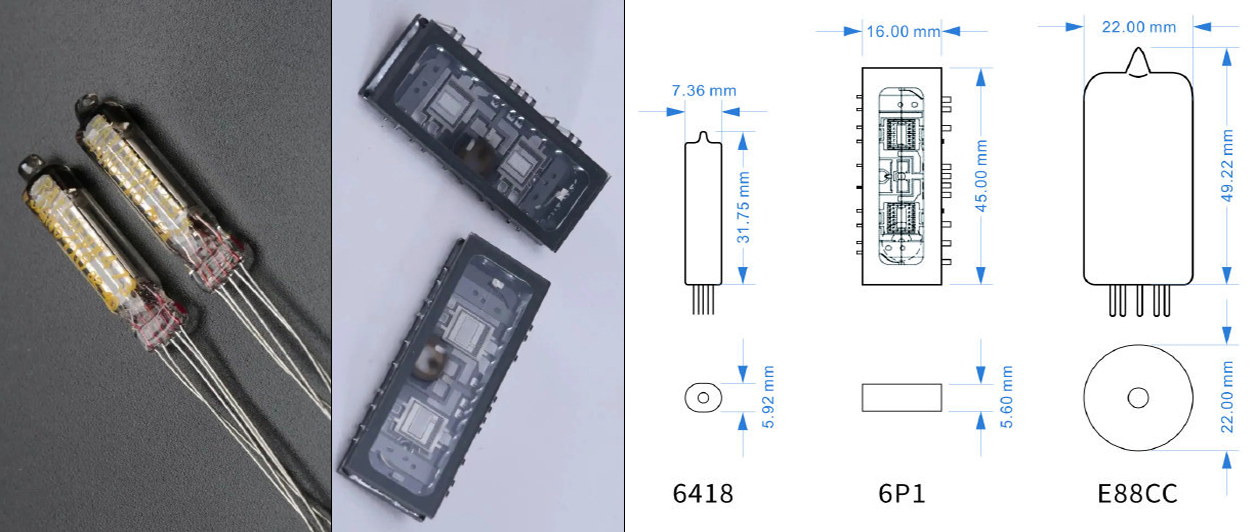
 "Why start our tube adventures with a desktop DAC not a portable or full-blown power amp? It's all about nailing that classic tube magic without the headaches. Portable tube gear is a tough nut to crack and the results just don't cut it yet. Most tube products you've probably run into fall into two camps: the trendy portable headphone amps and players that popped up over the last few years; or the old-school desktop tube amps with a smattering of headphone amps thrown in. For portables we're talking thumb-sized tubes or modern miniature tubes made with fancy processes. Their big gains are tiny footprints, low power draw and minimal heat – perfect for battery-power gadgets where every watt counts. Take the classic JAN6418 [upper left], basically a tube shrunk down to the size of your pinky, hence its nickname thumb tube. The guts and build are pretty much like full-sized tubes, just pocket-friendly. Then there's Japan's Korg NuTube which swaps in VFD vacuum-fluorescent display tech for an even smaller package that's a breeze to mount and solder [second from the left above].
"Desktop tubes on the other hand look like honest-to-goodness lightbulbs. They are bigger, thirstier for power and usually rock those classic pin bases that socket right into the chassis for easy swaps. The JJ E88CC tubes we import for Warmer are a prime example. The side-by-side drawing shows the size differences. What's the catch with miniature tubes? Power limits, voltage constraints and flat-out performance limits mean that they just don't deliver the full-bodied tube flavour of their bigger siblings. The valve vibe feels watered down so isn't as rich or soulful. And don't get me started on microphonics, that pesky tube 'hum' from vibrations. Slapping tubes into portable gear? With our sky-high demands for reliability and the user experience, we're not there yet. It needs more R&D. But once the tech matures and the audiophile crowd warms up to mini-tube sound, we'll absolutely launch portable tube gear. You have my word.
"How about tube power amps? Far more complex, with high build demands. Right now most tube rigs are power amps driving speakers or headphones which ramps up costs, tech hurdles and manufacturing headaches. Compare a full tube power amp to Warmer where tubes handle just voltage gain in the 'pre' stage. Bigger power needs higher voltage and pricier tubes. More power means more money, beefier PSU plus massive chokes as those transformer-looking coils to tame noise. It's like upgrading from a scooter to a tank. Top tube amps swear by their custom output transformers. These bad boys are expensive, finicky to wind and full of secrets. Different wire gauges, materials and winding tricks can make or break the sound. No wonder there are so many hybrid amps with tubes in the front, transistors in the back. It's for big cost savings. So weighing costs, complexity and more, we decided to kick things off with a tube-output R2R DAC. It keeps the price accessible, lets you mix and match your existing setup—active speakers, headphone amps, power amps—and opens up a world of flexible listening scenarios."
Whilst China's state-run tube manufacturer Shuguang long since closed their doors, offshoots Psvane and Linlai continue trading as do TJ/Full Music. Isn't it surprising that none of them could or would supply FiiO's Warmer project? Doesn't a wildly popular domestic brand openly getting into valve gear present a quintessential ground-floor opportunity to grow together? Either a categorical nope; or issues of raw volume and costs just couldn't see eye to eye. Once FiiO need EL84/34 or KT88 types for power amplifiers, will Chinese makers of them still not want to talk? For now JJ enjoy FiiO's glassy orders to be in pole position for all the other types they make once that time comes. On time and coming, when a month after publishing my intro I inquired on sample status, FiiO's Warmer inventory had sold out. I'd have to wait on the next production run. More than any reviewer opinion, this said reams about buyer response. FiiO's DAC wasn't just warmer but hot. By February 12th just before the Chinese New Year's holidays commenced, I had my own UPS tracker. That day a single JJ E88CC like the stockers sold for via—hold on—Amazon.ie. In the off-chance of a tube going bad, most of the niggle replacing it won't be cost at all. It'll be undoing 14 screws, fiddling with the retainer clips and figuring out which of the two bottles in the distorting channel has broken bad. This is right back at FiiO's concept of low maintenance so ease of use for their first-ever tube deck. Forget €699 for a single Western Electric 300B from Upscale Audio. Definitely forget €1'090 for a single Takatsuki 2A3 from Woo Audio.